
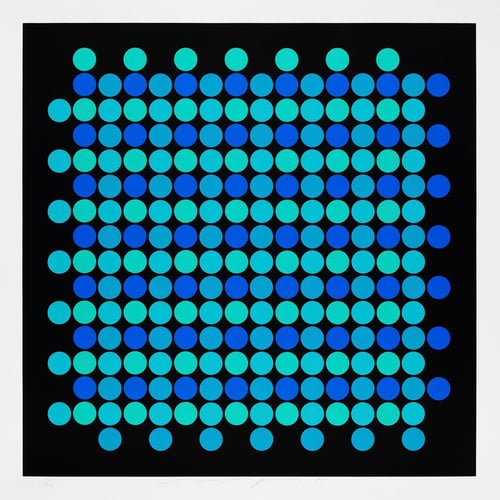
Almir Mavignier
Almir Mavignier (Brazil, 1925–2018) was a pioneer of Op Art and Concrete Art, celebrated for his precise, geometric compositions. Using optical effects and vibrant colors, his works create dynamic visual experiences. Mavignier played a vital role in bridging Brazilian modernism with international art movements, influencing the development of abstract art worldwide.
© Almir Mavignier. All rights reserved.
- Recently Added
- Price (Low-High)
- Price (High-Low)
- Year (Low-High)
- Year (High-Low)
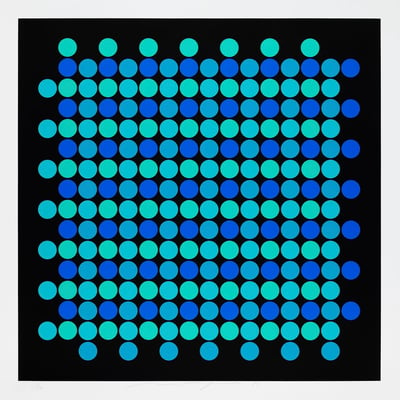
Almir Mavignier
Untiteld from 9x5 Konkret Portfolio, 1979
Limited Edition Print
Screen-print
EUR 1,600
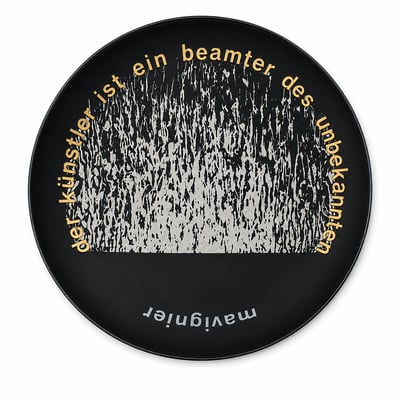
Almir Mavignier
der künstler ist ein beamter....., 1979
Sculpture / Object
Plate
EUR 980

Almir Mavignier
Komposition VI, 1965
Limited Edition Print
Lithograph
Currently Not Available
No sold works to show.
Born in Brazil, in 1925, Almir Mavignier studied in Germany at the Hochschule für Gestatlung in Ulm. Max Bense’s aesthetics of information and Josef Alber’s studies of colour proportionality have been major influences of Mavignier’s work. The works are mainly considered to be in the Op Art and Abstract genres. He has also worked as a commercial artist. He developed works such as Permutations by creating a pattern from a surface of geometrically ordered points. By using certain combinations of colour, the points form a surface which seems to vibrate. Mavignier has travelled and experienced much of the modern art scene. In 1951, after a solo exhibition in Sao Paulo, he moved to France, and lived in Paris. In 1952, Mavignier changed his location again, moving this time to Ulm in Germany. The year 1954 saw a stylistic development for Mavignier as he created his premier Point-Images. A further development of his style in 1955 saw Mavignier creating Grid-Images. Monochromatic images were first seen in Mavignier’s work in 1957 and in 1958 he co-founded and worked within Group 0, also called Zero Together. Almir Mavignier’s work was exhibited internationally through the 1950’s and 1960’s, with his works shown in the Venice Biennial, at Dokumeta 3 and 4 and at the MoMA in New York. Almir Mavignier has established his personal studio in Hamburg; he also teaches there at the Hochschule fur Bildende Kunst. (Artist website)
Related Artists



Related Articles
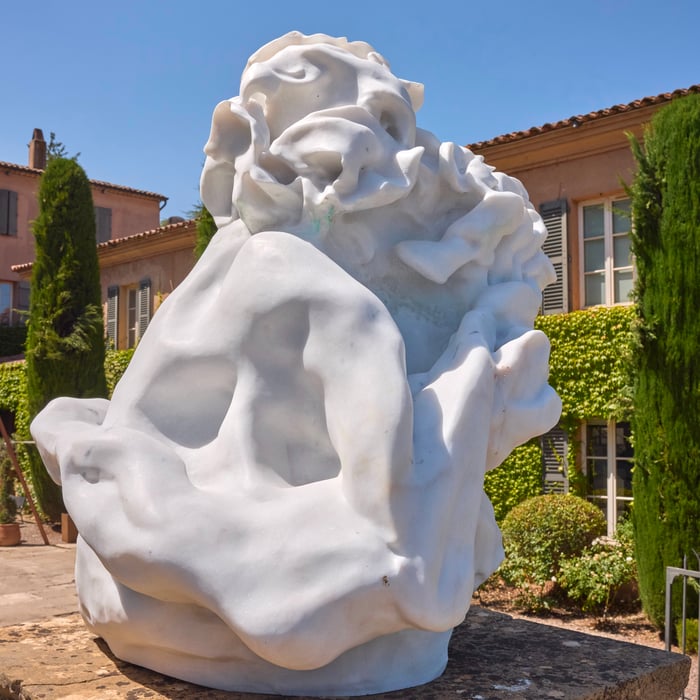
News, Popular, Collecting, Artists - August 12, 2026
In Minor Keys: Finding Intimacy and Identity at the 61st Venice Biennale — and in Your Collection
Explore how Koyo Kouoh’s 61st Venice Biennale vision, In Minor Keys, is shifting contemporary collecting toward quiet introspection, memory, and personal identi…Read More

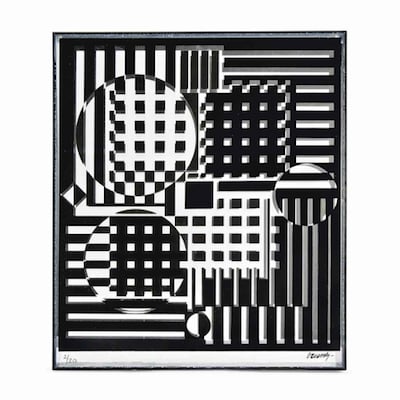 Artwork by Victor Vasarely
What is Op Art?
Op Art is a visual art style that uses optical illusions to create the impression of movement, vibrating patterns, flashing, or hidden images. The works are typically abstract, with many well-known pieces in black and white. The roots of Op Art can be traced back to earlier movements like Futurism, Constructivism, Dada, and Neo-Impressionism, particularly in…
Explore »

