
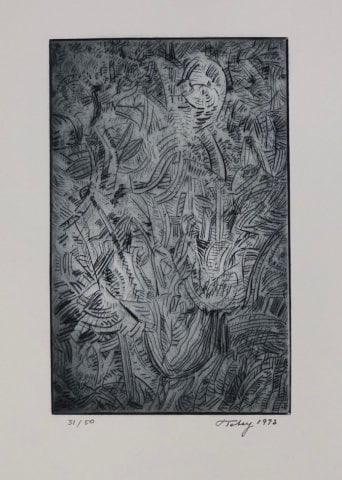
Mark Tobey
Mark Tobey (United States, 1890–1976) was an American painter known for his densely structured compositions inspired by Asian calligraphy. A founder of the Northwest School, his 'white writing' technique influenced Abstract Expressionism. Tobey's work reflects a fusion of Western and Eastern artistic traditions.
© Mark Tobey. All rights reserved.
- Recently Added
- Price (Low-High)
- Price (High-Low)
- Year (Low-High)
- Year (High-Low)
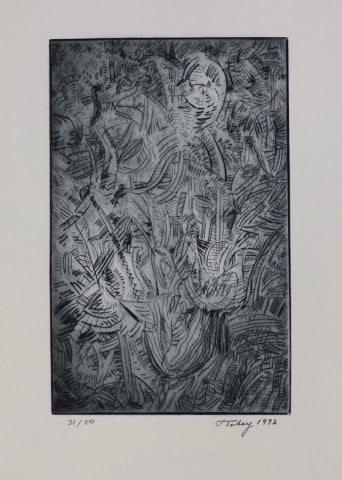
Mark Tobey
Album internacional, 1973
Limited Edition Print
Etching
EUR 850
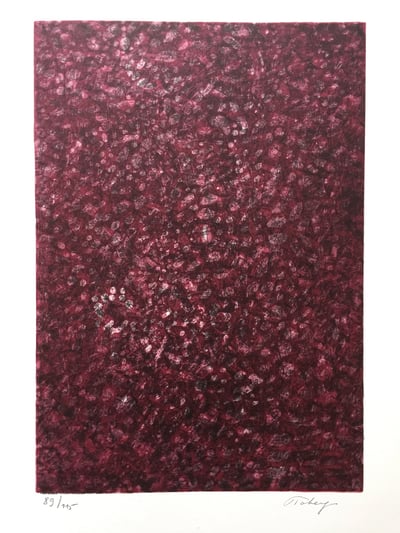
Mark Tobey
Jean Cassau
Limited Edition Print
Lithograph
Currently Not Available
On pavements and the bark of trees I have found whole worlds.
- Mark Tobey
- Mark Tobey
Inspired by mysticism and it’s bearing on art, Mark Tobey was an abstract painter whose works incorporated elements of Eastern Religion, international travels and Asian Calligraphy resulting in his own unique style that he dubbed ‘white writing’ - this technique involved using a base comprised of thousands of individual but interwoven brushstrokes, topped by a number of white calligraphic symbols and marks; such works as Broadway, Welcome Hero and Broadway norm showcase his white writing. Upon studying Zen painting while traveling Japan, Tobey began to create as a means of reflection and gave less emphasis to emotion, stating “I believe that painting should come through the avenues of meditation rather than the canals of action” - his unique methods, some of which had not yet been showcased in American art, inspired several younger artists, most notably Jackson Pollock. (Artist website)
Related Artists
Related Articles
Popular, Art Movements - November 20, 2024
Understanding Abstract Expressionism: Emotion and Gesture
Explore the emotional depth of Abstract Expressionism! Discover how artists like Pollock and Rothko used gesture and color to convey human complexity.Read More
News, Popular, Collecting, Artists - August 12, 2026
In Minor Keys: Finding Intimacy and Identity at the 61st Venice Biennale — and in Your Collection
Explore how Koyo Kouoh’s 61st Venice Biennale vision, In Minor Keys, is shifting contemporary collecting toward quiet introspection, memory, and personal identi…Read More
 Artwork by Roy Lichtenstein
What is late modernism?
Late Modernism refers to the continuation and evolution of Modernist principles in art, architecture, and literature from the mid-20th century into the late 20th century. This movement maintains a focus on form, abstraction, and the rejection of traditional styles, but it often incorporates more complexity and ambiguity compared to early Modernism. Late Mode…
Explore »

