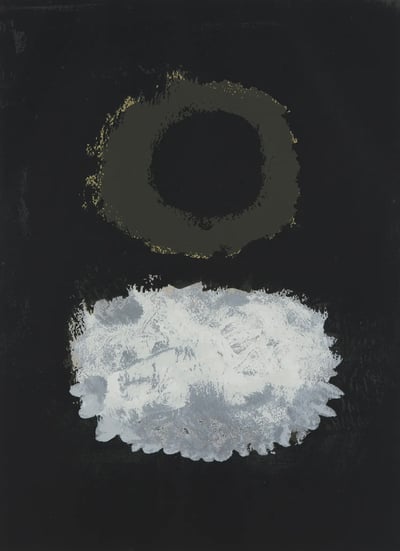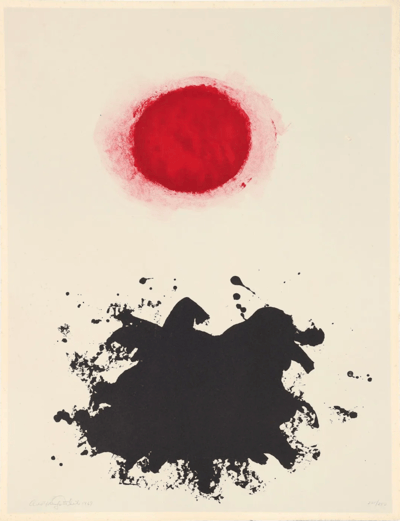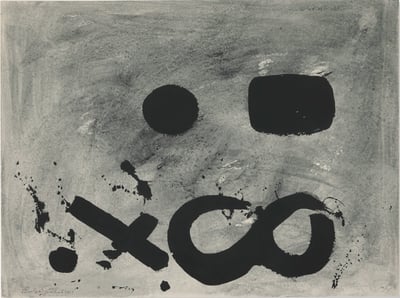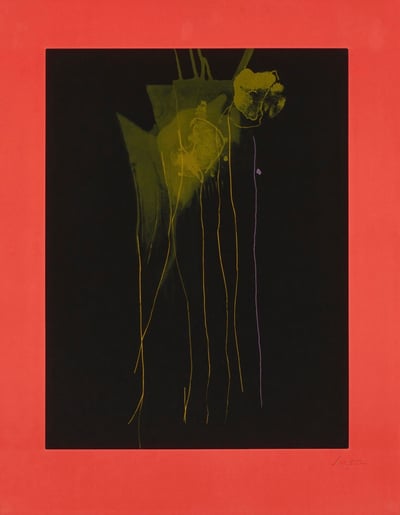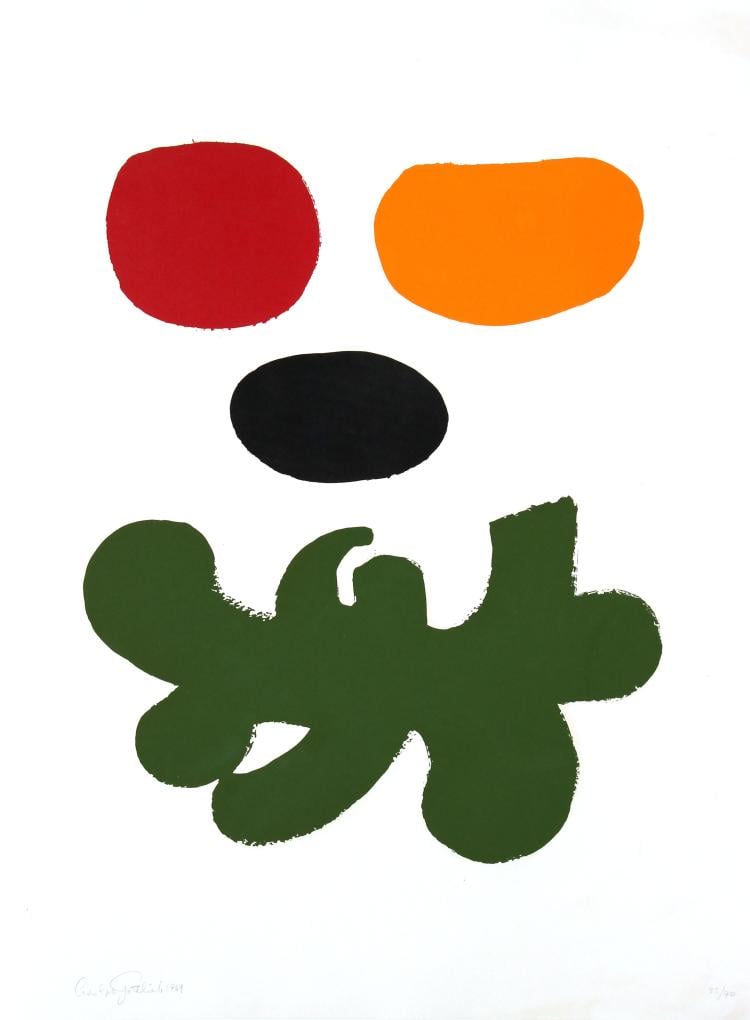
Levitation by Adolph Gottlieb is a limited-edition serigraph created in 1969. This abstract work consists of bold, organic shapes in striking colors, including a vivid red, a warm orange, a deep black, and a lush green. The forms float against a stark white background, creating a sense of balance and energy despite their asymmetry. The piece reflects Gottlieb's exploration of symbolic abstraction, where simple shapes and vibrant colors evoke emotional responses. The composition suggests weightlessness, aligning with the title, as if these forms are hovering in a serene, meditative space. Gottlieb’s use of color and shape conveys a powerful visual language that invites interpretation.
Adolph Gottlieb (United States, 1903–1974) was a pivotal American painter and sculptor, associated with Abstract Expressionism and Color Field painting. Known for his 'Burst' and 'Pictograph' series, Gottlieb's work juxtaposed bold shapes and vibrant colors to explore universal symbols and emotional expression. He was a co-founder of the influential New York School.
Serigraph Serigraph is a printmaking process that uses silk screen techniques to create an image. The image is digitally separated into individual colors, each of which is assigned to a separate silk screen. These screens are then used to apply each color by hand, layer by layer, to replicate the original artwork, often based on an oil painting.
Levitation by Adolph Gottlieb is a limited-edition serigraph created in 1969. This abstract work consists of bold, organic shapes in striking colors, including a vivid red, a warm orange, a deep black, and a lush green. The forms float against a stark white background, creating a sense of balance and energy despite their asymmetry. The piece reflects Gottlieb's exploration of symbolic abstraction, where simple shapes and vibrant colors evoke emotional responses. The composition suggests weightlessness, aligning with the title, as if these forms are hovering in a serene, meditative space. Gottlieb’s use of color and shape conveys a powerful visual language that invites interpretation.
Adolph Gottlieb (United States, 1903–1974) was a pivotal American painter and sculptor, associated with Abstract Expressionism and Color Field painting. Known for his 'Burst' and 'Pictograph' series, Gottlieb's work juxtaposed bold shapes and vibrant colors to explore universal symbols and emotional expression. He was a co-founder of the influential New York School.
I want to express the utmost intensity of the color, bring out the quality, make it expressive.
- Adolph Gottlieb
A widely acclaimed figure of abstract expressionism, Adolph Gottlieb was an artist whose works encompassed the mediums of painting, printmaking and sculpture. Gottlieb’s work was heavily symbolic – he would create original symbolism and portray it in such a manner that it remained universal and connected to a notion that already existed within the viewer; Pictographs was a highly acclaimed series that succinctly exemplifies this universality and simplicity that all viewers can relate to. Gottlieb’s later paintings often employed thick brushstrokes and circular motifs, as evidenced in Brink – this technique became one of the foremost factors in the development of Colour Field painting. Asides from painting, Gottlieb also forayed into sculpture for around 18 months and created roughly 42 sculptures in total – his materials included welded and painted aluminium and steel; Gottlieb noted that his background as a painter made it difficult for him to imagine objects without colour.
Abstract art uses form, shape, line, and color to create a visual experience without attempting to represent external reality. The composition exists independently of the world's visual references, focusing on expressing ideas and emotions through non-representational means.