Image: 24 × 18.8 in (61 × 48 cm).
Sheet: 36 × 27.25 in (91 × 69 cm).
Signed, dated and numbered to lower margin.
Published by Marlborough Graphics, New York.
Literature: Associated American Artists 73.
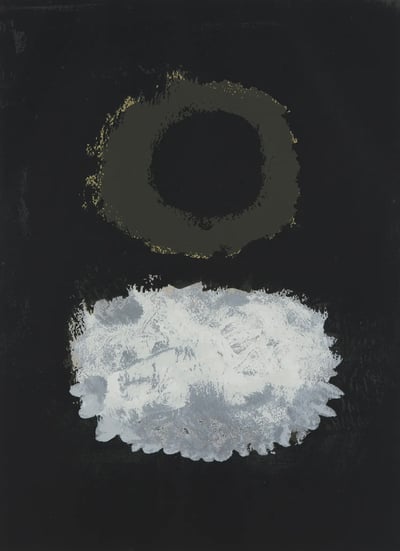
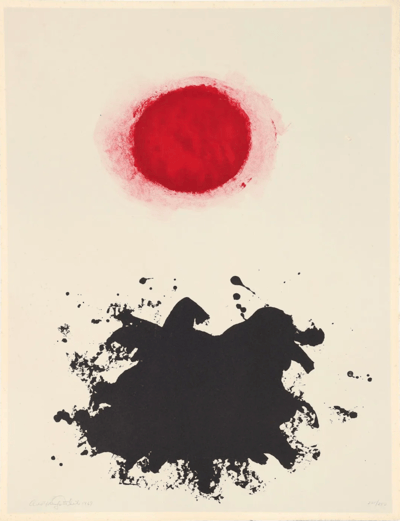
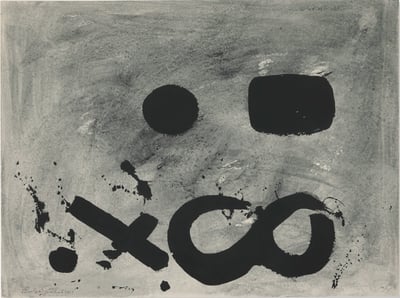
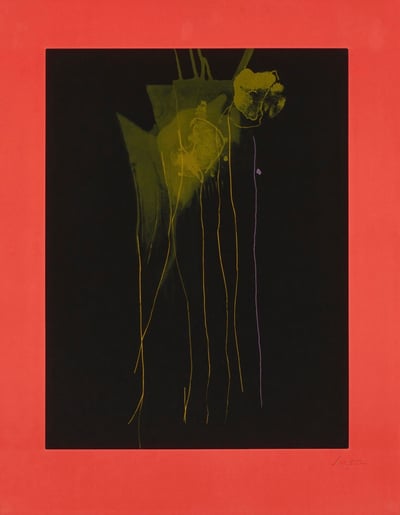
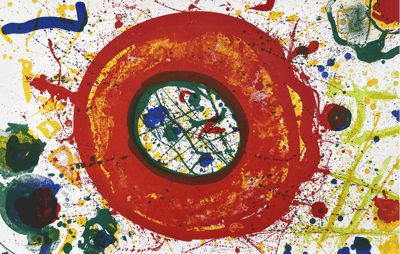
Crimson Ground by Adolph Gottlieb is a 1972 screenprint that showcases his signature use of symbolic abstraction and color field composition. A stark white circle hovers above a smaller black dot, both suspended in a vivid crimson rectangle that dominates the print. Beneath these forms, a band of gestural black and white brushstrokes adds a dynamic, almost calligraphic energy. The contrast between the geometric simplicity of the circles and the expressive markings below reflects Gottlieb's interest in the tension between order and spontaneity. Published by Marlborough Graphics and listed in Associated American Artists 73, this work exemplifies the artist's mature visual language.
Adolph Gottlieb (United States, 1903–1974) was a pivotal American painter and sculptor, associated with Abstract Expressionism and Color Field painting. Known for his 'Burst' and 'Pictograph' series, Gottlieb's work juxtaposed bold shapes and vibrant colors to explore universal symbols and emotional expression. He was a co-founder of the influential New York School.
Screen-print Screen printing is a technique where ink is transferred through a mesh onto a substrate, with areas blocked by a stencil to prevent ink from passing through. This method, also known as serigraphy or silkscreen printing, is commonly used to produce prints on posters, T-shirts, vinyl, stickers, wood, and other materials. The process is a type of stencil printing, allowing for vibrant, detailed designs on various surfaces.
Image: 24 × 18.8 in (61 × 48 cm).
Sheet: 36 × 27.25 in (91 × 69 cm).
Signed, dated and numbered to lower margin.
Published by Marlborough Graphics, New York.
Literature: Associated American Artists 73.
Crimson Ground by Adolph Gottlieb is a 1972 screenprint that showcases his signature use of symbolic abstraction and color field composition. A stark white circle hovers above a smaller black dot, both suspended in a vivid crimson rectangle that dominates the print. Beneath these forms, a band of gestural black and white brushstrokes adds a dynamic, almost calligraphic energy. The contrast between the geometric simplicity of the circles and the expressive markings below reflects Gottlieb's interest in the tension between order and spontaneity. Published by Marlborough Graphics and listed in Associated American Artists 73, this work exemplifies the artist's mature visual language.
Adolph Gottlieb (United States, 1903–1974) was a pivotal American painter and sculptor, associated with Abstract Expressionism and Color Field painting. Known for his 'Burst' and 'Pictograph' series, Gottlieb's work juxtaposed bold shapes and vibrant colors to explore universal symbols and emotional expression. He was a co-founder of the influential New York School.
I want to express the utmost intensity of the color, bring out the quality, make it expressive.
- Adolph Gottlieb
A widely acclaimed figure of abstract expressionism, Adolph Gottlieb was an artist whose works encompassed the mediums of painting, printmaking and sculpture. Gottlieb’s work was heavily symbolic – he would create original symbolism and portray it in such a manner that it remained universal and connected to a notion that already existed within the viewer; Pictographs was a highly acclaimed series that succinctly exemplifies this universality and simplicity that all viewers can relate to. Gottlieb’s later paintings often employed thick brushstrokes and circular motifs, as evidenced in Brink – this technique became one of the foremost factors in the development of Colour Field painting. Asides from painting, Gottlieb also forayed into sculpture for around 18 months and created roughly 42 sculptures in total – his materials included welded and painted aluminium and steel; Gottlieb noted that his background as a painter made it difficult for him to imagine objects without colour.
Gestural art is a term that describes painting with freely sweeping brushstrokes. The primary goal of gestural art is to allow the artist to physically express emotional impulses. The varied, yet expressive paint marks are intended to convey the artist's inner thoughts and emotions, which viewers are believed to understand through the dynamic and spontaneous application of paint.