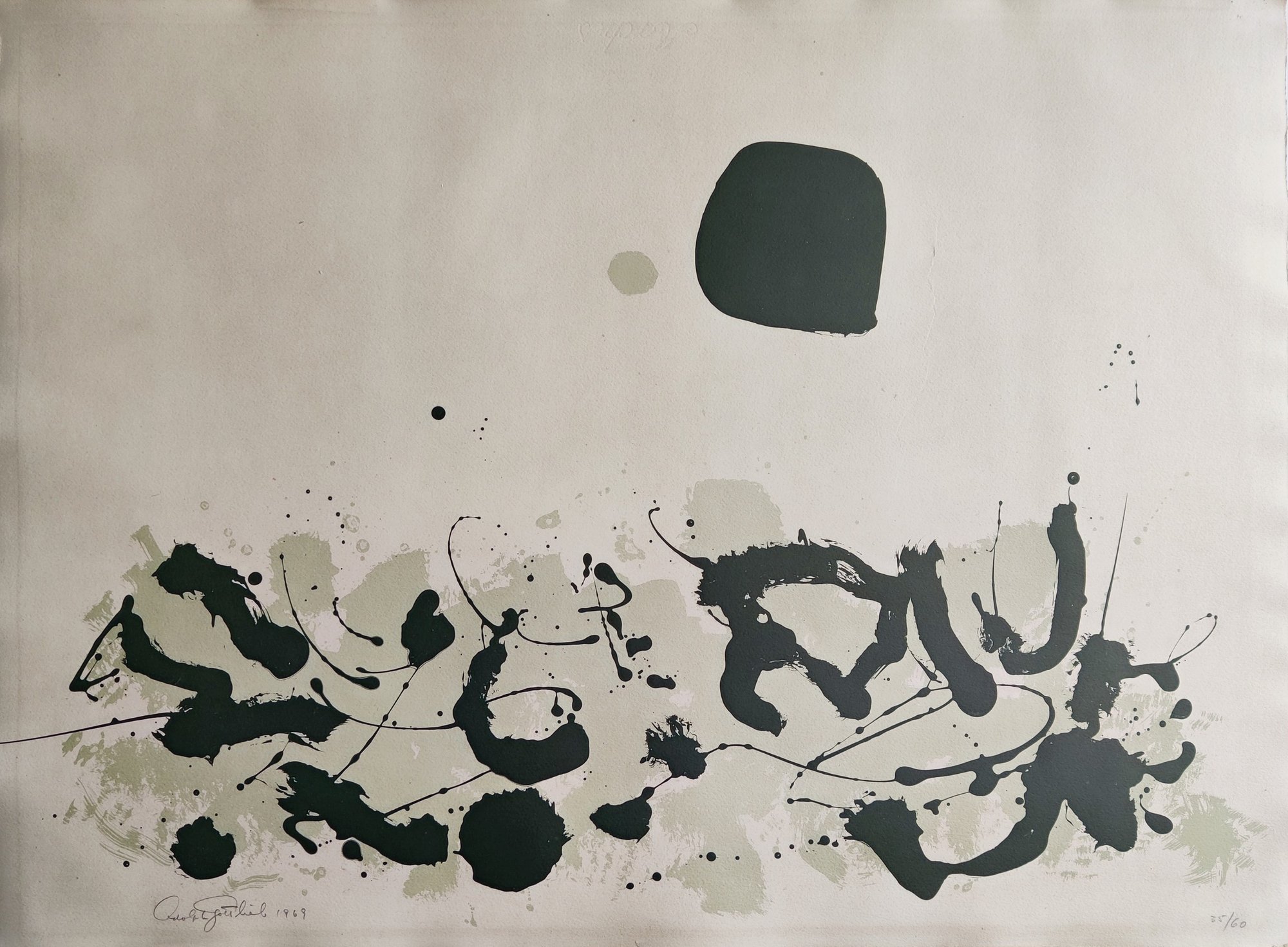
Lithograph in colors on Arches paper.
Hand signed and dated lower left.
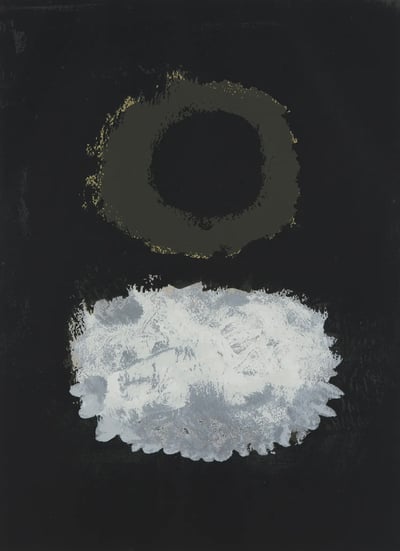
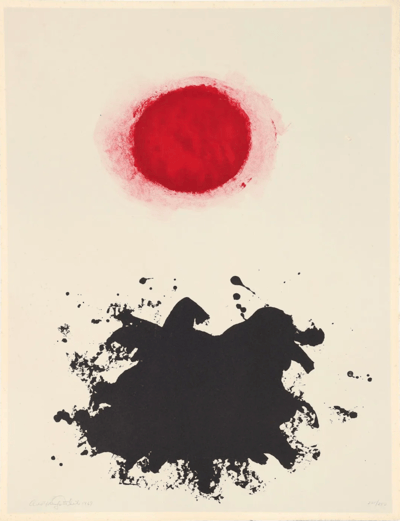
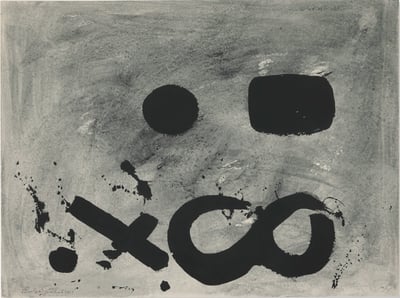
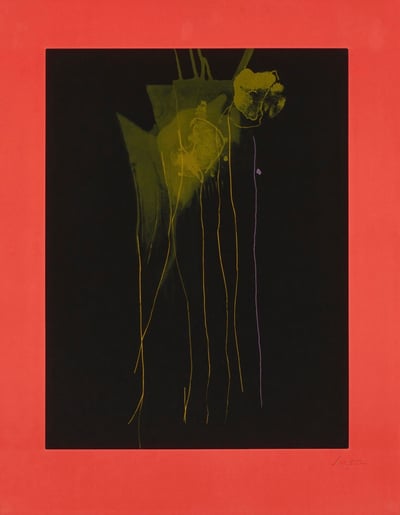
Germination (1969) is a lithograph in colors on Arches paper by Adolph Gottlieb, one of the key figures of Abstract Expressionism and the New York School. The work belongs to Gottlieb's celebrated Burst series, in which a luminous disc or orb hovers above a turbulent, gestural field -- a composition that reduces the tension between order and chaos, sky and earth, to its most essential opposition. In Germination, the burst form is energized and dynamic, its ruptured lower zone contrasting powerfully with the contained mass above. Signed and dated lower left, this lithograph captures the full expressive range of Gottlieb's mature language: bold, deliberate, and deeply felt. It stands as an eloquent statement of the Abstract Expressionist conviction in the power of pure form to convey universal human experience.
Adolph Gottlieb (United States, 1903–1974) was a pivotal American painter and sculptor, associated with Abstract Expressionism and Color Field painting. Known for his 'Burst' and 'Pictograph' series, Gottlieb's work juxtaposed bold shapes and vibrant colors to explore universal symbols and emotional expression. He was a co-founder of the influential New York School.
Lithograph Lithography is a printing method based on the principle that water and oil do not mix. It can be used to print artwork or text onto paper or other suitable materials. Traditionally, an image was drawn with wax, fat, or oil onto a lithographic limestone surface or plate. Today, metal plates and other surfaces are also used in lithographic printing.
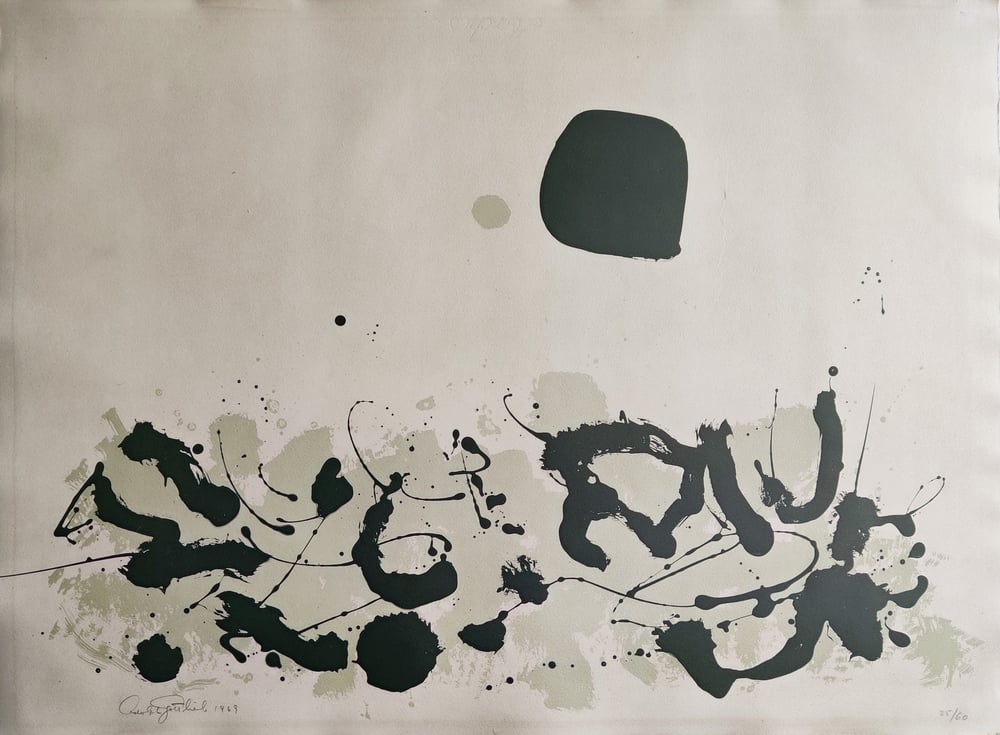
Lithograph in colors on Arches paper.
Hand signed and dated lower left.
Germination (1969) is a lithograph in colors on Arches paper by Adolph Gottlieb, one of the key figures of Abstract Expressionism and the New York School. The work belongs to Gottlieb's celebrated Burst series, in which a luminous disc or orb hovers above a turbulent, gestural field -- a composition that reduces the tension between order and chaos, sky and earth, to its most essential opposition. In Germination, the burst form is energized and dynamic, its ruptured lower zone contrasting powerfully with the contained mass above. Signed and dated lower left, this lithograph captures the full expressive range of Gottlieb's mature language: bold, deliberate, and deeply felt. It stands as an eloquent statement of the Abstract Expressionist conviction in the power of pure form to convey universal human experience.
Adolph Gottlieb (United States, 1903–1974) was a pivotal American painter and sculptor, associated with Abstract Expressionism and Color Field painting. Known for his 'Burst' and 'Pictograph' series, Gottlieb's work juxtaposed bold shapes and vibrant colors to explore universal symbols and emotional expression. He was a co-founder of the influential New York School.
I want to express the utmost intensity of the color, bring out the quality, make it expressive.
- Adolph Gottlieb
A widely acclaimed figure of abstract expressionism, Adolph Gottlieb was an artist whose works encompassed the mediums of painting, printmaking and sculpture. Gottlieb’s work was heavily symbolic – he would create original symbolism and portray it in such a manner that it remained universal and connected to a notion that already existed within the viewer; Pictographs was a highly acclaimed series that succinctly exemplifies this universality and simplicity that all viewers can relate to. Gottlieb’s later paintings often employed thick brushstrokes and circular motifs, as evidenced in Brink – this technique became one of the foremost factors in the development of Colour Field painting. Asides from painting, Gottlieb also forayed into sculpture for around 18 months and created roughly 42 sculptures in total – his materials included welded and painted aluminium and steel; Gottlieb noted that his background as a painter made it difficult for him to imagine objects without colour.
Automatism refers to a technique in the creative process that accesses material from the unconscious or subconscious mind. It is based on Sigmund Freud’s psychoanalytic method of free association. Artists value this process for its ability to inspire creative thought and spontaneous creation.