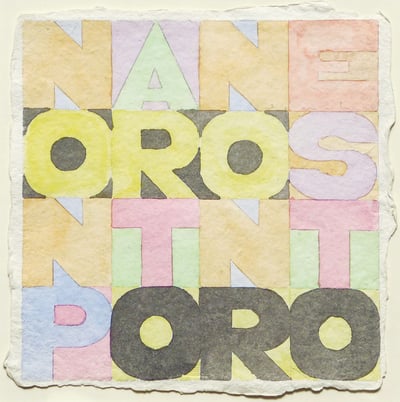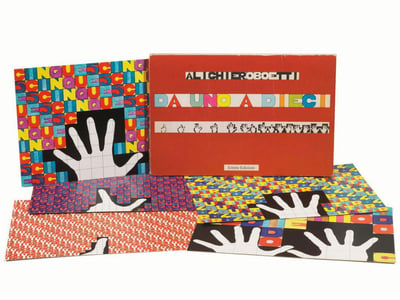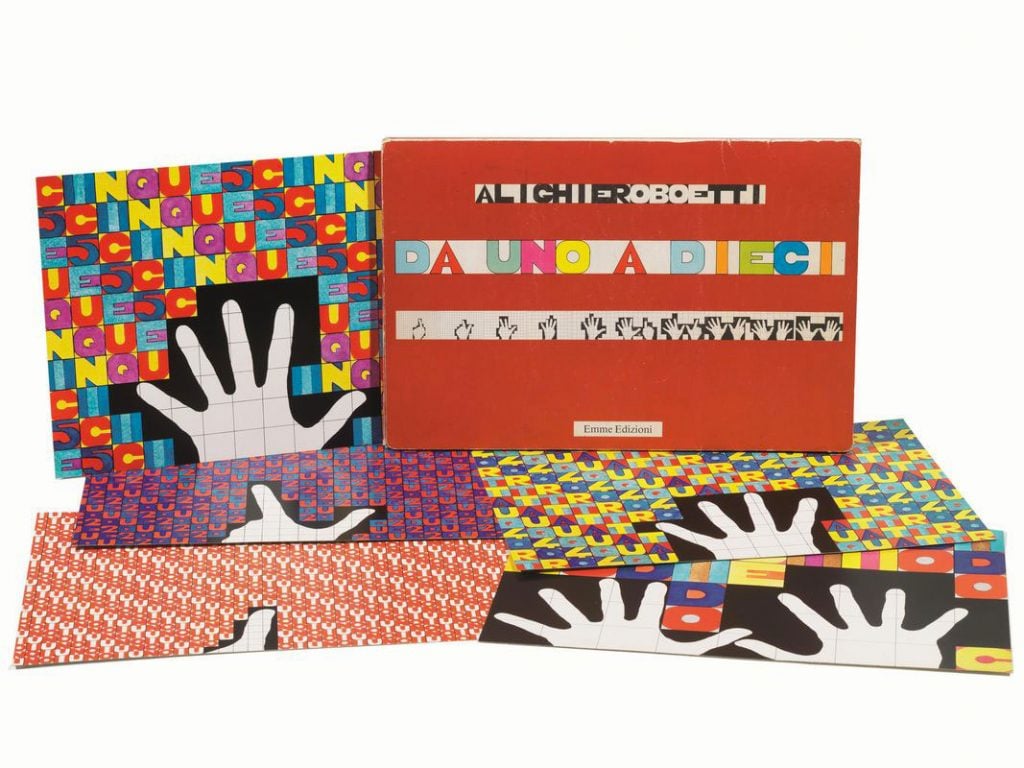
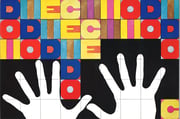
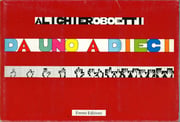
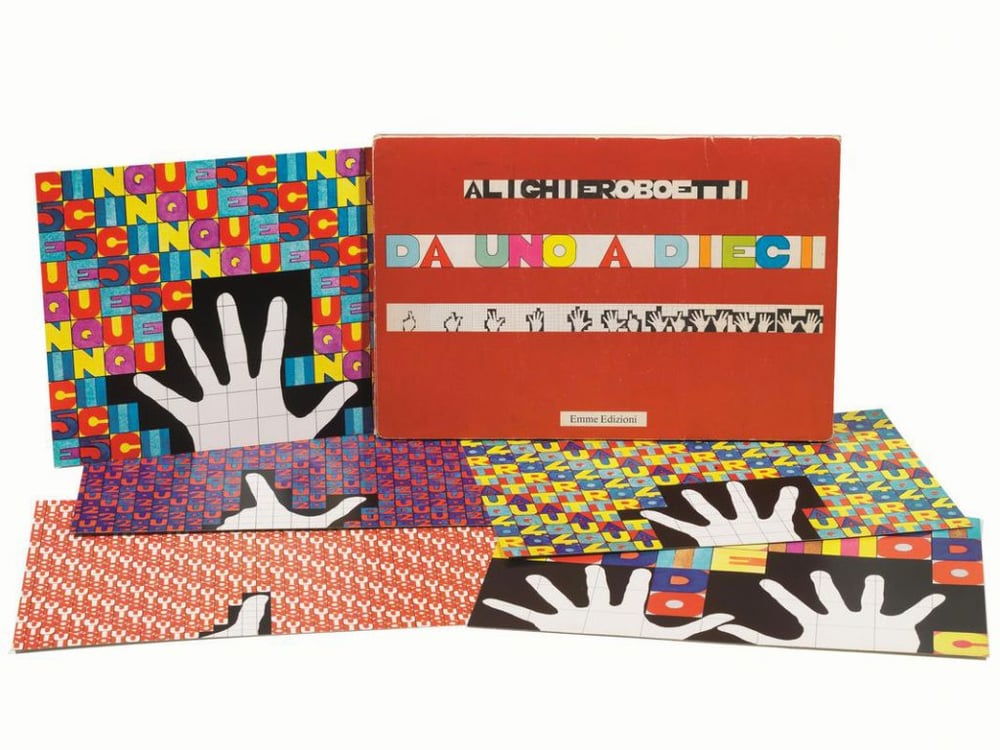
Da uno a dieci by Alighiero Boetti, created in 1980, is a vibrant and playful limited edition offset print portfolio featuring 20 sheets—10 in color and 10 in black and white. This work exemplifies Boetti's fascination with numbers, patterns, and linguistic exploration. The brightly colored sheets are adorned with bold, repetitive typography and hand motifs, encouraging viewers to interact with the concept of counting and numerical progression from one to ten. The combination of graphical repetition and contrasting color schemes reflects Boetti’s approach to conceptual art, where he merges systematic structures with creative expression. This portfolio offers an engaging visual journey through structured patterns, embodying the artist’s unique blend of order and spontaneity.
Alighiero Boetti (Italy, 1940–1994) was a key figure in the Arte Povera movement, celebrated for his conceptual and collaborative approach. Renowned for his embroidered maps and textual works, Boetti’s art often explored themes of duality, language, and global interconnectedness. His innovative practice blurred boundaries between artist and artisan.
Offset PrintOffset lithography is a printing technique where the inked image is first transferred (offset) from a plate to a rubber blanket and then to the printing surface. This method combines the lithographic process, which relies on the repulsion of water and oil, to keep non-printing areas ink-free by attracting a water-based film. Offset lithography was originally developed to reduce costs in reproducing artwork and is widely used for high-volume printing due to its efficiency and ability to produce sharp, consistent images.
Da uno a dieci by Alighiero Boetti, created in 1980, is a vibrant and playful limited edition offset print portfolio featuring 20 sheets—10 in color and 10 in black and white. This work exemplifies Boetti's fascination with numbers, patterns, and linguistic exploration. The brightly colored sheets are adorned with bold, repetitive typography and hand motifs, encouraging viewers to interact with the concept of counting and numerical progression from one to ten. The combination of graphical repetition and contrasting color schemes reflects Boetti’s approach to conceptual art, where he merges systematic structures with creative expression. This portfolio offers an engaging visual journey through structured patterns, embodying the artist’s unique blend of order and spontaneity.
Alighiero Boetti (Italy, 1940–1994) was a key figure in the Arte Povera movement, celebrated for his conceptual and collaborative approach. Renowned for his embroidered maps and textual works, Boetti’s art often explored themes of duality, language, and global interconnectedness. His innovative practice blurred boundaries between artist and artisan.
It's just a question of knowing the rules of the game.
- Alighiero Boetti
Alighiero Boetti (b. 1940 Italy, d. 1994 Italy) was a prominent Italian conceptual artist and a key figure in the Arte Povera movement. Boetti's work is celebrated for its exploration of duality, order, and chaos, often using everyday materials to challenge traditional notions of art. His most famous works include the embroidered world maps, known as "Mappa," created with the help of Afghan artisans, which reflect his interest in geopolitics and the collaborative process. Boetti was fascinated by the interplay between the individual and the collective, a theme that runs throughout his diverse body of work, ranging from sculpture and installation to drawing and textile art. His innovative approach and intellectual depth have cemented his place as a significant figure in 20th-century art. (Artist website)
Mail Art is a populist art movement centered on the creation and exchange of small-scale artworks through the postal service. It developed out of the Fluxus movement in the 1950s and 1960s and has since evolved into a global art movement. Ray Johnson is recognized as the first mail artist, and his New York School is considered the first network of mail artists. Mail artists rely heavily on a network to exchange their works, often creating a community of artists connected through the postal system.