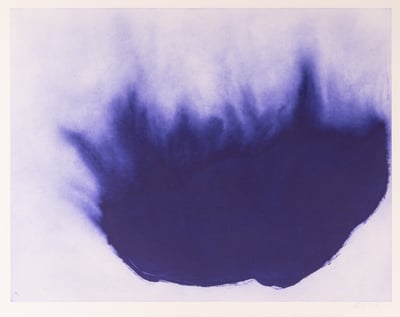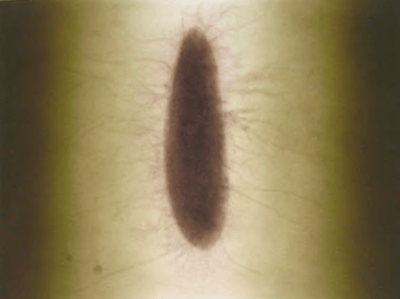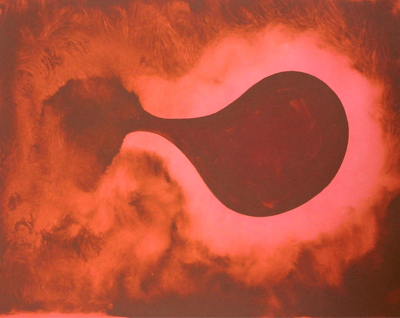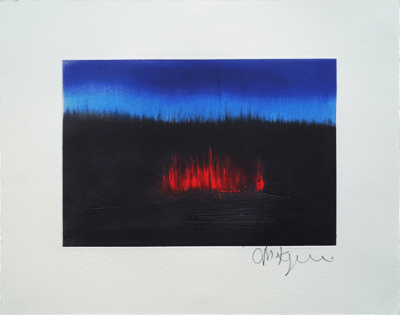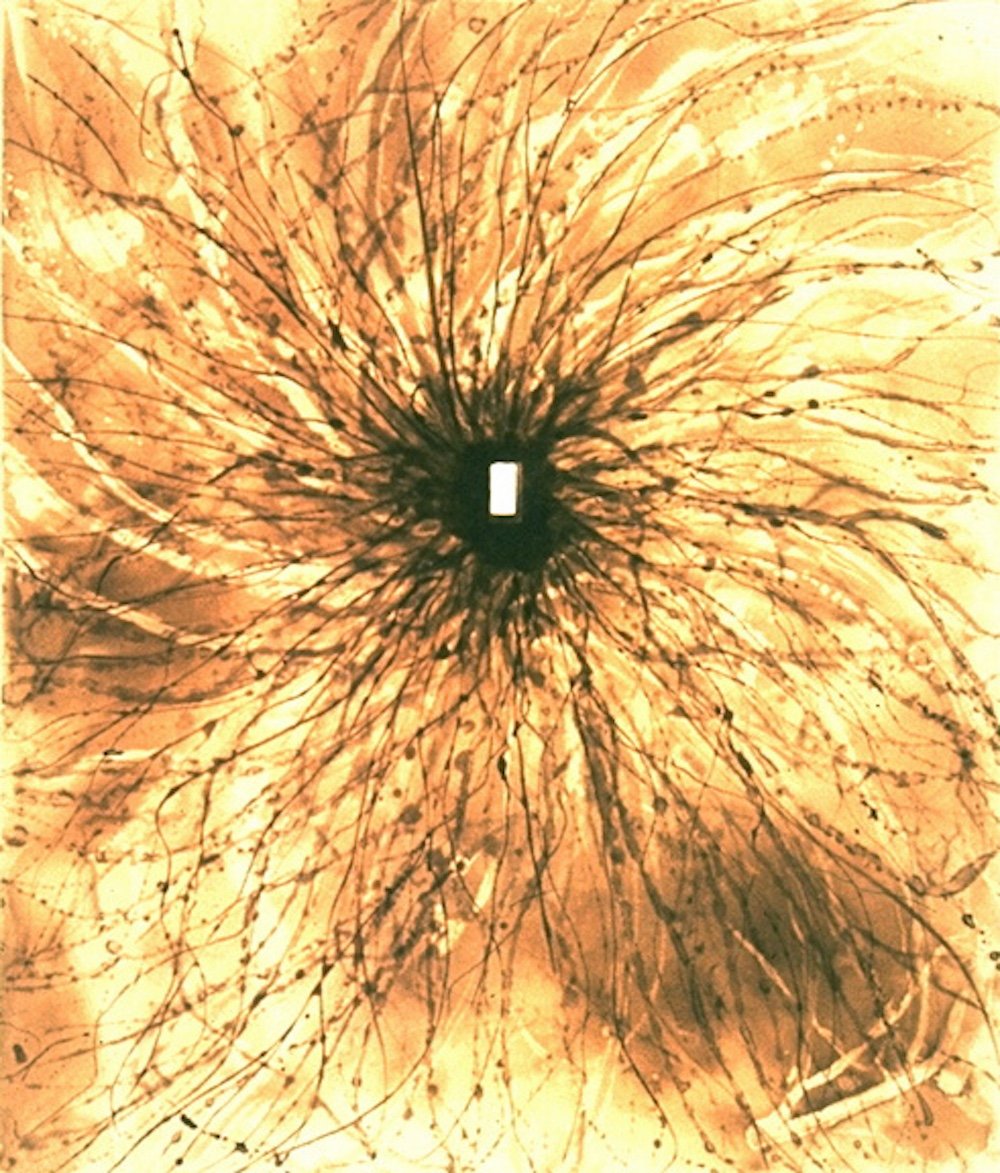
Spit bite aquatint.
Image size: 28 x 24 in; 71 x 61 cm.
Paper size: 36 x 30.75 in; 91.5 × 78 cm.
Published by Crown Point Press and printed by Lawrence Hamlin.
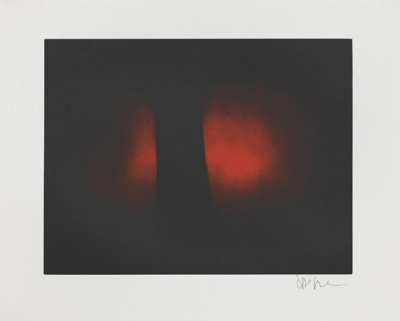
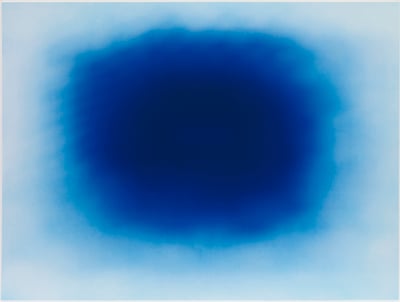
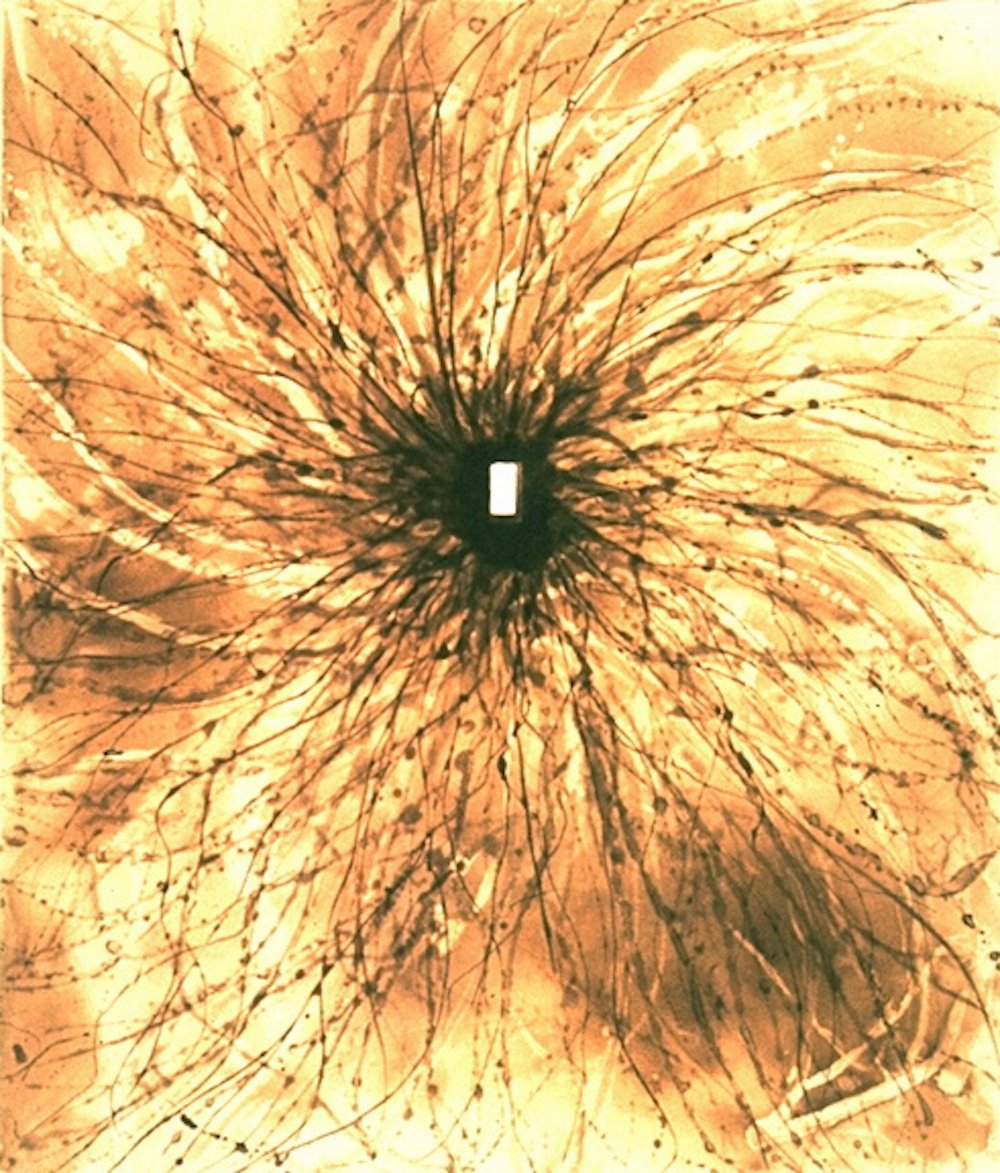
Concentric lines of warm ochre and orange radiate outward from a small, luminous rectangular void at the centre of the sheet, evoking a threshold between the known and the unknowable. Printed by Crown Point Press using the spit bite aquatint technique, Door belongs to Kapoor's early investigations of the portal as a psychological and spatial motif. The starburst composition creates an almost devotional intensity, pulling the eye inward with quiet force. A key work from the artist's print oeuvre, it embodies the liminal tension between colour, darkness, and passage that has defined Kapoor's career.
Anish Kapoor (India/UK, 1954) is a renowned sculptor celebrated for his monumental, abstract works. Known for experimenting with materials like polished steel and vibrant pigments, his art explores perception and space. Iconic creations include 'Cloud Gate' in Chicago and his use of Vantablack, the world’s darkest material.
AquatintIntaglio is a printmaking technique where the artist creates marks on a metal plate that hold ink or dye. The inked plate is then pressed onto paper, transferring the ink to the sheet. This process can be repeated multiple times depending on the technique. Intaglio methods, such as etching, often involve applying a mordant (acid) to the metal plate to create the design. Intaglio encompasses various techniques, including engraving, etching, and drypoint.
Spit bite aquatint.
Image size: 28 x 24 in; 71 x 61 cm.
Paper size: 36 x 30.75 in; 91.5 × 78 cm.
Published by Crown Point Press and printed by Lawrence Hamlin.
Concentric lines of warm ochre and orange radiate outward from a small, luminous rectangular void at the centre of the sheet, evoking a threshold between the known and the unknowable. Printed by Crown Point Press using the spit bite aquatint technique, Door belongs to Kapoor's early investigations of the portal as a psychological and spatial motif. The starburst composition creates an almost devotional intensity, pulling the eye inward with quiet force. A key work from the artist's print oeuvre, it embodies the liminal tension between colour, darkness, and passage that has defined Kapoor's career.
Anish Kapoor (India/UK, 1954) is a renowned sculptor celebrated for his monumental, abstract works. Known for experimenting with materials like polished steel and vibrant pigments, his art explores perception and space. Iconic creations include 'Cloud Gate' in Chicago and his use of Vantablack, the world’s darkest material.
One must not believe any of those mythologies about oneself as an artist.
- Anish Kapoor
Anish Kapoor is a British-Indian sculptor who lived and worked in London until he moved to study art the Chelsea School of Art and Design. He gained fame in the 1980's for his geometric sculptures he created from simple materials; limestone, granite, plaster, pigment and marble. Anish Kapoor’s earlier works were generally simple, curved forms with monochromatic and bright colors. Anish preferred to use powder pigment to define his forms. Anish Kapoor thought his early works all formed themselves out of each other and decided to give them a generic name, "A Thousand Names." Anish Kapoor felt this number implied the infinity he felt described these works. The pieces either sat on the floor or projected from a wall; the floor pieces defined the surface of the floor, while the pieces in the wall appeared to be partially submerged. Anish Kapoor continued his explorations of matter and non-matter into the 1980's and 1990's and his sculptures seem to recede into the distance or disappear into the ground. He also started to sculpt with stone, creating stone works made of solid, quarried stone. In the mid-1990's, Anish switched his materials again, this time to the highly reflective surface of polished stainless-steel. With the use of stainless-steel, Anish's sculptures moved into more challenging manipulations of form and space. His 35-meter high piece titled, Taratantata is installed in the Baltic Flour Mills in Gateshead, England. He also has a piece, Marsyas which is a large work consisting of three steel rings joined with a single span of PVC membrane that measures 3,400 square feet end to end, in Turbine Hall of Tate Modern in London. Anish also uses red wax as part of his designs, depicting flesh, blood and transfiguration. In 2007 his, Svayambh, a 1.5 meter block of red wax was part of the Biennale estuaire, shown in a major show at the Haus Der Kunst in Munich. Some of Anish's work blurs the boundaries between architecture and art. (Artist website)
Minimalism is a style in music and visual arts characterized by pared-down designs and simplicity. It began in Western art after World War II, gaining prominence particularly in American visual arts. Minimalism draws heavily on aspects of modernism and is often viewed as a reaction against Abstract Expressionism, as well as a precursor to post-minimal art practices. Prominent minimalist artists include Agnes Martin, Donald Judd, Robert Morris, Frank Stella, and Dan Flavin.