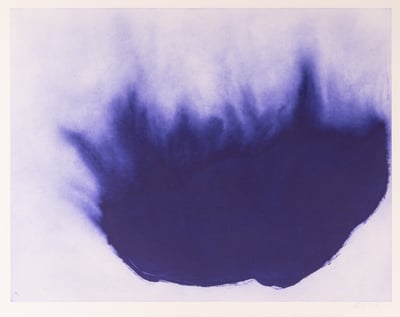
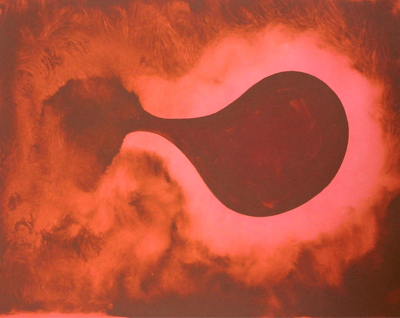
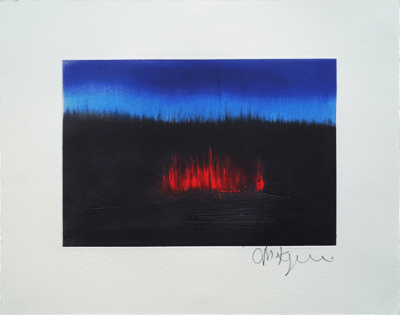
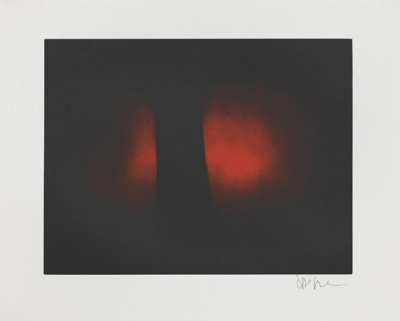
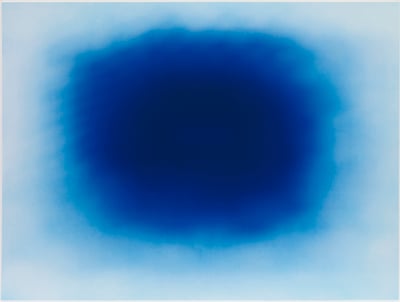
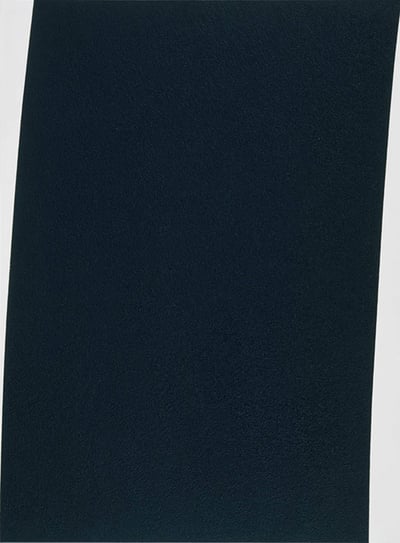
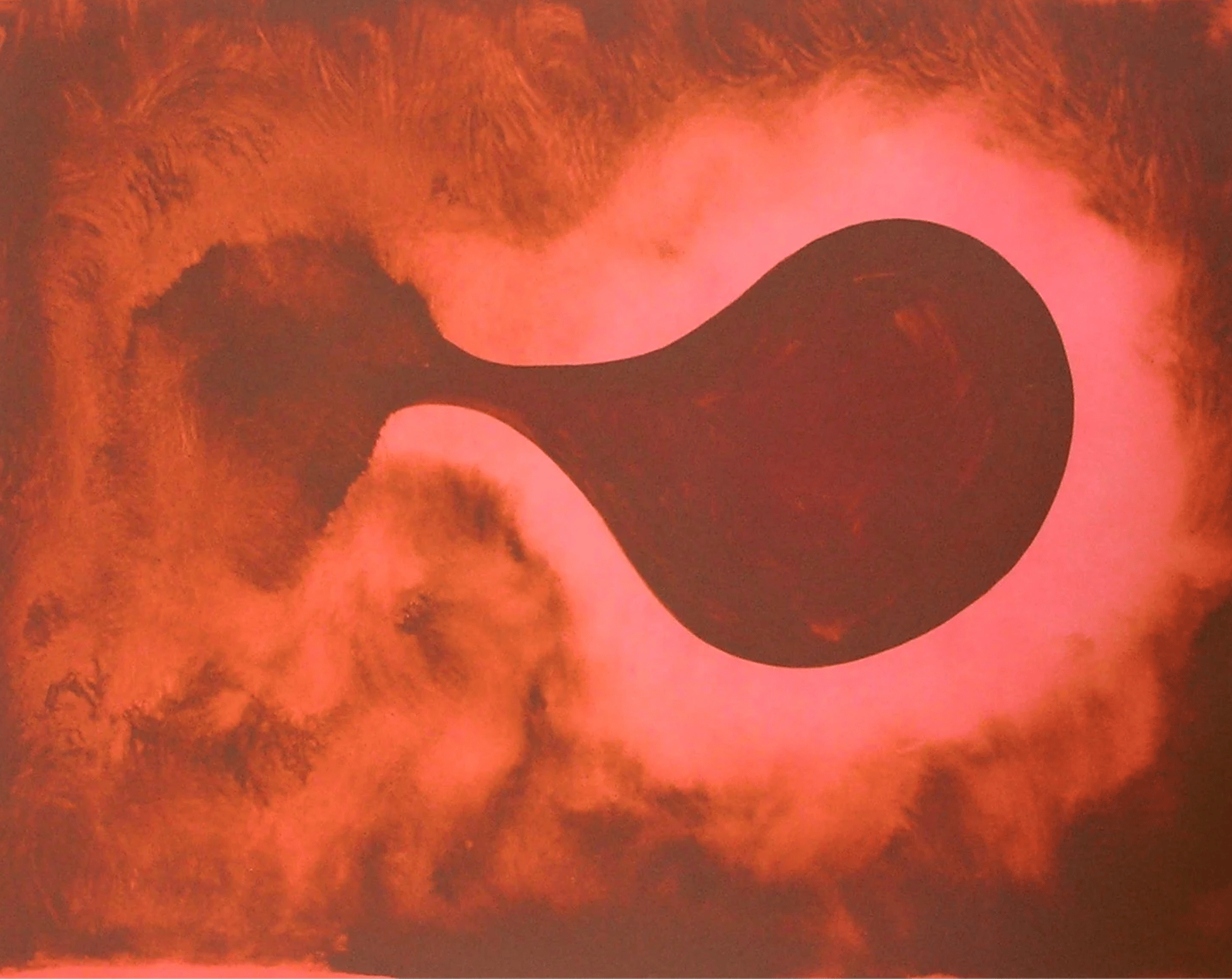
A large, dark curved form looms against a warm coral and orange field, its edges softly dissolving into the surrounding haze. Kapoor's etching captures the paradox at the heart of his work: a shape that appears simultaneously solid and immaterial, drawing the viewer into an ambiguous depth. The saturated warmth of the ground heightens the gravitational pull of the central void-like presence. Part of the artist's 2007 print suite, this work offers a compelling entry point into Kapoor's exploration of mass, colour, and the sublime.
Anish Kapoor (India/UK, 1954) is a renowned sculptor celebrated for his monumental, abstract works. Known for experimenting with materials like polished steel and vibrant pigments, his art explores perception and space. Iconic creations include 'Cloud Gate' in Chicago and his use of Vantablack, the world’s darkest material.
EtchingEtching is a technique where a design is created on a metal surface by using a strong acid or mordant to eat away the unprotected parts of the metal, leaving the desired pattern in relief (intaglio). In modern art and manufacturing, different chemicals may be used depending on the material being etched.
A large, dark curved form looms against a warm coral and orange field, its edges softly dissolving into the surrounding haze. Kapoor's etching captures the paradox at the heart of his work: a shape that appears simultaneously solid and immaterial, drawing the viewer into an ambiguous depth. The saturated warmth of the ground heightens the gravitational pull of the central void-like presence. Part of the artist's 2007 print suite, this work offers a compelling entry point into Kapoor's exploration of mass, colour, and the sublime.
Anish Kapoor (India/UK, 1954) is a renowned sculptor celebrated for his monumental, abstract works. Known for experimenting with materials like polished steel and vibrant pigments, his art explores perception and space. Iconic creations include 'Cloud Gate' in Chicago and his use of Vantablack, the world’s darkest material.
One must not believe any of those mythologies about oneself as an artist.
- Anish Kapoor
Anish Kapoor is a British-Indian sculptor who lived and worked in London until he moved to study art the Chelsea School of Art and Design. He gained fame in the 1980's for his geometric sculptures he created from simple materials; limestone, granite, plaster, pigment and marble. Anish Kapoor’s earlier works were generally simple, curved forms with monochromatic and bright colors. Anish preferred to use powder pigment to define his forms. Anish Kapoor thought his early works all formed themselves out of each other and decided to give them a generic name, "A Thousand Names." Anish Kapoor felt this number implied the infinity he felt described these works. The pieces either sat on the floor or projected from a wall; the floor pieces defined the surface of the floor, while the pieces in the wall appeared to be partially submerged. Anish Kapoor continued his explorations of matter and non-matter into the 1980's and 1990's and his sculptures seem to recede into the distance or disappear into the ground. He also started to sculpt with stone, creating stone works made of solid, quarried stone. In the mid-1990's, Anish switched his materials again, this time to the highly reflective surface of polished stainless-steel. With the use of stainless-steel, Anish's sculptures moved into more challenging manipulations of form and space. His 35-meter high piece titled, Taratantata is installed in the Baltic Flour Mills in Gateshead, England. He also has a piece, Marsyas which is a large work consisting of three steel rings joined with a single span of PVC membrane that measures 3,400 square feet end to end, in Turbine Hall of Tate Modern in London. Anish also uses red wax as part of his designs, depicting flesh, blood and transfiguration. In 2007 his, Svayambh, a 1.5 meter block of red wax was part of the Biennale estuaire, shown in a major show at the Haus Der Kunst in Munich. Some of Anish's work blurs the boundaries between architecture and art. (Artist website)
Contemporary art refers to avant-garde or innovative art created in the recent past or present day. The exact starting point of contemporary art varies depending on the institution, often tied to the founding year of museums or galleries that showcase the style. Contemporary art is characterized by its focus on current ideas, diverse media, and the exploration of new concepts and techniques.