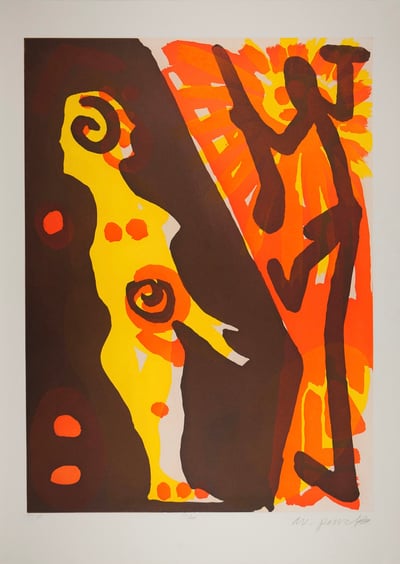
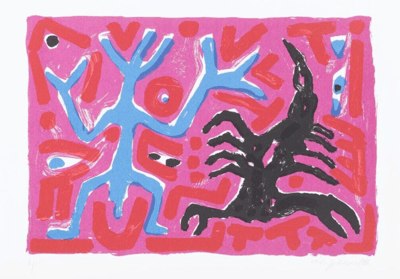
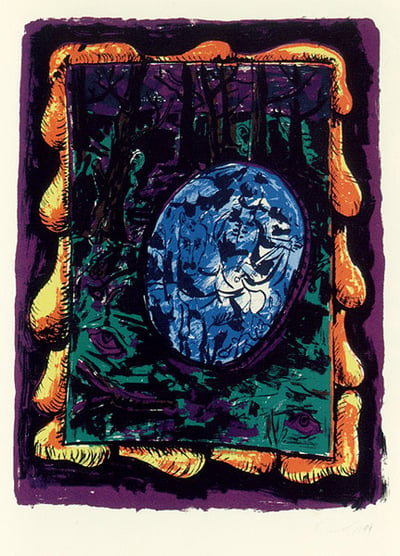
// A.R. Penck’s Homage to Beuys (1989) is a dynamic lithograph that combines bold forms and abstract symbols in a tribute to the influential German artist Joseph Beuys. The composition is dominated by strong black shapes against a vibrant red background, creating an intense visual rhythm that evokes themes of primal energy and artistic rebellion. Penck's use of recurring symbols—such as human figures, animals, and abstract markings—suggests a narrative that is both personal and universal, reflecting Beuys' impact on art and society. The raw, gestural quality of the lines and the chaotic arrangement of elements embody Penck’s expressionistic approach, inviting viewers to decipher meaning within the abstract forms. This piece exemplifies Penck’s distinctive style and his engagement with themes of identity, politics, and artistic legacy.
A.R. Penck (Germany, 1939–2017), born Ralf Winkler, was a neo-expressionist artist known for his bold, symbolic paintings and sculptures. His works often featured stick figures and graphic symbols, addressing themes of power, conflict, and humanity. Emerging from East Germany, Penck’s art became a defining voice of postwar European expressionism.
Lithograph Lithography is a printing method based on the principle that water and oil do not mix. It can be used to print artwork or text onto paper or other suitable materials. Traditionally, an image was drawn with wax, fat, or oil onto a lithographic limestone surface or plate. Today, metal plates and other surfaces are also used in lithographic printing.
// A.R. Penck’s Homage to Beuys (1989) is a dynamic lithograph that combines bold forms and abstract symbols in a tribute to the influential German artist Joseph Beuys. The composition is dominated by strong black shapes against a vibrant red background, creating an intense visual rhythm that evokes themes of primal energy and artistic rebellion. Penck's use of recurring symbols—such as human figures, animals, and abstract markings—suggests a narrative that is both personal and universal, reflecting Beuys' impact on art and society. The raw, gestural quality of the lines and the chaotic arrangement of elements embody Penck’s expressionistic approach, inviting viewers to decipher meaning within the abstract forms. This piece exemplifies Penck’s distinctive style and his engagement with themes of identity, politics, and artistic legacy.
A.R. Penck (Germany, 1939–2017), born Ralf Winkler, was a neo-expressionist artist known for his bold, symbolic paintings and sculptures. His works often featured stick figures and graphic symbols, addressing themes of power, conflict, and humanity. Emerging from East Germany, Penck’s art became a defining voice of postwar European expressionism.
What we have here is a true democratisation of art.
- A.R. Penck
A.R. Penck is a German sculptor, printmaker, painter and jazz percussionist. His early artistic education took place with other neo-expressionist painters in the city of Dresden, and he joined such figures as Georg Baselitz, Joerg Immendorff and Markus Luepertz, all of whom were considered as instigators of dissident by the East German government.
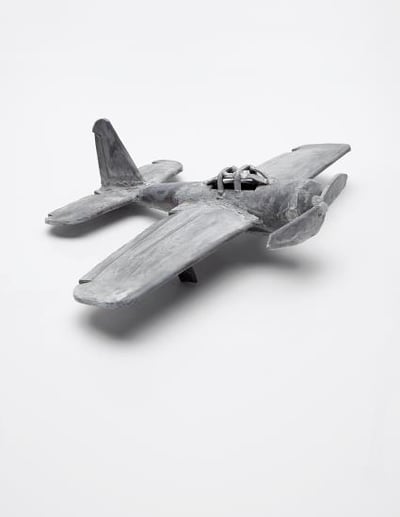
Their work appeared in several West Berlin shows in the 1970s, moving on to major galleries and museums in Western Europe in the 1980s, most famously in the "New Art" show at London's Tate Gallery in 1983. In the 1980s, A.R. Penck was known for paintings featuring human forms drawn with neo-primitivist design, including pictographic elements, human figures and other forms that appear on totems. His work continued to show up in many significant shows in New York City and London. A.R. Penck’s sculpture is less well known but expresses the same ideas as his drawings and paintings in terms of primitivism. His sculptures incorporate everyday materials such as cardboard, bottles, tin cans and wood, and they show crude assembly methods to evoke that primitive ambiance.
Neue Wilden is the term German artists used for Neo-Expressionism. In the 1970s and 80s, expressive painting re-emerged in Germany, with artists embracing intense colors and broad brushstrokes. The movement grew in opposition to minimal and conceptual art, favoring a return to raw, emotional expression through bold and dynamic painting techniques.