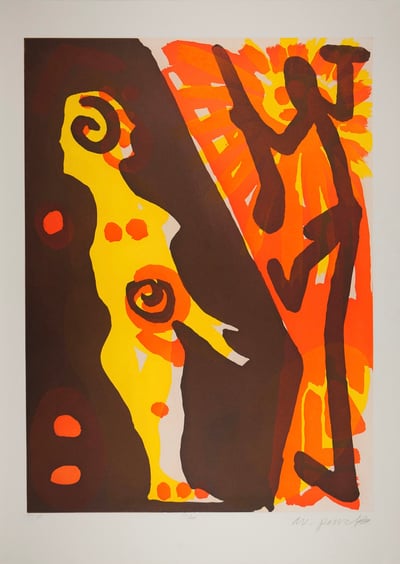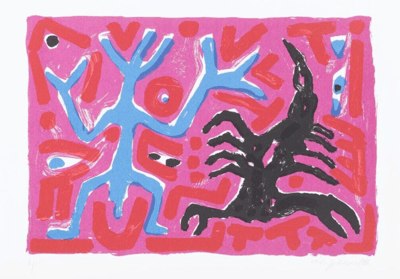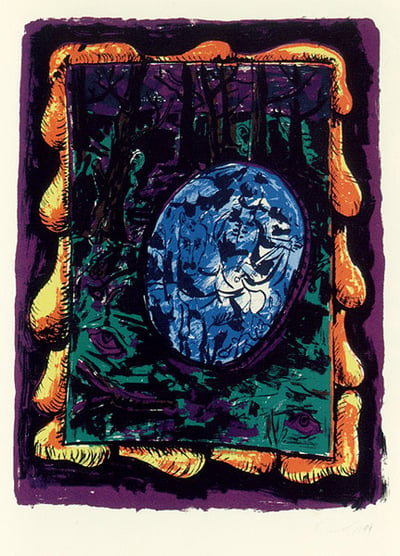
// Serie I Vergleich by A.R. Penck is an etching and aquatint print that showcases his distinct style of abstract figures and symbolic forms. This limited edition piece, with an edition size of 50, features a dynamic interplay of black silhouettes set against a vibrant backdrop of blue, yellow, and brown shapes. Penck’s work often explores themes of communication, conflict, and human relationships, rendered in a primitive yet profound visual language. In this piece, figures with exaggerated postures and gestures engage in what seems to be a dialogue or confrontation, hinting at a narrative about social interactions or existential comparisons. The layered colors and bold forms invite viewers to interpret the underlying messages within this compelling abstract composition.
A.R. Penck (Germany, 1939–2017), born Ralf Winkler, was a neo-expressionist artist known for his bold, symbolic paintings and sculptures. His works often featured stick figures and graphic symbols, addressing themes of power, conflict, and humanity. Emerging from East Germany, Penck’s art became a defining voice of postwar European expressionism.
Etching and AquatintEtching and aquatint are printmaking techniques. In aquatint, the printing plate is etched with a pattern of tiny pits and cracks to create a wide range of tonal gradations. This technique allows artists to replicate the broad, flat tones found in watercolor paintings and ink washes.
// Serie I Vergleich by A.R. Penck is an etching and aquatint print that showcases his distinct style of abstract figures and symbolic forms. This limited edition piece, with an edition size of 50, features a dynamic interplay of black silhouettes set against a vibrant backdrop of blue, yellow, and brown shapes. Penck’s work often explores themes of communication, conflict, and human relationships, rendered in a primitive yet profound visual language. In this piece, figures with exaggerated postures and gestures engage in what seems to be a dialogue or confrontation, hinting at a narrative about social interactions or existential comparisons. The layered colors and bold forms invite viewers to interpret the underlying messages within this compelling abstract composition.
A.R. Penck (Germany, 1939–2017), born Ralf Winkler, was a neo-expressionist artist known for his bold, symbolic paintings and sculptures. His works often featured stick figures and graphic symbols, addressing themes of power, conflict, and humanity. Emerging from East Germany, Penck’s art became a defining voice of postwar European expressionism.
What we have here is a true democratisation of art.
- A.R. Penck
A.R. Penck is a German sculptor, printmaker, painter and jazz percussionist. His early artistic education took place with other neo-expressionist painters in the city of Dresden, and he joined such figures as Georg Baselitz, Joerg Immendorff and Markus Luepertz, all of whom were considered as instigators of dissident by the East German government.
Their work appeared in several West Berlin shows in the 1970s, moving on to major galleries and museums in Western Europe in the 1980s, most famously in the "New Art" show at London's Tate Gallery in 1983. In the 1980s, A.R. Penck was known for paintings featuring human forms drawn with neo-primitivist design, including pictographic elements, human figures and other forms that appear on totems. His work continued to show up in many significant shows in New York City and London. A.R. Penck’s sculpture is less well known but expresses the same ideas as his drawings and paintings in terms of primitivism. His sculptures incorporate everyday materials such as cardboard, bottles, tin cans and wood, and they show crude assembly methods to evoke that primitive ambiance.
A Happening is a term used to describe artistic and theatrical events held by artists in the 1950s and 60s. These events were typically staged in gallery installations or planned environments and often involved audience participation, along with elements like lighting, sounds, and slide projections. Happenings were a precursor to performance art, which later included the active participation of the artists themselves.