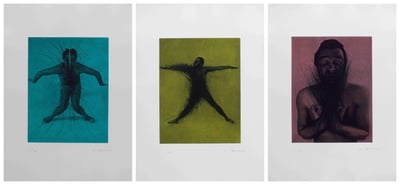
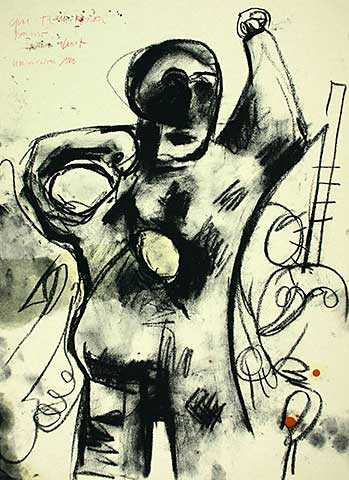
This photo etching on zinc, reworked with drypoint, measures 68 x 50 cm and belongs to a limited edition of 40. The composition features a dynamic figure, arms and legs outstretched in a cruciform stance, set against a vibrant green background. Chaotic black drypoint lines overlap the body, creating an intense sense of movement, energy, and abstraction. The facial profile of the figure, rendered in shadow, contrasts sharply with the expressive, frenzied marks that envelop the torso and limbs, evoking tension between control and release.
Body Pose III is part of Arnulf Rainer’s broader exploration of performative action and expressive distortion during the 1970s. By combining photography with etching techniques, Rainer transforms his own body into an artistic medium, blurring the line between performance art and traditional printmaking. The work reflects Rainer’s fascination with the physical form, psychological states, and the interplay of structure and chaos.
Arnulf Rainer (Austria, 1929) is a pioneering artist known for his abstract informal art. He co-founded the Hundsgruppe in 1950 and developed his signature 'overpaintings,' where he layered paint over existing images, exploring themes of creation and destruction. Rainer's work often delves into the subconscious, reflecting his interest in dreams and the mystical.
Mixed MediaMixed media refers to artwork that incorporates more than one medium within a single piece. Unlike multimedia art, which combines distinct forms of visual art and often includes elements like sound, video, or digital media, mixed media focuses on combining traditional art materials, such as paint, ink, and collage. Mixed media art allows artists to achieve a wide range of effects and textures by layering and blending different materials.
This photo etching on zinc, reworked with drypoint, measures 68 x 50 cm and belongs to a limited edition of 40. The composition features a dynamic figure, arms and legs outstretched in a cruciform stance, set against a vibrant green background. Chaotic black drypoint lines overlap the body, creating an intense sense of movement, energy, and abstraction. The facial profile of the figure, rendered in shadow, contrasts sharply with the expressive, frenzied marks that envelop the torso and limbs, evoking tension between control and release.
Body Pose III is part of Arnulf Rainer’s broader exploration of performative action and expressive distortion during the 1970s. By combining photography with etching techniques, Rainer transforms his own body into an artistic medium, blurring the line between performance art and traditional printmaking. The work reflects Rainer’s fascination with the physical form, psychological states, and the interplay of structure and chaos.
Arnulf Rainer (Austria, 1929) is a pioneering artist known for his abstract informal art. He co-founded the Hundsgruppe in 1950 and developed his signature 'overpaintings,' where he layered paint over existing images, exploring themes of creation and destruction. Rainer's work often delves into the subconscious, reflecting his interest in dreams and the mystical.
Only an 'almost,' a 'nearly,' is possible.
- Arnulf Rainer
Renowned for his abstractappropriation art, Arnulf Rainer is a painter and founder of the Hundgruppe (dog group) alongside fellow artists Brauer and Mikl. Rainer has recevied acclaim for his technique of ‘overpainting’ which involves him taking a pre-existing work, and painting over it, usually with gestural strokes and a heavy impasto; Wine Crucifix is one of his most notable ‘overpaintings’ - originally painted in 1957 by the artist, he decided to rework it in 1978 noting that the ‘quality and truth of the picture only grew as it became darker and darker’. Rainer was heavily inspired by the depths of the human mind and explored his own subconscious through painting with the technique of Automatism, popular among Surrealist painters – he also experimented with painting with his feet and fingers as well as exploring the effect of hallucinogenic drugs on his creativity.
Gestural art is a term that describes painting with freely sweeping brushstrokes. The primary goal of gestural art is to allow the artist to physically express emotional impulses. The varied, yet expressive paint marks are intended to convey the artist's inner thoughts and emotions, which viewers are believed to understand through the dynamic and spontaneous application of paint.