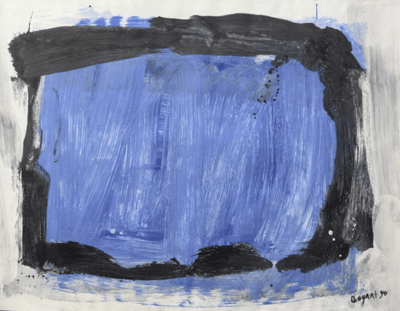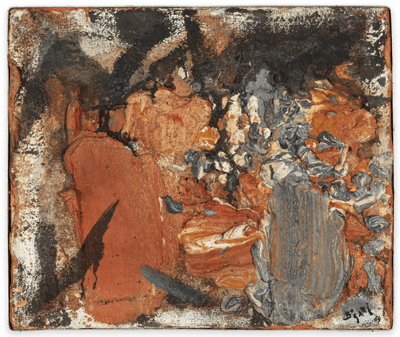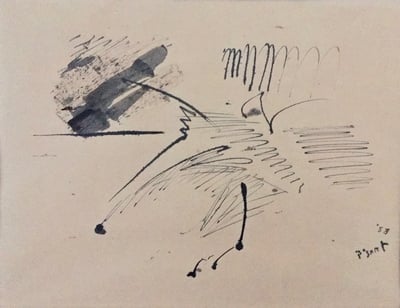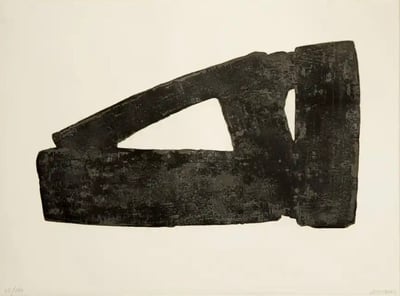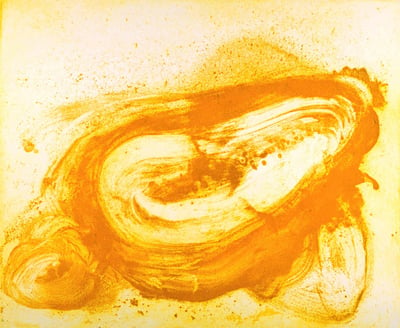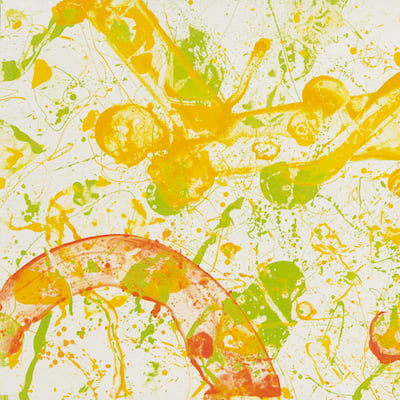
Bram Bogart (Belgium, 1921–2012) was an influential expressionist painter known for his bold impasto technique, creating textured, almost sculptural canvases. Associated with the CoBrA movement, his works often featured vibrant colors and abstract forms, emphasizing materiality and physical presence in art.
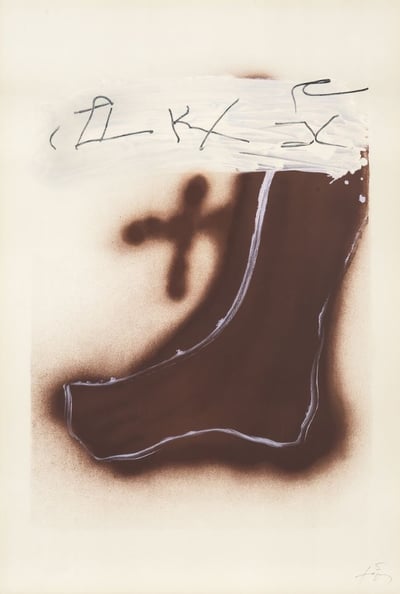
aquagravureAquagravure is a technique that combines multiple processes. It involves compressing wet paper pulp in a carved wood mold until the water drains off. The compressed paper is then painted, and ink is added to the mold to print onto the painted paper. The final work is allowed to dry. This method results in a unique textural and visual effect, blending elements of printmaking and papermaking.
Bram Bogart (Belgium, 1921–2012) was an influential expressionist painter known for his bold impasto technique, creating textured, almost sculptural canvases. Associated with the CoBrA movement, his works often featured vibrant colors and abstract forms, emphasizing materiality and physical presence in art.
Bram Bogart was a Belgian painter, who was most closely associated with the abstract expressionist movement. He attended a technical school in the Netherlands, where he trained for a career as a decorator, while simultaneously taking a correspondence class in drawing. Bram Bogart launched his professional career by assuming an advertising position in Rotterdam. After World War II he settled in Paris, France and became one of the founders of Art Informel. Bogart used an array of materials throughout his artistic career. He had a genuine interest in the material possibilities of painting. In fact, the bulk of his work lies in composition and texture. Early in Bram Bogart’s profession, he experimented with figurative drawing and cubism. During this time he would focus on depicting flowers, still life paintings, and self-portraits. Later, in the 1950s, Bram Bogart shifted his focus to working with impasto. Bogart would use thick layers of boldly applied, vibrant paint colors in his pieces. The technique he implemented was based on using a brush, a trowel, and a painter’s knife to move rhythmically above a canvas that would be lying on the floor and could weigh up to several hundred pounds. Consequently, he developed an expressionist style that became more abstract as time passed. In the 1960’s, Bogart broadened his style by exploring the use of a more predominant three-dimensional material. He would create a mixture of several elements that included varnish, mortar, powdered chalk, and raw pigment. Bogart would then apply the mixture to large structures with wooden backing. Overall, this created a very impressive effect. Bram Bogart was without question, an extremely unique and gifted artist.
Tachisme is a French abstract painting style that gained popularity between 1940 and 1950, often seen as the European counterpart to Abstract Expressionism. However, there are stylistic differences between the two. Tachisme, which emerged from Art Informel, rejected geometric abstraction in favor of more intuitive and spontaneous expression. It was a reaction against the structured forms of Cubism and is closely related to Informalism. Tachisme emphasizes gestural brushwork, irregular forms, and a focus on the process of painting itself.