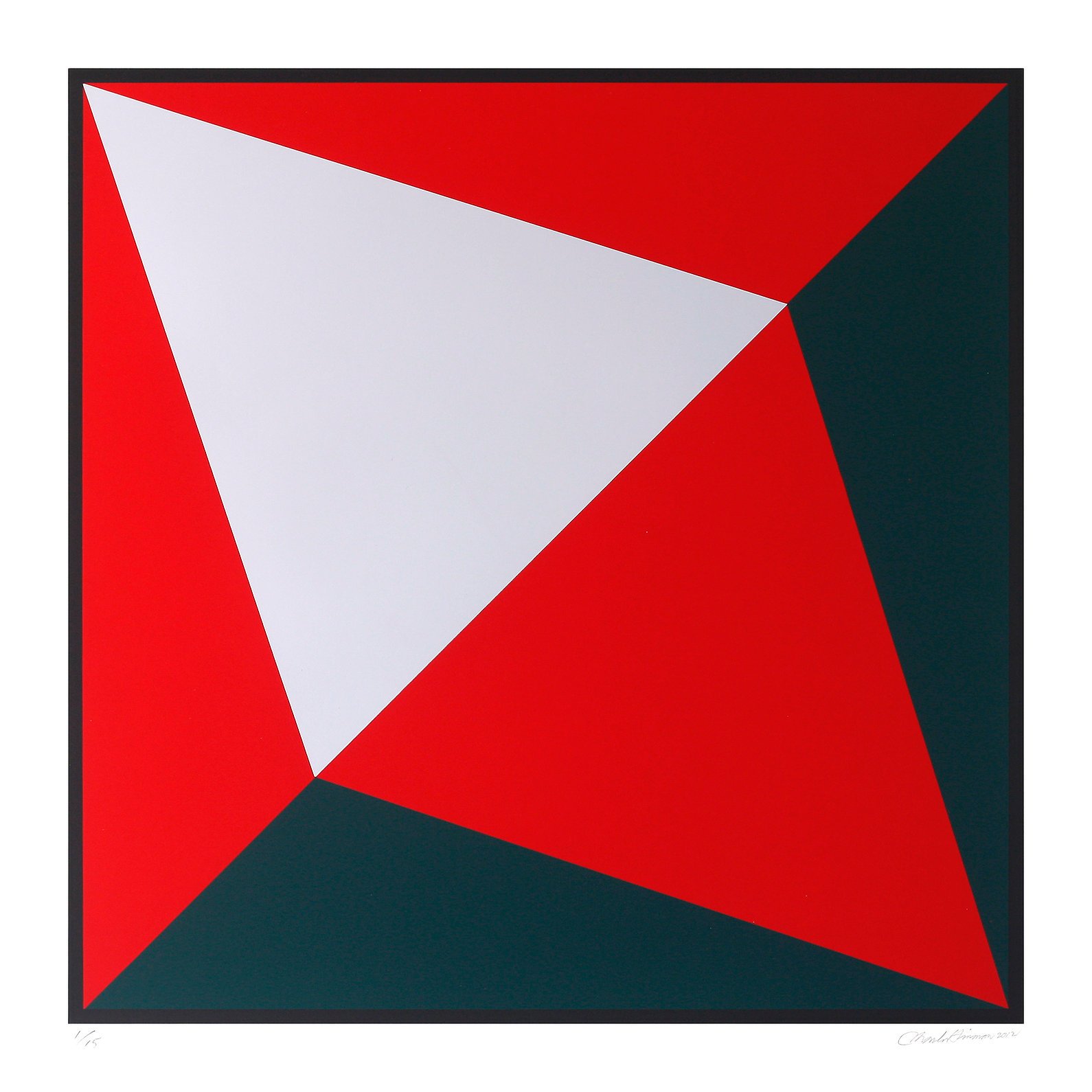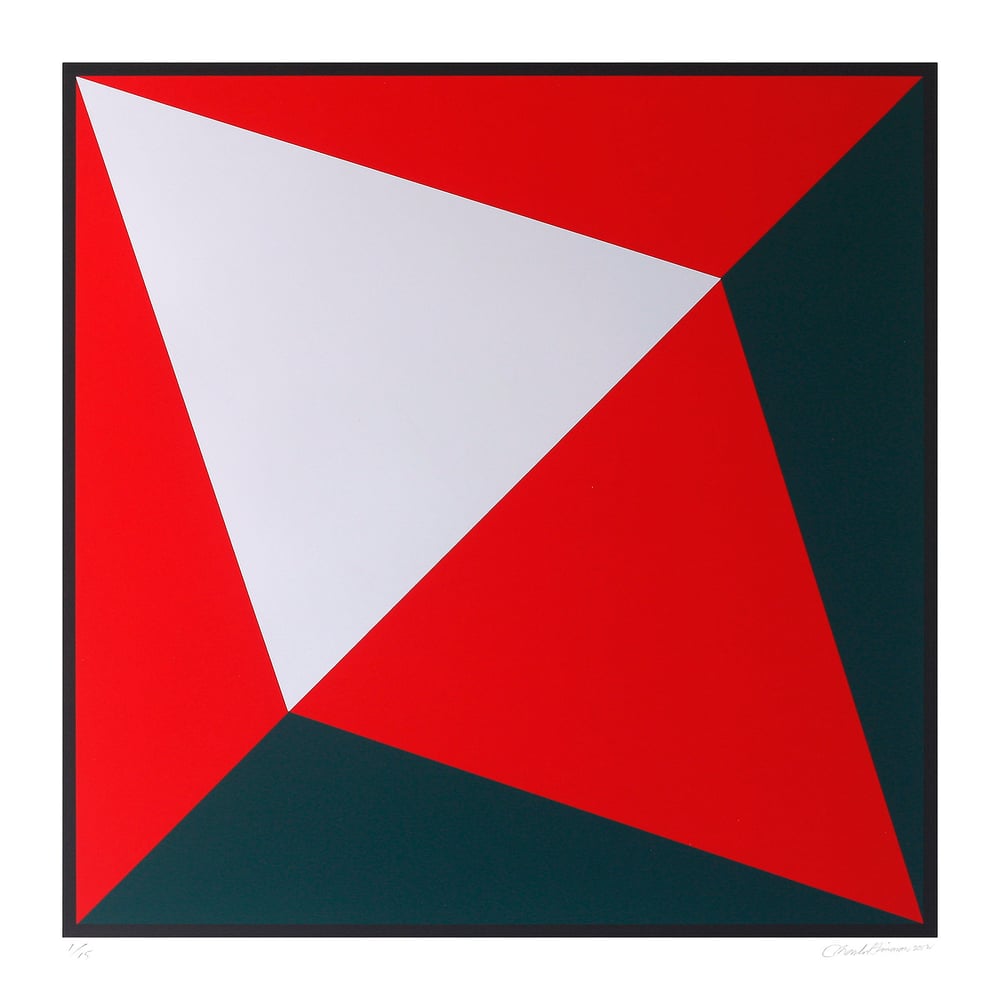
Charles Hinman’s Lavender Triangle is a vibrant silkscreen print that explores geometric abstraction through bold shapes and striking color contrasts. Printed on 290-gram Coventry Rag paper, the composition centers around a triangular form in white, which is sharply juxtaposed against surrounding red and dark green shapes. The precise alignment of these colors and shapes creates a dynamic sense of depth and movement within the square frame. Hinman’s minimalist approach, combined with his use of bold colors, invites viewers to engage with the spatial relationships and visual tension between the forms.
Charles Hinman (United States, 1932–2026) was an American abstract minimalist painter renowned for pioneering three-dimensional shaped canvases in the mid-1960s. His innovative works merged painting and sculpture, using geometric forms and vibrant colors to create dynamic visual experiences. Hinman's art challenged traditional boundaries and influenced the development of contemporary abstract art.
Silkscreen Silkscreen is a printmaking method that uses a screen made of silk or other mesh fabric. The screen is treated with a substance that blocks ink in certain areas, allowing ink to pass through only in the desired sections. Each color in the print requires a separate screen.
Charles Hinman’s Lavender Triangle is a vibrant silkscreen print that explores geometric abstraction through bold shapes and striking color contrasts. Printed on 290-gram Coventry Rag paper, the composition centers around a triangular form in white, which is sharply juxtaposed against surrounding red and dark green shapes. The precise alignment of these colors and shapes creates a dynamic sense of depth and movement within the square frame. Hinman’s minimalist approach, combined with his use of bold colors, invites viewers to engage with the spatial relationships and visual tension between the forms.
Charles Hinman (United States, 1932–2026) was an American abstract minimalist painter renowned for pioneering three-dimensional shaped canvases in the mid-1960s. His innovative works merged painting and sculpture, using geometric forms and vibrant colors to create dynamic visual experiences. Hinman's art challenged traditional boundaries and influenced the development of contemporary abstract art.
I think of my paintings as occupying a 6-dimensional space: the three dimensions of space, one each of time, light, and color.
- Charles Hinman
Charles Hinman’s art expanded the concept of the shaped canvas in the 1960s. He freed his works from the physical confines of the traditional canvas by allowing them to extend beyond the wall, creating a fusion of sculpture and painting.
Hinman’s series developed from the more organic forms of his earliest work into a more geometric style, and later into complex, leaf-like pieces in the 1980s. The influence of Russian Suprematism is notable, while his more recent works focused on light and color in a more minimalist style.
In the early 1960s, Charles Hinman lived and worked in Lower Manhattan, where he formed a small artists’ community with several other promising young artists. This group was not part of a cohesive movement, but sought to distinguish its work from the Abstract Expressionism of the era.
His Eclipse series (2010) of shaped paintings featured color concealed behind black and white canvases. Many critics considered the Gem series (2010–2011), with its complex triangular forms, to be among his most interesting works.
Hinman described his work as “dynamic... occupying a six-dimensional space.” His practice focused on the viewer’s perception, altering the appearance of volume depending on perspective.
Geometric abstraction is a form of abstract art that uses geometric shapes arranged in a non-illusionistic space (though not always) and combined into non-representational (non-objective) compositions. Based on years of artistic research, some artists have proposed that geometric abstraction offers a solution to modern challenges by rejecting traditional illusionistic practices in favor of clarity and simplicity.