Color photogravure with spit bite aquatint and aquatint
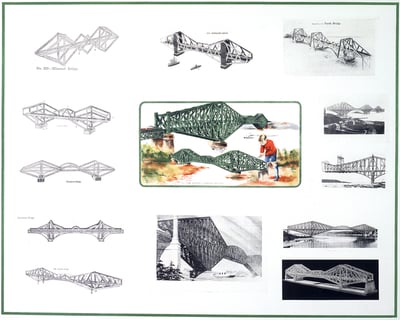
Cantilever Bridges by Chris Burden, created in 2000, is a limited edition aquatint print that explores the structural elegance and engineering marvel of cantilever bridges. The artwork features a series of technical illustrations and detailed renderings of various cantilever bridge designs, highlighting the diversity in their forms and functions. At the center of the composition is a colored image of a prominent cantilever bridge with a figure observing it, adding a human scale to the monumental structure. The combination of black-and-white technical drawings with the central color element creates a sense of contrast, emphasizing the complexity and artistry involved in bridge design. Burden’s work often delves into themes of engineering and human ingenuity, and this piece captures the beauty and ambition of infrastructure.
Chris Burden (USA, 1946–2015) was a groundbreaking performance and conceptual artist known for works that pushed physical and psychological limits. Famous pieces like Shoot (1971) and Trans-Fixed (1974) explored themes of danger, endurance, and societal boundaries. Later in his career, Burden created large-scale installations and sculptures, blending engineering with artistic innovation.
aquatintIntaglio is a printmaking technique where the artist creates marks on a metal plate that hold ink or dye. The inked plate is then pressed onto paper, transferring the ink to the sheet. This process can be repeated multiple times depending on the technique. Intaglio methods, such as etching, often involve applying a mordant (acid) to the metal plate to create the design. Intaglio encompasses various techniques, including engraving, etching, and drypoint.
Color photogravure with spit bite aquatint and aquatint
Cantilever Bridges by Chris Burden, created in 2000, is a limited edition aquatint print that explores the structural elegance and engineering marvel of cantilever bridges. The artwork features a series of technical illustrations and detailed renderings of various cantilever bridge designs, highlighting the diversity in their forms and functions. At the center of the composition is a colored image of a prominent cantilever bridge with a figure observing it, adding a human scale to the monumental structure. The combination of black-and-white technical drawings with the central color element creates a sense of contrast, emphasizing the complexity and artistry involved in bridge design. Burden’s work often delves into themes of engineering and human ingenuity, and this piece captures the beauty and ambition of infrastructure.
Chris Burden (USA, 1946–2015) was a groundbreaking performance and conceptual artist known for works that pushed physical and psychological limits. Famous pieces like Shoot (1971) and Trans-Fixed (1974) explored themes of danger, endurance, and societal boundaries. Later in his career, Burden created large-scale installations and sculptures, blending engineering with artistic innovation.
“Limits” is a relative term. Like beauty, it is often in the eye of the beholder.
- Chris Burden
Chris Burden (b. 1946 USA, d. 2015 USA) was an influential American artist known for his provocative and often extreme performance art. Burden's work challenged the boundaries of art and life, using his body as a medium to explore themes of pain, endurance, and the role of the artist in society. His most famous piece, Shoot (1971), involved being shot in the arm by an assistant, a performance that epitomized his commitment to pushing the limits of physical and psychological experience. Beyond performance, Burden also created large-scale sculptures and installations that addressed issues such as power, technology, and the urban environment. His work has left an indelible mark on contemporary art, inspiring future generations to rethink the possibilities of art as a form of social commentary.
Postmodernism is an art movement that emerged as a reaction against authority and traditional boundaries, seeking to blur the lines between art and everyday life. It aimed to bridge the gap between the cultural elite and the general public by embracing eclectic mixtures of earlier conventions and styles. Postmodernist art often challenges established norms and celebrates diversity, irony, and pastiche, making it a movement that reflects the complexities of contemporary culture.