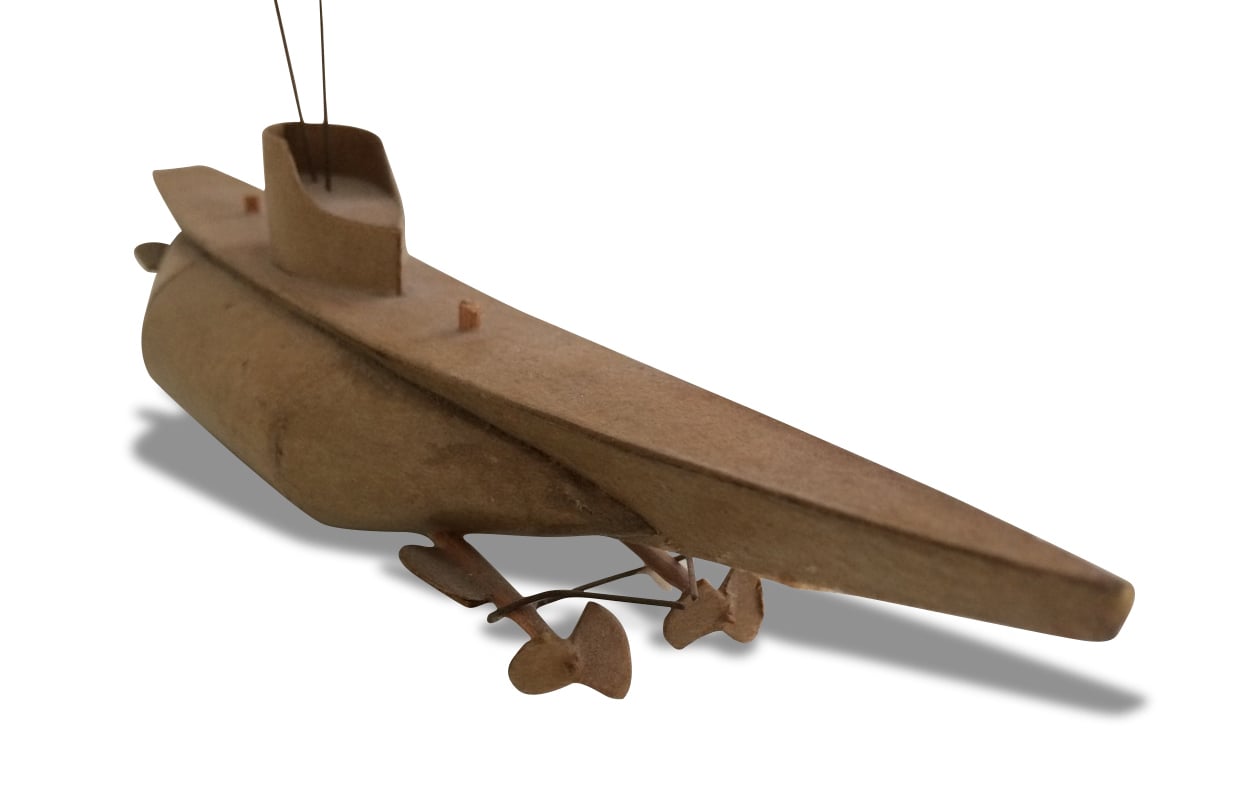
From All The Submarines Of The Unites States Of America. Cardboard and metal
Submarine by Chris Burden is a mixed-media sculpture created in 1987 as part of his series All The Submarines of the United States of America. Constructed from cardboard and metal, this model is a minimalist representation of a submarine, capturing its essential form with raw materials. The piece embodies Burden's exploration of themes such as military power and the hidden, often ominous presence of underwater vessels. The sculpture's simplicity emphasizes the anonymity and ubiquity of submarines, making a subtle commentary on the covert nature of naval operations. Its modest size and unadorned construction evoke both fragility and functionality, drawing attention to the inconspicuous yet impactful role submarines play in military contexts.
Artwork Copyright © Chris BurdenChris Burden (USA, 1946–2015) was a groundbreaking performance and conceptual artist known for works that pushed physical and psychological limits. Famous pieces like Shoot (1971) and Trans-Fixed (1974) explored themes of danger, endurance, and societal boundaries. Later in his career, Burden created large-scale installations and sculptures, blending engineering with artistic innovation.
Artwork Copyright © Chris BurdenSubmarine, 1987
Form
Medium
Size
- Inches
- Centimeters
Price
- USD
- EUR
- GBP
- CHF
- Authenticity Guaranteed
- Insured Shipping
- Online Since 2005
●Inventory 4533
●Not signed
●Comes with gallery invoice and certificate
●Sell Us a Similar Artwork. Learn more.
From All The Submarines Of The Unites States Of America. Cardboard and metal
Submarine by Chris Burden is a mixed-media sculpture created in 1987 as part of his series All The Submarines of the United States of America. Constructed from cardboard and metal, this model is a minimalist representation of a submarine, capturing its essential form with raw materials. The piece embodies Burden's exploration of themes such as military power and the hidden, often ominous presence of underwater vessels. The sculpture's simplicity emphasizes the anonymity and ubiquity of submarines, making a subtle commentary on the covert nature of naval operations. Its modest size and unadorned construction evoke both fragility and functionality, drawing attention to the inconspicuous yet impactful role submarines play in military contexts.
Artwork Copyright © Chris BurdenChris Burden (USA, 1946–2015) was a groundbreaking performance and conceptual artist known for works that pushed physical and psychological limits. Famous pieces like Shoot (1971) and Trans-Fixed (1974) explored themes of danger, endurance, and societal boundaries. Later in his career, Burden created large-scale installations and sculptures, blending engineering with artistic innovation.
Artwork Copyright © Chris Burden- Recently Added
- Price (Low-High)
- Price (High-Low)
- Year (Low-High)
- Year (High-Low)

Chris Burden
If You Fly, If You Drive (diptych), 1973
Limited Edition Print
Lithograph
USD 12,500

Chris Burden
Can not do nails, 1974
Photography
Lithograph
USD 11,300

Chris Burden
Submarine, 1987
Sculpture / Object
Mixed Media
USD 4,850
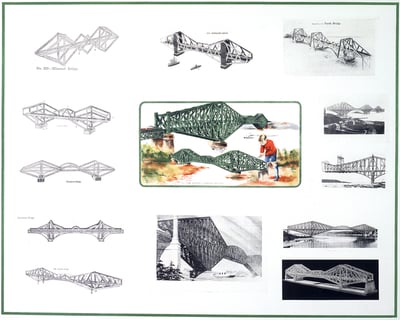
Chris Burden
Cantilever Bridges, 2000
Limited Edition Print
Aquatint
Currently Not Available
Related Artists


Artwork by Louise Bourgeois
What is Postmodernism?
Postmodernism is an art movement that emerged as a reaction against authority and traditional boundaries, seeking to blur the lines between art and everyday life. It aimed to bridge the gap between the cultural elite and the general public by embracing eclectic mixtures of earlier conventions and styles. Postmodernist art often challenges established norms and celebrates diversity, irony, and pastiche, making it a movement that reflects the complexities of contemporary culture.