Photographic print (C-print) on paper
- Unsigned, Unnumbered
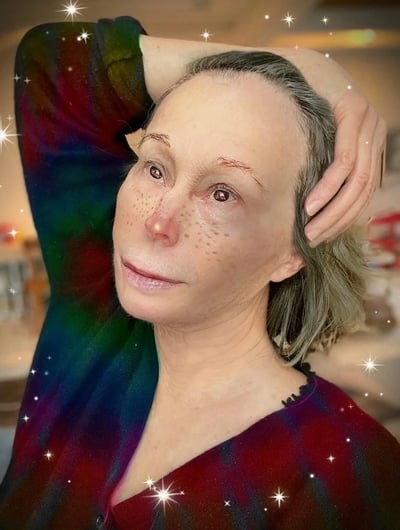
Cindy Sherman’s Untitled (Twinkle-Nose) (2021) is a captivating C-print photograph that reflects her ongoing exploration of identity and self-transformation through digital manipulation. In this image, Sherman appears as a figure with exaggerated and slightly surreal features, including an elongated nose, wide-set eyes, and subtle freckles. Her hand is posed dramatically behind her head, and the image is adorned with digital twinkling stars that add a whimsical, almost ethereal quality to the scene. The composition plays with the boundaries between reality and fantasy, as Sherman alters her appearance through filters and editing techniques. This work continues Sherman’s career-long investigation into the fluidity of identity and the ways in which images, especially in the digital age, can be manipulated to create new personas. Despite the fantastical elements, the figure retains a contemplative expression, highlighting Sherman’s ability to balance artifice with psychological depth.
Cindy Sherman (USA, 1954) is a contemporary artist celebrated for her transformative self-portraits that challenge societal norms. Her iconic series, 'Untitled Film Stills' (1977–1980), features 70 black-and-white photographs exploring female archetypes in cinema. Sherman's work critiques identity, gender, and representation, earning her global acclaim and exhibitions in major museums like MoMA and Tate.
C-PrintA C-type print, also known as a chromogenic print, is a photographic print made from a color negative or slide. The print is created on chromogenic paper, which contains three emulsion layers, each sensitized to a different primary color. After exposure, the paper is processed in a series of chemical baths, where each layer reacts to the chemicals to produce the final image. C-type prints are known for their rich color depth and are widely used in fine art and commercial photography.
Photographic print (C-print) on paper
- Unsigned, Unnumbered
Cindy Sherman’s Untitled (Twinkle-Nose) (2021) is a captivating C-print photograph that reflects her ongoing exploration of identity and self-transformation through digital manipulation. In this image, Sherman appears as a figure with exaggerated and slightly surreal features, including an elongated nose, wide-set eyes, and subtle freckles. Her hand is posed dramatically behind her head, and the image is adorned with digital twinkling stars that add a whimsical, almost ethereal quality to the scene. The composition plays with the boundaries between reality and fantasy, as Sherman alters her appearance through filters and editing techniques. This work continues Sherman’s career-long investigation into the fluidity of identity and the ways in which images, especially in the digital age, can be manipulated to create new personas. Despite the fantastical elements, the figure retains a contemplative expression, highlighting Sherman’s ability to balance artifice with psychological depth.
Cindy Sherman (USA, 1954) is a contemporary artist celebrated for her transformative self-portraits that challenge societal norms. Her iconic series, 'Untitled Film Stills' (1977–1980), features 70 black-and-white photographs exploring female archetypes in cinema. Sherman's work critiques identity, gender, and representation, earning her global acclaim and exhibitions in major museums like MoMA and Tate.
I didn't have any interest in traditional art.
- Cindy Sherman
Cindy Sherman is a contemporary New York photographer who is one of the leading exponents of the "Pictures Generation", an artistic movement which emerged in the early 1980s. Described as 'socially critical photography', her work is a highly intimate exploration of the modern female persona, self identity, gender and class. Cindy Sherman first gained fame with her Untitled Film Stills black and white collection dated 1976-1980. An extraordinary series of self-portraiture in which she features as a variety of characters in evocative cinematic scenes. The photos portray heroines of film noir, horror and psychological drama genres to produce a haunting study of the female gaze. In 1995 the Museum of Modern Art bought all 69 stills for a reported amount of $1 million. Mainly working alone in her New York studio, Cindy Sherman’s work has evolved over the decades to include visual forms such as the centerfold, historical portrait, fantasy, myth, as well as a series involving prosthetics and mannequins in sexualized positions. Cindy Sherman’s influences include film, popular culture, the nature of representation, and the 1950s television shows she grew up watching. These influences permeate her work which she infuses with elements of the grotesque, macabre, disturbing, and confronting. Initially trained as a fine artist, Cindy Sherman moved into photography because of its immediacy and so she could concentrate on conceptualization. Her work has moved from black and white to colour prints, large-scale photography, digital photography, and she directed her first film Office Killer in 1997. The Museum of Modern Art held a retrospective of Sherman's work in 2012 featuring over 170 works tracing the major themes of her career. She remains an important social commentator, with her subject matter of the representation of the self and contemporary identity issues being more relevant today than ever.
The Uncanny is a concept described by psychologist Sigmund Freud as the eerie or unsettling feeling that arises when something familiar is presented in a strange or unfamiliar way. Surrealist artists, who aimed to reveal the subconscious and merge it with reality, often utilized this concept by combining familiar objects in unexpected and bizarre ways. This approach created a sense of discomfort or unease, challenging the viewer's perception of reality.