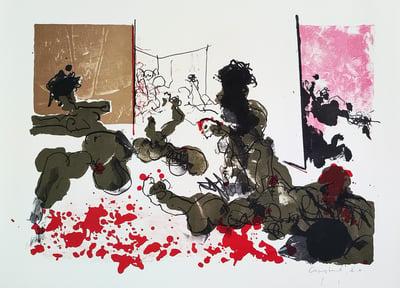
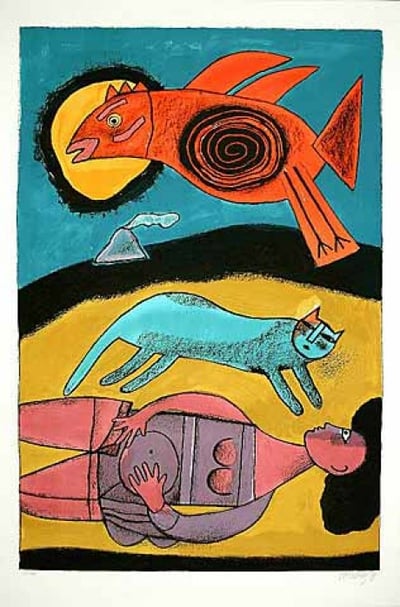
// Le Massacre by Constant Nieuwenhuys, a 1972 lithograph, is a powerful and dynamic composition that captures the chaotic and violent intensity suggested by its title. The work, measuring 57 x 77.5 cm, uses an expressive and gestural style to depict fragmented figures amidst splashes of deep red, evoking a sense of turmoil and conflict. The rough, overlapping lines and splattered forms create a sense of movement, suggesting a chaotic battle or massacre scene. This limited edition print, produced in a run of 350 copies plus artist proofs, showcases Constant’s critical view on humanity and his engagement with themes of violence and social unrest.
Constant Nieuwenhuys (Netherlands, 1920–2005), known as Constant, was a visionary artist and co-founder of the CoBrA movement. His work evolved from vibrant abstract expressionism to the utopian 'New Babylon' project, envisioning a society shaped by creativity and play. Constant’s innovative ideas and artistic contributions made him a central figure in post-war European art.
Lithograph Lithography is a printing method based on the principle that water and oil do not mix. It can be used to print artwork or text onto paper or other suitable materials. Traditionally, an image was drawn with wax, fat, or oil onto a lithographic limestone surface or plate. Today, metal plates and other surfaces are also used in lithographic printing.
// Le Massacre by Constant Nieuwenhuys, a 1972 lithograph, is a powerful and dynamic composition that captures the chaotic and violent intensity suggested by its title. The work, measuring 57 x 77.5 cm, uses an expressive and gestural style to depict fragmented figures amidst splashes of deep red, evoking a sense of turmoil and conflict. The rough, overlapping lines and splattered forms create a sense of movement, suggesting a chaotic battle or massacre scene. This limited edition print, produced in a run of 350 copies plus artist proofs, showcases Constant’s critical view on humanity and his engagement with themes of violence and social unrest.
Constant Nieuwenhuys (Netherlands, 1920–2005), known as Constant, was a visionary artist and co-founder of the CoBrA movement. His work evolved from vibrant abstract expressionism to the utopian 'New Babylon' project, envisioning a society shaped by creativity and play. Constant’s innovative ideas and artistic contributions made him a central figure in post-war European art.
A painting is not a structure of colours and lines, but an animal, a night, a cry, a man, or all of these together.
- Constant Nieuwenhuys
Born in Amsterdam, musician, painter, sculptor, author and graphic artist Constant Nieuwenhuys painted at the age of 16 his first oil painting. Throughout Constant's life, he later became the recipient of 7 awards due to his works. While he showed a key interest in oil paints and canvases starting from a young age, Constant Nieuwenhuys had, at a certain period, resorted to painting upon bed sheets and tablecloths while in hiding from the Nazis. With no better word to describe his style aside from the obvious abstract, Constant's art was experimental. He believed art to be fleeting and sought it to be ever-changing. After having already established a name for himself by the age of 32, Constant Nieuwenhuys received a scholarship to study for three months in London, complimenting his former education at the State Academy of Fine Arts in his home country. With the help of Asger Jorn, Constant Nieuwenhuys founded the CoBrA art movement, consisting of an experimental art-form known as avant-garde.
Avant-garde refers to innovative and experimental ideas in the arts that challenge established norms and conventions. Originating from the French term for advance guard, it describes both the movement and the artists who push the boundaries of creativity, often exploring new techniques, forms, and concepts. The avant-garde has been a driving force in various art movements throughout history, such as Dadaism, Surrealism, and Abstract Expressionism, continually reshaping the landscape of art and culture.