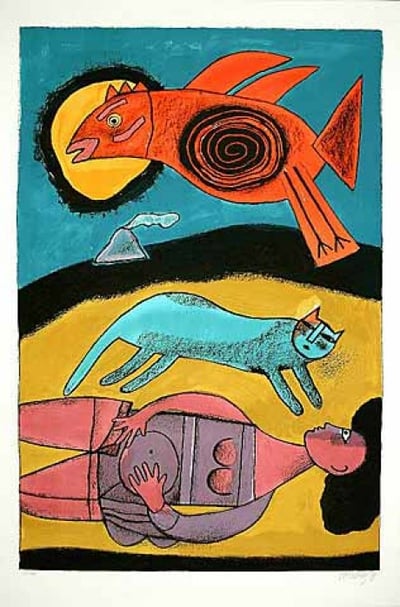
Hand signed right below; paper size: 64 x 70 cm.
framed: 93 x 100 cm.; literature: "Constant, Grafiek", by Trudy van der Horst, Waanders Publishers, page's 156 and 157
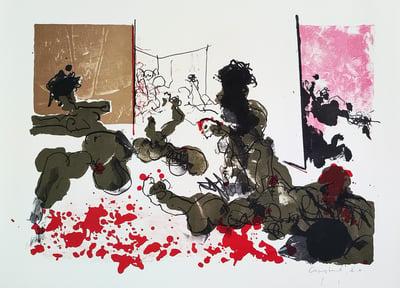
L'ultima cena by Constant Nieuwenhuys, created in 1980, is a limited-edition print that uses etching and aquatint techniques to reimagine the iconic Last Supper scene in a distinctly modern and abstract manner. The composition features elongated, almost spectral figures in a dimly lit, angular room dominated by earthy and red hues. A single overhead light casts a dramatic glow, focusing attention on the central figures while creating deep shadows along the walls. The scene feels both intimate and unsettling, capturing an atmosphere of existential reflection. This reinterpretation by Nieuwenhuys challenges traditional religious iconography, presenting the Last Supper as a gathering of ambiguous forms that invite contemplation on human presence and absence.
Constant Nieuwenhuys (Netherlands, 1920–2005), known as Constant, was a visionary artist and co-founder of the CoBrA movement. His work evolved from vibrant abstract expressionism to the utopian 'New Babylon' project, envisioning a society shaped by creativity and play. Constant’s innovative ideas and artistic contributions made him a central figure in post-war European art.
Etching and AquatintEtching and aquatint are printmaking techniques. In aquatint, the printing plate is etched with a pattern of tiny pits and cracks to create a wide range of tonal gradations. This technique allows artists to replicate the broad, flat tones found in watercolor paintings and ink washes.
Hand signed right below; paper size: 64 x 70 cm.
framed: 93 x 100 cm.; literature: "Constant, Grafiek", by Trudy van der Horst, Waanders Publishers, page's 156 and 157
L'ultima cena by Constant Nieuwenhuys, created in 1980, is a limited-edition print that uses etching and aquatint techniques to reimagine the iconic Last Supper scene in a distinctly modern and abstract manner. The composition features elongated, almost spectral figures in a dimly lit, angular room dominated by earthy and red hues. A single overhead light casts a dramatic glow, focusing attention on the central figures while creating deep shadows along the walls. The scene feels both intimate and unsettling, capturing an atmosphere of existential reflection. This reinterpretation by Nieuwenhuys challenges traditional religious iconography, presenting the Last Supper as a gathering of ambiguous forms that invite contemplation on human presence and absence.
Constant Nieuwenhuys (Netherlands, 1920–2005), known as Constant, was a visionary artist and co-founder of the CoBrA movement. His work evolved from vibrant abstract expressionism to the utopian 'New Babylon' project, envisioning a society shaped by creativity and play. Constant’s innovative ideas and artistic contributions made him a central figure in post-war European art.
A painting is not a structure of colours and lines, but an animal, a night, a cry, a man, or all of these together.
- Constant Nieuwenhuys
Born in Amsterdam, musician, painter, sculptor, author and graphic artist Constant Nieuwenhuys painted at the age of 16 his first oil painting. Throughout Constant's life, he later became the recipient of 7 awards due to his works. While he showed a key interest in oil paints and canvases starting from a young age, Constant Nieuwenhuys had, at a certain period, resorted to painting upon bed sheets and tablecloths while in hiding from the Nazis. With no better word to describe his style aside from the obvious abstract, Constant's art was experimental. He believed art to be fleeting and sought it to be ever-changing. After having already established a name for himself by the age of 32, Constant Nieuwenhuys received a scholarship to study for three months in London, complimenting his former education at the State Academy of Fine Arts in his home country. With the help of Asger Jorn, Constant Nieuwenhuys founded the CoBrA art movement, consisting of an experimental art-form known as avant-garde.
Avant-garde refers to innovative and experimental ideas in the arts that challenge established norms and conventions. Originating from the French term for advance guard, it describes both the movement and the artists who push the boundaries of creativity, often exploring new techniques, forms, and concepts. The avant-garde has been a driving force in various art movements throughout history, such as Dadaism, Surrealism, and Abstract Expressionism, continually reshaping the landscape of art and culture.