

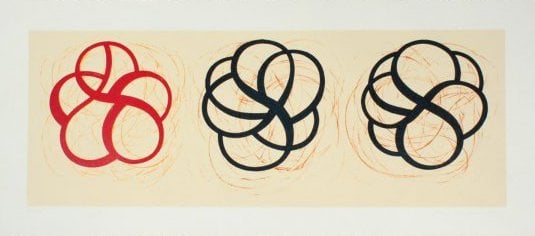
Untitled, (red, black, black), color lithograph, pencil signed and dated '99, marked PP 1, back stamped "Cirrus Editions, Ltd, 1999" and marked 5906-CK99 verso. Unframed, loose, 17" x 45" image on 23" x 51" sheet. There is one small area about 2" of minor creases on the edge, other than that the print is perfect, like it was just printed.
Red, Black, Black by Craig Kauffman is a vibrant lithograph created in 1999, exemplifying Kauffman's exploration of form and color through minimalistic, looping shapes. This print, marked as a Print Proof (PP 1) and signed by the artist, features three interlocking circular designs arranged in a horizontal sequence. The composition progresses from a red outline on the left to two black variations, each shape overlapping to create intricate patterns reminiscent of organic forms or abstracted floral shapes. The dynamic repetition and variation of the forms invite viewers to consider the relationship between color and shape. The piece measures 43 cm by 114.3 cm, showcasing Kauffman's affinity for clean lines and his influence from California's minimalist art movements.
Artwork Copyright © Craig KauffmanCraig Kauffman (USA, 1932–2010) was a pioneering artist of the Light and Space movement. Renowned for his acrylic wall reliefs, he used industrial materials to create luminous, abstract works that explored perception and spatial experience. His art is held in prominent collections, including MoMA and Tate Modern.
Artwork Copyright © Craig KauffmanRed, Black, Black, 1999
Form
Medium
Size
- Inches
- Centimeters
Edition
Price
- USD
- EUR
- GBP
- CHF
- Authenticity Guaranteed
- Insured Shipping
- Online Since 2005
●Inventory 5365
●Signed
●Comes with gallery invoice and certificate
●Sell Us a Similar Artwork. Learn more.
Untitled, (red, black, black), color lithograph, pencil signed and dated '99, marked PP 1, back stamped "Cirrus Editions, Ltd, 1999" and marked 5906-CK99 verso. Unframed, loose, 17" x 45" image on 23" x 51" sheet. There is one small area about 2" of minor creases on the edge, other than that the print is perfect, like it was just printed.
Red, Black, Black by Craig Kauffman is a vibrant lithograph created in 1999, exemplifying Kauffman's exploration of form and color through minimalistic, looping shapes. This print, marked as a Print Proof (PP 1) and signed by the artist, features three interlocking circular designs arranged in a horizontal sequence. The composition progresses from a red outline on the left to two black variations, each shape overlapping to create intricate patterns reminiscent of organic forms or abstracted floral shapes. The dynamic repetition and variation of the forms invite viewers to consider the relationship between color and shape. The piece measures 43 cm by 114.3 cm, showcasing Kauffman's affinity for clean lines and his influence from California's minimalist art movements.
Artwork Copyright © Craig KauffmanCraig Kauffman (USA, 1932–2010) was a pioneering artist of the Light and Space movement. Renowned for his acrylic wall reliefs, he used industrial materials to create luminous, abstract works that explored perception and spatial experience. His art is held in prominent collections, including MoMA and Tate Modern.
Artwork Copyright © Craig Kauffman- Recently Added
- Price (Low-High)
- Price (High-Low)
- Year (Low-High)
- Year (High-Low)
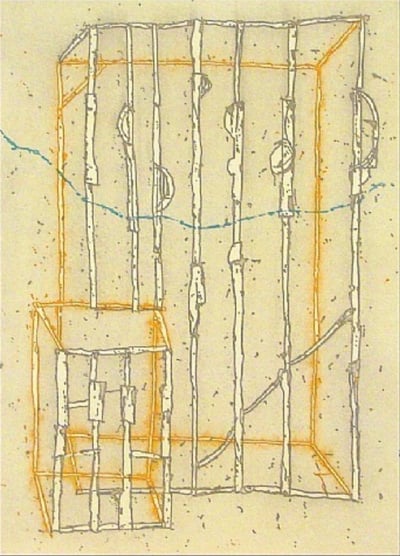
Craig Kauffman
Untitled, #2, 1988
Limited Edition Print
Etching
USD 1,800

Craig Kauffman
Red, Black, Black, 1999
Limited Edition Print
Lithograph
USD 2,200
Related Artists
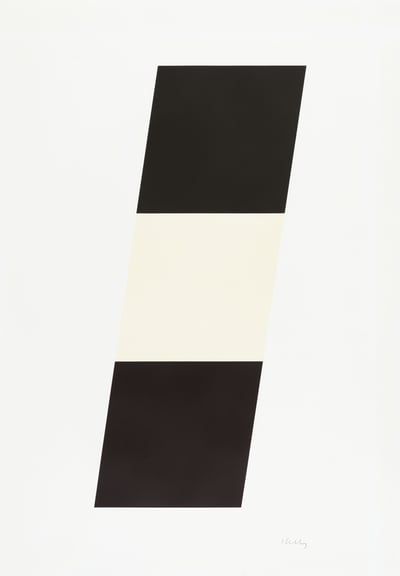

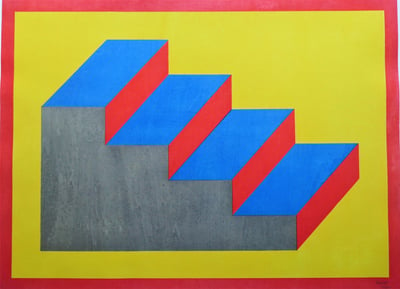

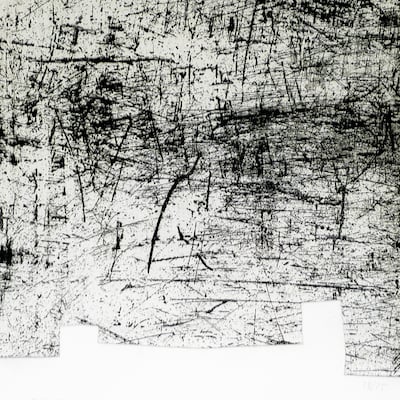
Artwork by Eduardo Chillida
What is abstract art?
Abstract art uses form, shape, line, and color to create a visual experience without attempting to represent external reality. The composition exists independently of the world's visual references, focusing on expressing ideas and emotions through non-representational means.

Craig Kauffman
Red, Black, Black, 1999
43 x 114.3 cm


