


China on paper
- Signed, dated and dedicated on the back
- Archived and authenticated at Archivio Dadamaino
Il movimento delle cose by Dadamaino, created in 1994, is a pen and ink drawing that exemplifies the artist's exploration of movement and rhythm through repetitive patterns. The artwork features intricate, undulating lines that create a sense of continuous flow and motion across the paper. The delicate, almost hypnotic patterns suggest organic forms and shifting waves, invoking both calm and complexity. This work is part of Dadamaino’s broader study of optical and kinetic art, where simple forms are repeated to create a dynamic visual experience. The piece measures 50 x 70 cm and is signed, dated, and dedicated on the back. It is archived and authenticated by Archivio Dadamaino, further confirming its significance within the artist's oeuvre.
Artwork Copyright © DadamainoDadamaino (Italy, 1930–2004), born Eduarda Emilia Maino, was a pioneering artist in the Italian avant-garde. Associated with the Zero group and Arte Povera, she explored themes of space, light, and rhythm through minimalistic works. Her iconic Volumes series featured perforated canvases, challenging traditional notions of depth and perception in art.
Artwork Copyright © DadamainoIl movimento delle cose, 1994
Form
Medium
Size
- Inches
- Centimeters
Edition
Price
- USD
- EUR
- GBP
- CHF
- Authenticity Guaranteed
- Insured Shipping
- Online Since 2005
●Inventory 13541
●Signed
●Comes with gallery invoice and certificate
●Sell Us a Similar Artwork. Learn more.
China on paper
- Signed, dated and dedicated on the back
- Archived and authenticated at Archivio Dadamaino
Il movimento delle cose by Dadamaino, created in 1994, is a pen and ink drawing that exemplifies the artist's exploration of movement and rhythm through repetitive patterns. The artwork features intricate, undulating lines that create a sense of continuous flow and motion across the paper. The delicate, almost hypnotic patterns suggest organic forms and shifting waves, invoking both calm and complexity. This work is part of Dadamaino’s broader study of optical and kinetic art, where simple forms are repeated to create a dynamic visual experience. The piece measures 50 x 70 cm and is signed, dated, and dedicated on the back. It is archived and authenticated by Archivio Dadamaino, further confirming its significance within the artist's oeuvre.
Artwork Copyright © DadamainoDadamaino (Italy, 1930–2004), born Eduarda Emilia Maino, was a pioneering artist in the Italian avant-garde. Associated with the Zero group and Arte Povera, she explored themes of space, light, and rhythm through minimalistic works. Her iconic Volumes series featured perforated canvases, challenging traditional notions of depth and perception in art.
Artwork Copyright © Dadamaino- Recently Added
- Price (Low-High)
- Price (High-Low)
- Year (Low-High)
- Year (High-Low)

Dadamaino
Il movimento delle cose, 1994
Drawing / Watercolor
Pen and ink
EUR 8,350
Related Artists


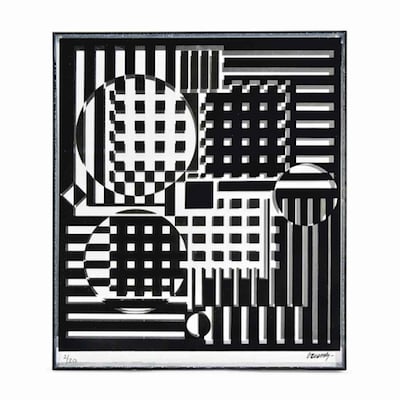
Artwork by Victor Vasarely
What is Op Art?
Op Art is a visual art style that uses optical illusions to create the impression of movement, vibrating patterns, flashing, or hidden images. The works are typically abstract, with many well-known pieces in black and white. The roots of Op Art can be traced back to earlier movements like Futurism, Constructivism, Dada, and Neo-Impressionism, particularly in their use of color effects and graphic design.


Dadamaino
Il movimento delle cose, 1994
50 x 70 cm


