

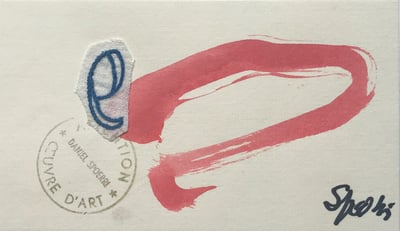
// Collage 2 - E by Daniel Spoerri, a 2017 collage on paper, showcases the artist’s playful approach to mixed media and abstraction. In this piece, a fluid, red brushstroke arcs across the composition, giving a sense of motion and spontaneity. An element of texture is added with a fabric patch featuring a blue letter e, positioned near a circular stamp marked Oeuvre d'Art and Daniel Spoerri. Spoerri’s signature appears in the lower corner, grounding the work with his personal mark. The combination of stamp, textural patch, and sweeping red stroke invites viewers to consider the interplay between language, texture, and gestural expression.
Artwork Copyright © Daniel SpoerriDaniel Spoerri (Switzerland, 1930–2024) was a pioneering artist and writer, best known for his 'snare-pictures'—assemblages capturing everyday objects, notably meal remnants, affixed to surfaces and displayed vertically. A key figure in the Nouveau Réalisme movement, he also founded the Eat Art movement, exploring the intersection of art and gastronomy. Spoerri's works are featured in major institutions, including the Museum of Modern Art and the Centre Pompidou.
Artwork Copyright © Daniel SpoerriCollage 2 - E, 2017
Form
Medium
Size
- Inches
- Centimeters
Edition
Price
- USD
- EUR
- GBP
- CHF
- Authenticity Guaranteed
- Insured Shipping
- Online Since 2005
●Inventory 6967
●Signed
●Comes with gallery invoice and certificate
●Sell Us a Similar Artwork. Learn more.
// Collage 2 - E by Daniel Spoerri, a 2017 collage on paper, showcases the artist’s playful approach to mixed media and abstraction. In this piece, a fluid, red brushstroke arcs across the composition, giving a sense of motion and spontaneity. An element of texture is added with a fabric patch featuring a blue letter e, positioned near a circular stamp marked Oeuvre d'Art and Daniel Spoerri. Spoerri’s signature appears in the lower corner, grounding the work with his personal mark. The combination of stamp, textural patch, and sweeping red stroke invites viewers to consider the interplay between language, texture, and gestural expression.
Artwork Copyright © Daniel SpoerriDaniel Spoerri (Switzerland, 1930–2024) was a pioneering artist and writer, best known for his 'snare-pictures'—assemblages capturing everyday objects, notably meal remnants, affixed to surfaces and displayed vertically. A key figure in the Nouveau Réalisme movement, he also founded the Eat Art movement, exploring the intersection of art and gastronomy. Spoerri's works are featured in major institutions, including the Museum of Modern Art and the Centre Pompidou.
Artwork Copyright © Daniel Spoerri- Recently Added
- Price (Low-High)
- Price (High-Low)
- Year (Low-High)
- Year (High-Low)
Daniel Spoerri
Collage 2 - E, 2017
Drawing / Watercolor
Collage
EUR 500
Related Artists


Artwork by Robert Longo
What is Performance Art?
Performance Art is a genre of fine art that is traditionally interdisciplinary, involving various art forms. It can be scripted or unscripted, random or carefully orchestrated, spontaneous, or meticulously planned, with or without audience participation. Performance Art can be presented live or through media, with the artist either present or absent. It typically involves four basic elements: space, the performer’s body or presence through a medium, time, and the relationship between performer and audience. The artwork consists of actions performed by an individual or group in a specific time and space.

Daniel Spoerri
Collage 2 - E, 2017
18 x 11 cm


