

Lithograph on Somerset paper
Lissitzky-Letterhead by David Diao, created in 2021, is a lithograph that highlights the power of simplicity and spatial composition. The work features a beige rectangular form placed against a flat green background, with a bold red line and a small geometric detail in black, red, and beige occupying the upper-right corner of the rectangle. The asymmetry and minimal elements create a subtle tension and invite the viewer to reflect on balance, proportion, and negative space. Measuring 56 x 76 cm, this limited-edition print exemplifies Diao’s refined, minimalist approach to modern abstraction.
Artwork Copyright © David DiaoDavid Diao (China/USA, 1943) is a Chinese-American artist known for his abstract paintings that blend minimalist aesthetics with personal and art historical narratives. His work often references modernist icons and explores themes of identity, displacement, and the art market. Diao's art has been exhibited internationally, including retrospectives at the Ullens Center for Contemporary Art in Beijing.
Artwork Copyright © David DiaoLissitzky-Letterhead, 2021
Form
Medium
Size
- Inches
- Centimeters
Edition
Price
- USD
- EUR
- GBP
- CHF
- Authenticity Guaranteed
- Insured Shipping
- Online Since 2005
●Inventory 9969
●Signed
●Comes with gallery invoice and certificate
●Any questions?
Lithograph on Somerset paper
Lissitzky-Letterhead by David Diao, created in 2021, is a lithograph that highlights the power of simplicity and spatial composition. The work features a beige rectangular form placed against a flat green background, with a bold red line and a small geometric detail in black, red, and beige occupying the upper-right corner of the rectangle. The asymmetry and minimal elements create a subtle tension and invite the viewer to reflect on balance, proportion, and negative space. Measuring 56 x 76 cm, this limited-edition print exemplifies Diao’s refined, minimalist approach to modern abstraction.
Artwork Copyright © David DiaoDavid Diao (China/USA, 1943) is a Chinese-American artist known for his abstract paintings that blend minimalist aesthetics with personal and art historical narratives. His work often references modernist icons and explores themes of identity, displacement, and the art market. Diao's art has been exhibited internationally, including retrospectives at the Ullens Center for Contemporary Art in Beijing.
Artwork Copyright © David DiaoAvailability
SORT BY

David Diao
Lissitzky-Letterhead, 2021
Limited Edition Print
Lithograph
EUR 2,000

David Diao
Lissitzky-Curves Breuer UNESCO, 2021
Limited Edition Print
Lithograph
EUR 2,000

David Diao
Lissitzky-Curves Herman-Miller, 2021
Limited Edition Print
Lithograph
EUR 2,000

David Diao
Without title, 2019
Limited Edition Print
Lithograph
Currently Not Available

David Diao
Berlin-Chair Unassembled 1, 2019
Limited Edition Print
Lithograph
Currently Not Available
Related Artists


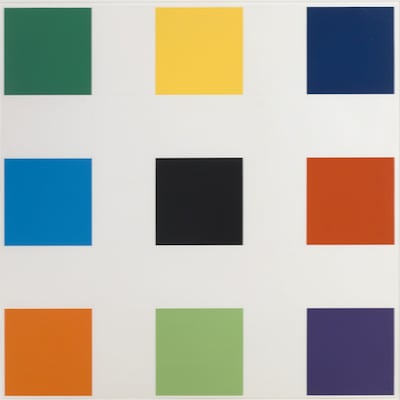
Artwork by Ellsworth Kelly
What is Hard Edge Art?
Hard Edge art is a style of abstract painting that became popular in the 1960s. It features areas of color separated by crisp, sharp edges that are painted with geometric precision. The term hard-edge painting was coined by art critic Jules Langsner to describe this approach, which contrasts with the softer, more fluid forms of other abstract styles.

David Diao
Lissitzky-Letterhead, 2021
56 x 76 cm


