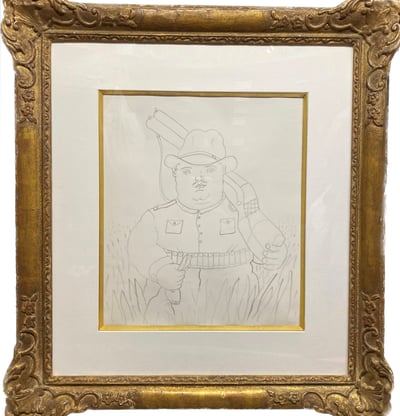
// Hunter by Fernando Botero is a pencil drawing from 1980, embodying the artist's unique style of exaggerated, voluminous figures. The sketch depicts a rotund hunter, dressed in classic hunting attire, complete with a hat, ammunition belt, and rifle slung over his shoulder. Standing amidst tall grasses, the figure's facial expression and body language convey a sense of calm confidence. Botero's characteristic approach to form, with his emphasis on rounded and inflated shapes, adds a humorous and satirical element to the portrayal, possibly commenting on themes of masculinity and authority. The simplicity of pencil on paper highlights the elegance of Botero’s line work and his ability to evoke personality through minimal detail.
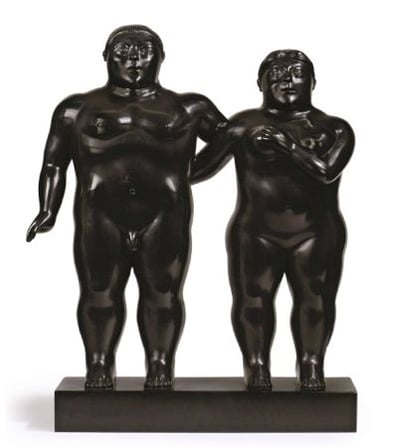
Fernando Botero (Colombia, 1932–2023) was a renowned artist known for his distinctive 'Boterismo' style, characterized by exaggerated, voluminous forms. His paintings and sculptures often depicted whimsical yet critical scenes of everyday life, politics, and religion, blending humor with social commentary. Botero’s works are celebrated for their unique blend of color, form, and satire.
PencilA pencil is a writing and drawing tool with a core of solid pigment, typically graphite or colored, encased in a protective layer of wood or composite material. Pencils make marks on paper by transferring part of the core pigment onto the surface.
// Hunter by Fernando Botero is a pencil drawing from 1980, embodying the artist's unique style of exaggerated, voluminous figures. The sketch depicts a rotund hunter, dressed in classic hunting attire, complete with a hat, ammunition belt, and rifle slung over his shoulder. Standing amidst tall grasses, the figure's facial expression and body language convey a sense of calm confidence. Botero's characteristic approach to form, with his emphasis on rounded and inflated shapes, adds a humorous and satirical element to the portrayal, possibly commenting on themes of masculinity and authority. The simplicity of pencil on paper highlights the elegance of Botero’s line work and his ability to evoke personality through minimal detail.
Fernando Botero (Colombia, 1932–2023) was a renowned artist known for his distinctive 'Boterismo' style, characterized by exaggerated, voluminous forms. His paintings and sculptures often depicted whimsical yet critical scenes of everyday life, politics, and religion, blending humor with social commentary. Botero’s works are celebrated for their unique blend of color, form, and satire.
An artist is attracted to certain kinds of form without knowing why.
- Fernando Botero
Known for his instantly-recognisable, signature style labelled ‘Boterismo’ - a depiction of figures and people in a large, exaggerated fashion and a representation of both humour and socio-political criticism - Fernando Botero was one of the most successful artists of Latin America. His employment of flat, bright colours alongside distinctly outlined forms was heavily influenced by traditional Latin-America folk art, as well as the works of Francisco de Goya and Diego Velazquez; one of Botero’s most celebrated works is Mona Lisa, Age 12 a paraphrasing of Leonardo da Vinci’s original work with a twist that alluded to the aforementioned Goya and Velazquez. Botero captured the various walks of life to be found in his native Colombia throughout his work in sculpture and painting; Card Players and Death of Pablo Escobar are among the most celebrated of his artistic creations.
Modern Realism is an art style that depicts subjects as they exist in reality. Emerging after the development of abstract art, Modern Realism combines traditional realistic representation with modern techniques and approaches. Artists in this style focus on painting or drawing everyday life, portraying realistic subjects with a contemporary perspective.