Fernando Botero's Man and Woman is a bronze sculpture that exemplifies the artist's signature style of voluminous and exaggerated forms. Depicting a nude couple standing side by side, the piece captures Botero's exploration of the human figure with a sense of humor and warmth. The figures are rounded and full, their bodies stylized in a way that challenges traditional depictions of beauty. Botero’s work often celebrates the human form in its diversity and abundance, and this sculpture is no exception, conveying a feeling of dignity and intimacy between the two figures. The dark patina on the bronze enhances the sculpture's smooth surfaces, emphasizing its tactile quality. Limited to an edition of six, this piece carries Botero's stamped signature and foundry mark, marking it as an authentic creation from one of the most distinctive sculptors of contemporary art.
Fernando Botero (Colombia, 1932–2023) was a renowned artist known for his distinctive 'Boterismo' style, characterized by exaggerated, voluminous forms. His paintings and sculptures often depicted whimsical yet critical scenes of everyday life, politics, and religion, blending humor with social commentary. Botero’s works are celebrated for their unique blend of color, form, and satire.
bronzeBronze is a metal alloy made primarily of copper and tin, with a typical modern composition of 88% copper and 12% tin. Over time, bronze develops a patina, a surface color that often turns deep green due to oxidation. Large bronze objects, such as sculptures, are typically made in foundries. Bronze is valued for its durability and has been widely used throughout history for art, tools, and weapons.
Fernando Botero's Man and Woman is a bronze sculpture that exemplifies the artist's signature style of voluminous and exaggerated forms. Depicting a nude couple standing side by side, the piece captures Botero's exploration of the human figure with a sense of humor and warmth. The figures are rounded and full, their bodies stylized in a way that challenges traditional depictions of beauty. Botero’s work often celebrates the human form in its diversity and abundance, and this sculpture is no exception, conveying a feeling of dignity and intimacy between the two figures. The dark patina on the bronze enhances the sculpture's smooth surfaces, emphasizing its tactile quality. Limited to an edition of six, this piece carries Botero's stamped signature and foundry mark, marking it as an authentic creation from one of the most distinctive sculptors of contemporary art.
Fernando Botero (Colombia, 1932–2023) was a renowned artist known for his distinctive 'Boterismo' style, characterized by exaggerated, voluminous forms. His paintings and sculptures often depicted whimsical yet critical scenes of everyday life, politics, and religion, blending humor with social commentary. Botero’s works are celebrated for their unique blend of color, form, and satire.
An artist is attracted to certain kinds of form without knowing why.
- Fernando Botero
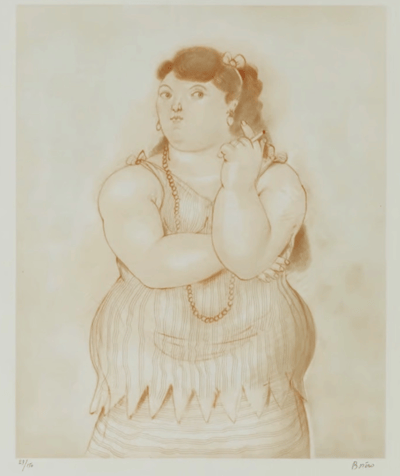
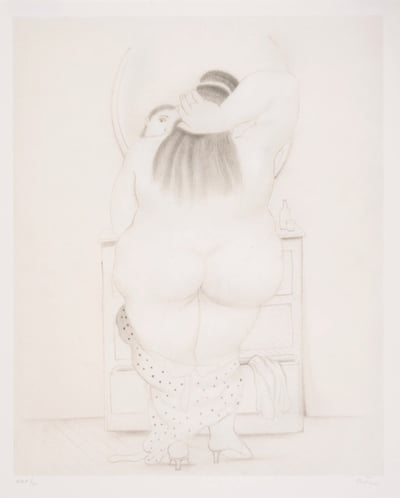
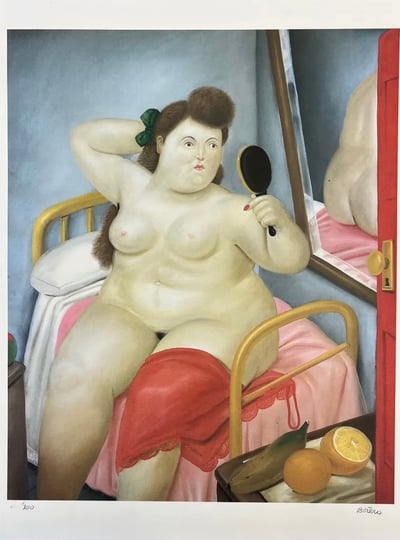
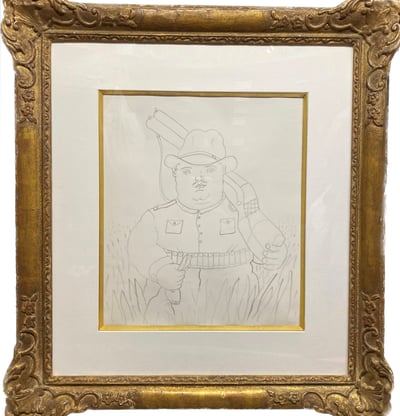
Known for his instantly-recognisable, signature style labelled ‘Boterismo’ - a depiction of figures and people in a large, exaggerated fashion and a representation of both humour and socio-political criticism - Fernando Botero was one of the most successful artists of Latin America. His employment of flat, bright colours alongside distinctly outlined forms was heavily influenced by traditional Latin-America folk art, as well as the works of Francisco de Goya and Diego Velazquez; one of Botero’s most celebrated works is Mona Lisa, Age 12 a paraphrasing of Leonardo da Vinci’s original work with a twist that alluded to the aforementioned Goya and Velazquez. Botero captured the various walks of life to be found in his native Colombia throughout his work in sculpture and painting; Card Players and Death of Pablo Escobar are among the most celebrated of his artistic creations.
Naïve art describes a style of artwork that is simple and unsophisticated, often created by artists without formal training in an academy or art school. The style is characterized by a lack of advanced techniques, giving it a childlike appearance. Naïve art often features bright colors, simple shapes, and a straightforward approach to subject matter, reflecting the artist's untrained perspective.