Hand-signed, numbered
- Published by Edition Copenhagen, Denmark
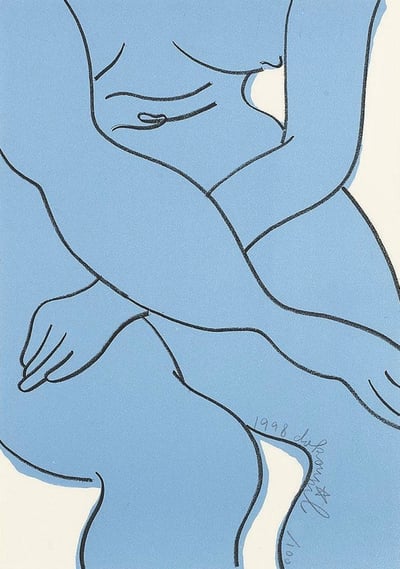
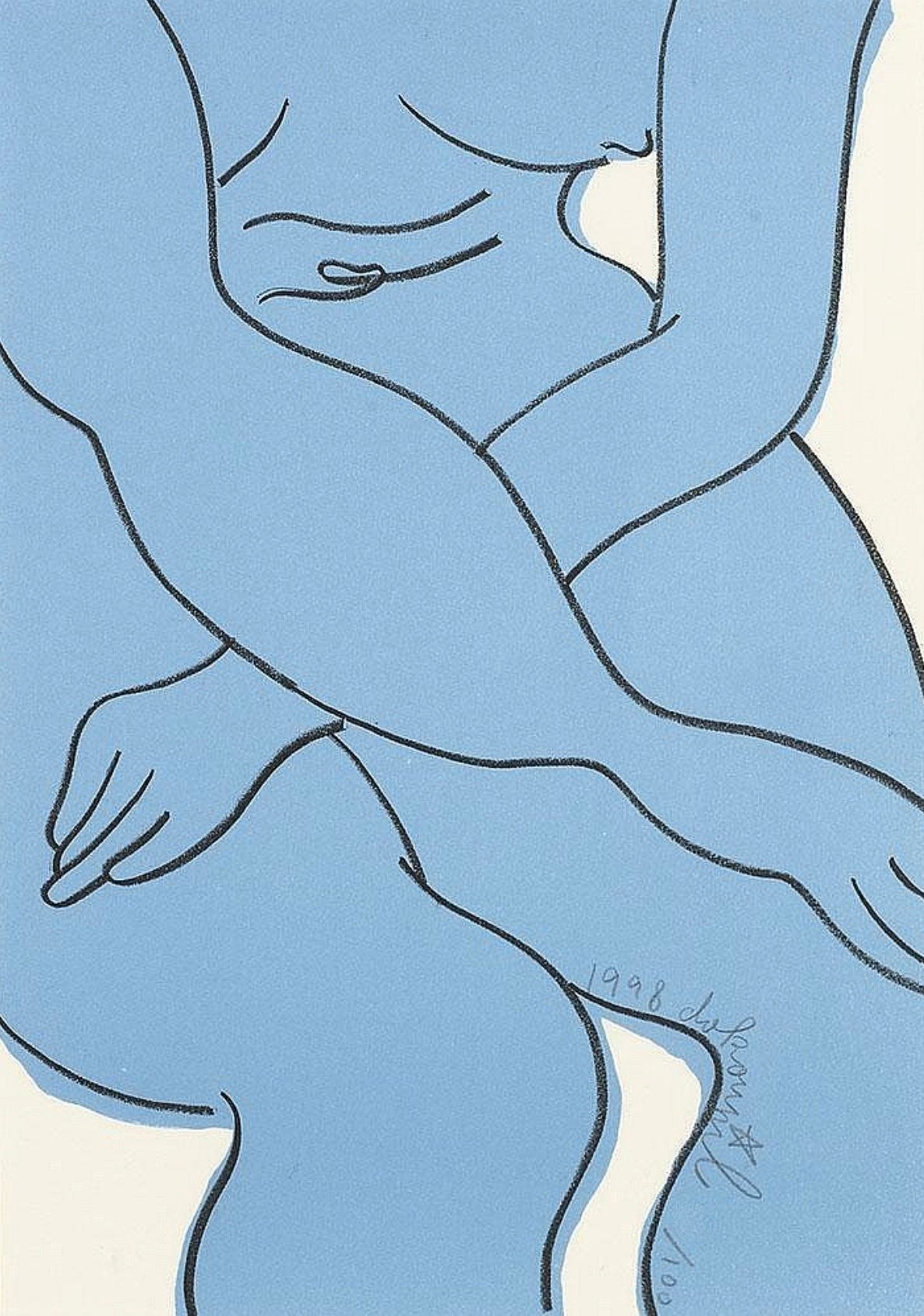
Georg Jiri Dokoupil's 'Blue Nude' is a 1998 lithograph that presents a minimalist yet striking portrayal of the human form. The image features a simplified, abstracted nude figure, rendered in soft shades of blue with clean, flowing black outlines. The figure is seated, with arms crossed, creating a sense of quiet introspection and calm. Dokoupil’s use of negative space and a limited color palette adds to the artwork’s serene and contemplative nature. The smooth, fluid lines of the body echo classical themes of the nude in art while maintaining a distinctly modern, abstract approach, making this piece both timeless and contemporary.
Georg Jiri Dokoupil (Czech Republic/Germany, 1954) is a versatile contemporary artist and a founding member of the Mülheimer Freiheit group. Known for his experimental approach, he employs unconventional techniques, such as using soot or soap bubbles to create dynamic, abstract compositions. Dokoupil’s eclectic style defies categorization, continually pushing artistic boundaries.
Lithograph Lithography is a printing method based on the principle that water and oil do not mix. It can be used to print artwork or text onto paper or other suitable materials. Traditionally, an image was drawn with wax, fat, or oil onto a lithographic limestone surface or plate. Today, metal plates and other surfaces are also used in lithographic printing.
Hand-signed, numbered
- Published by Edition Copenhagen, Denmark
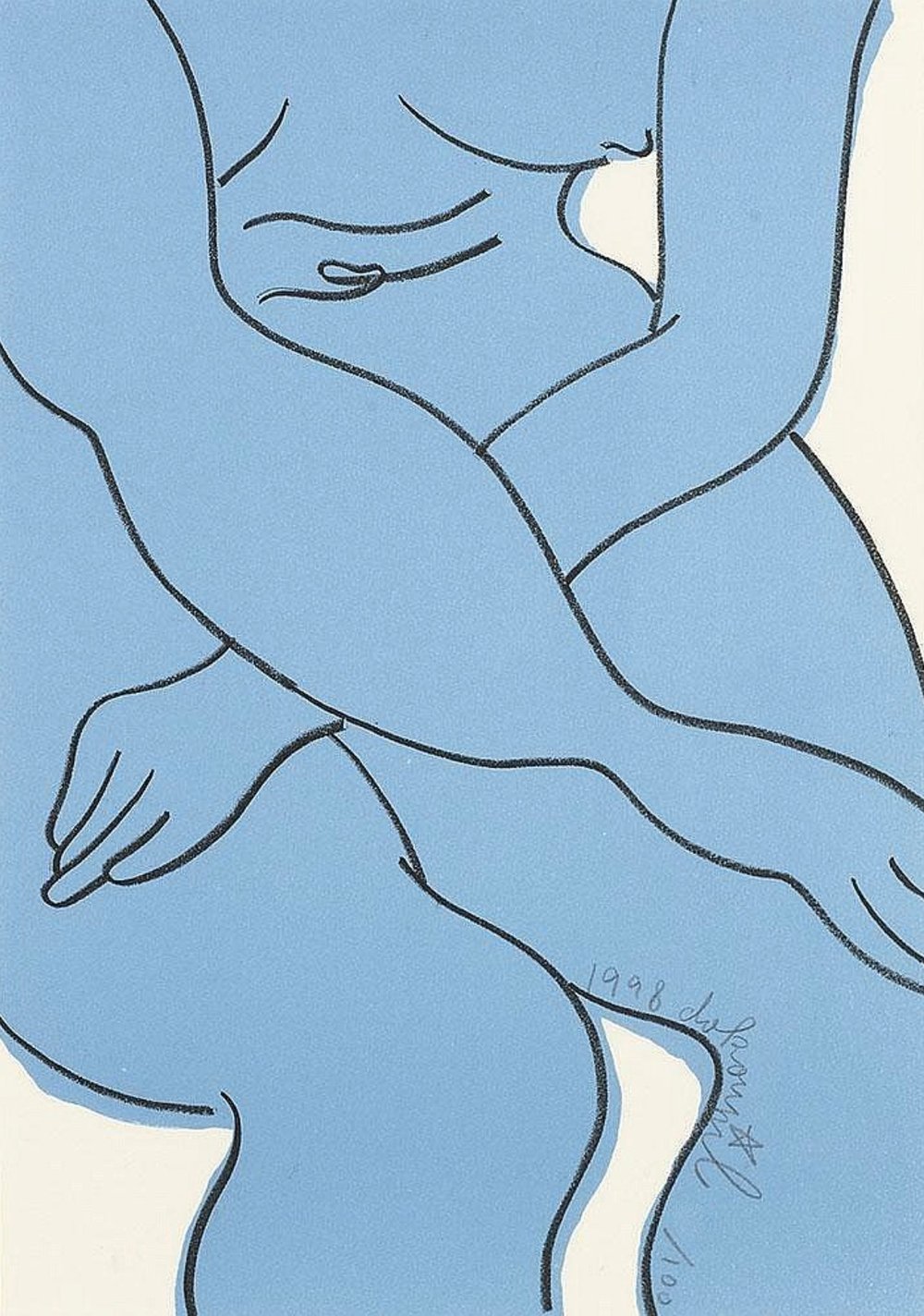
Georg Jiri Dokoupil's 'Blue Nude' is a 1998 lithograph that presents a minimalist yet striking portrayal of the human form. The image features a simplified, abstracted nude figure, rendered in soft shades of blue with clean, flowing black outlines. The figure is seated, with arms crossed, creating a sense of quiet introspection and calm. Dokoupil’s use of negative space and a limited color palette adds to the artwork’s serene and contemplative nature. The smooth, fluid lines of the body echo classical themes of the nude in art while maintaining a distinctly modern, abstract approach, making this piece both timeless and contemporary.
Georg Jiri Dokoupil (Czech Republic/Germany, 1954) is a versatile contemporary artist and a founding member of the Mülheimer Freiheit group. Known for his experimental approach, he employs unconventional techniques, such as using soot or soap bubbles to create dynamic, abstract compositions. Dokoupil’s eclectic style defies categorization, continually pushing artistic boundaries.
Common features are expressionism and an erotic charge.
- Georg Jiri Dokoupil
Elements of Pop Art, Surrealism and German Neo- Expressionism all feature in the art of Jiri Georg Dokoupil. He can best be described as Post-Modernist, constantly renewing his style and developing new techniques. Jiri Georg Dokoupil makes use of different iconography in his paintings, sculptures and other media, and sometimes parodies the type of visual language used in advertising and printed comics. In the 1970s Jiri Georg Dokoupil studied fine arts at various art academies, including the University of Frankfurt and the Cooper Union in New York, where he met German artist Hans Haacke, who had some influence on his art. Jiri Georg Dokoupil became a founder-member of an important group of German Neo-Expressionists known as Mulheimer Freiheit, named after the street where they shared a studio, and in 1982 he had solo exhibitions in Amsterdam, Cologne and Rotterdam. Also in 1982 he submitted God Show Me Your Balls to Documenta 7 in Kassel. This immense work was created in tribute to the artist Julian Schnabel, who had not been asked to exhibit there, and it brought Jiri Georg Dokoupil recognition in the world of art. He has never wanted to develop a permanent style that would be recognizable as his, preferring to experiment with different techniques and to be influenced by a number of art movements. In any medium or style of painting, his art is strongly self-expressive. By the end of the 1980s he was using the flame of a candle to create his Soot Paintings. In his later works he has developed new techniques for using paint and pigment to create still life and figurative images. Since 1983 he has been teaching art in Dusseldorf, Kassel and Madrid as a guest professor. His works are now in the permanent collections of major modern art museums in several European cities.
Neue Wilden is the term German artists used for Neo-Expressionism. In the 1970s and 80s, expressive painting re-emerged in Germany, with artists embracing intense colors and broad brushstrokes. The movement grew in opposition to minimal and conceptual art, favoring a return to raw, emotional expression through bold and dynamic painting techniques.