Etching and aquatint with hand-coloring on Arches paper measuring - Hand-signed by the artist in pencil, dated and numbered - Designated as Heenk 33 in the artist's catalogue raisonne.
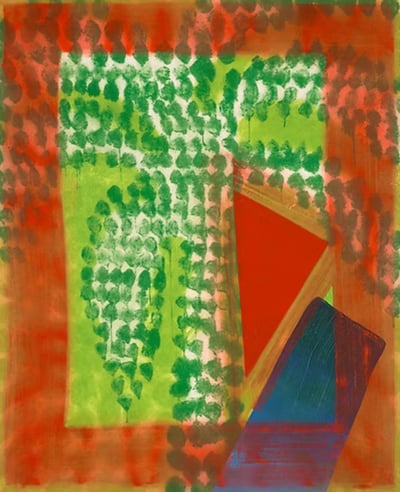
Howard Hodgkin’s A Furnished Room (1977) is a limited edition etching and aquatint print infused with bold, contrasting colors and abstract forms. This piece, created on Arches paper and enhanced with hand-coloring, features a central green shape framed within layers of deep orange, evoking a sense of depth and warmth. The irregular forms and vibrant color choices suggest an interior space without explicitly depicting it, leaving the interpretation open to the viewer. Hodgkin's work often focuses on evoking memories and emotions associated with particular spaces, and A Furnished Room captures a feeling of contained energy within a seemingly calm, structured setting. The print measures 54 x 69 cm and is signed, dated, and numbered by the artist, making it a notable example of Hodgkin’s exploration of color, form, and emotion.
Howard Hodgkin (United Kingdom, 1932–2017) was a British painter and printmaker renowned for his vibrant, abstract works that evoke emotional intensity. His distinctive style, characterized by bold brushstrokes and rich color palettes, often blurred the lines between representation and abstraction. Hodgkin's contributions to contemporary art were recognized with the Turner Prize in 1985.
Etching and AquatintEtching and aquatint are printmaking techniques. In aquatint, the printing plate is etched with a pattern of tiny pits and cracks to create a wide range of tonal gradations. This technique allows artists to replicate the broad, flat tones found in watercolor paintings and ink washes.
Etching and aquatint with hand-coloring on Arches paper measuring - Hand-signed by the artist in pencil, dated and numbered - Designated as Heenk 33 in the artist's catalogue raisonne.
Howard Hodgkin’s A Furnished Room (1977) is a limited edition etching and aquatint print infused with bold, contrasting colors and abstract forms. This piece, created on Arches paper and enhanced with hand-coloring, features a central green shape framed within layers of deep orange, evoking a sense of depth and warmth. The irregular forms and vibrant color choices suggest an interior space without explicitly depicting it, leaving the interpretation open to the viewer. Hodgkin's work often focuses on evoking memories and emotions associated with particular spaces, and A Furnished Room captures a feeling of contained energy within a seemingly calm, structured setting. The print measures 54 x 69 cm and is signed, dated, and numbered by the artist, making it a notable example of Hodgkin’s exploration of color, form, and emotion.
Howard Hodgkin (United Kingdom, 1932–2017) was a British painter and printmaker renowned for his vibrant, abstract works that evoke emotional intensity. His distinctive style, characterized by bold brushstrokes and rich color palettes, often blurred the lines between representation and abstraction. Hodgkin's contributions to contemporary art were recognized with the Turner Prize in 1985.
When I finish a painting, it usually looks as surprising to me as to anyone else.
- Howard Hodgkin
Often associated with abstraction, Howard Hodgkin was a highly acclaimed painter and printmaker known for his rich interplay between ground, colour and gesture. Hodgkin was heavily influenced by the works of such artists as Matisse and Picasso and his own works were almost always painted upon the backs of old picture frames – this, along with his use of vibrant colour and expressive brush marks, created an interesting relationship between the painted frame and its base; Rain and Indian Subject Blue are just two examples of this technique. Asides from painting, Hodgkin was an accomplished print-maker – his printing was often labour-intensive and intricate, as demonstrated in his Venetian Views series; this work consists of four different prints depicting Venice at four separate times of day – Venice, Afternoon is perhaps the most notable among this series as it is displayed across sixteen separate sheets and the rich colour used throughout gives the work a painterly effect. (Artist website)
Colour Field Painting is an abstract style characterized by large areas of a single color or simple, solid colors. The term was first used in the 1950s to describe the work of three American Abstract Expressionist painters—Barnett Newman, Mark Rothko, and Clyfford Still. Their work emphasized the emotional power of color and the creation of vast, meditative spaces through expansive color fields.