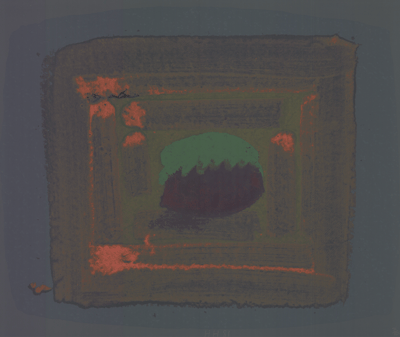
Lithograph from three aluminium plates printed in yellow, orange and brown, with hand colouring in violet gouache - On Lexington hand-made paper - Hand signed, dated and numbered in pencil - Published by Petersburg Press, New York - Reference: Heenk 35 and 51
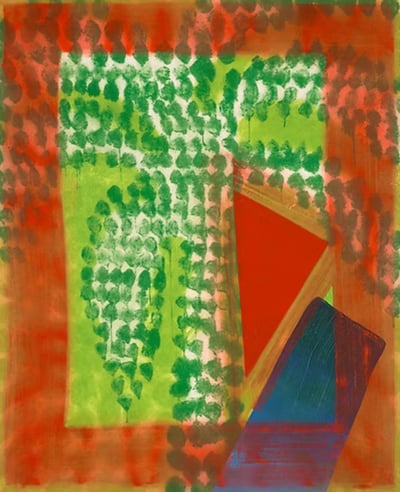
Howard Hodgkin's Nick's Room (1977) is a lithograph characterized by bold color blocks and expressive brushstrokes. Created using three aluminum plates printed in yellow, orange, and brown, the piece is further enhanced with hand-applied violet gouache, giving it a unique, textured quality. The composition centers around a deep purple rectangular form encased in a rich orange border, with rough, almost tactile edges that create a sense of intimacy and enclosure. The interplay of warm tones and gestural strokes evokes a feeling of personal space, as though peering into a private room saturated with memory. Printed on Lexington hand-made paper, each print is hand-signed, dated, and numbered, exemplifying Hodgkin's commitment to blending painterly expression with printmaking precision.
Howard Hodgkin (United Kingdom, 1932–2017) was a British painter and printmaker renowned for his vibrant, abstract works that evoke emotional intensity. His distinctive style, characterized by bold brushstrokes and rich color palettes, often blurred the lines between representation and abstraction. Hodgkin's contributions to contemporary art were recognized with the Turner Prize in 1985.
Lithograph Lithography is a printing method based on the principle that water and oil do not mix. It can be used to print artwork or text onto paper or other suitable materials. Traditionally, an image was drawn with wax, fat, or oil onto a lithographic limestone surface or plate. Today, metal plates and other surfaces are also used in lithographic printing.
Lithograph from three aluminium plates printed in yellow, orange and brown, with hand colouring in violet gouache - On Lexington hand-made paper - Hand signed, dated and numbered in pencil - Published by Petersburg Press, New York - Reference: Heenk 35 and 51
Howard Hodgkin's Nick's Room (1977) is a lithograph characterized by bold color blocks and expressive brushstrokes. Created using three aluminum plates printed in yellow, orange, and brown, the piece is further enhanced with hand-applied violet gouache, giving it a unique, textured quality. The composition centers around a deep purple rectangular form encased in a rich orange border, with rough, almost tactile edges that create a sense of intimacy and enclosure. The interplay of warm tones and gestural strokes evokes a feeling of personal space, as though peering into a private room saturated with memory. Printed on Lexington hand-made paper, each print is hand-signed, dated, and numbered, exemplifying Hodgkin's commitment to blending painterly expression with printmaking precision.
Howard Hodgkin (United Kingdom, 1932–2017) was a British painter and printmaker renowned for his vibrant, abstract works that evoke emotional intensity. His distinctive style, characterized by bold brushstrokes and rich color palettes, often blurred the lines between representation and abstraction. Hodgkin's contributions to contemporary art were recognized with the Turner Prize in 1985.
When I finish a painting, it usually looks as surprising to me as to anyone else.
- Howard Hodgkin
Often associated with abstraction, Howard Hodgkin was a highly acclaimed painter and printmaker known for his rich interplay between ground, colour and gesture. Hodgkin was heavily influenced by the works of such artists as Matisse and Picasso and his own works were almost always painted upon the backs of old picture frames – this, along with his use of vibrant colour and expressive brush marks, created an interesting relationship between the painted frame and its base; Rain and Indian Subject Blue are just two examples of this technique. Asides from painting, Hodgkin was an accomplished print-maker – his printing was often labour-intensive and intricate, as demonstrated in his Venetian Views series; this work consists of four different prints depicting Venice at four separate times of day – Venice, Afternoon is perhaps the most notable among this series as it is displayed across sixteen separate sheets and the rich colour used throughout gives the work a painterly effect. (Artist website)
Colour Field Painting is an abstract style characterized by large areas of a single color or simple, solid colors. The term was first used in the 1950s to describe the work of three American Abstract Expressionist painters—Barnett Newman, Mark Rothko, and Clyfford Still. Their work emphasized the emotional power of color and the creation of vast, meditative spaces through expansive color fields.