
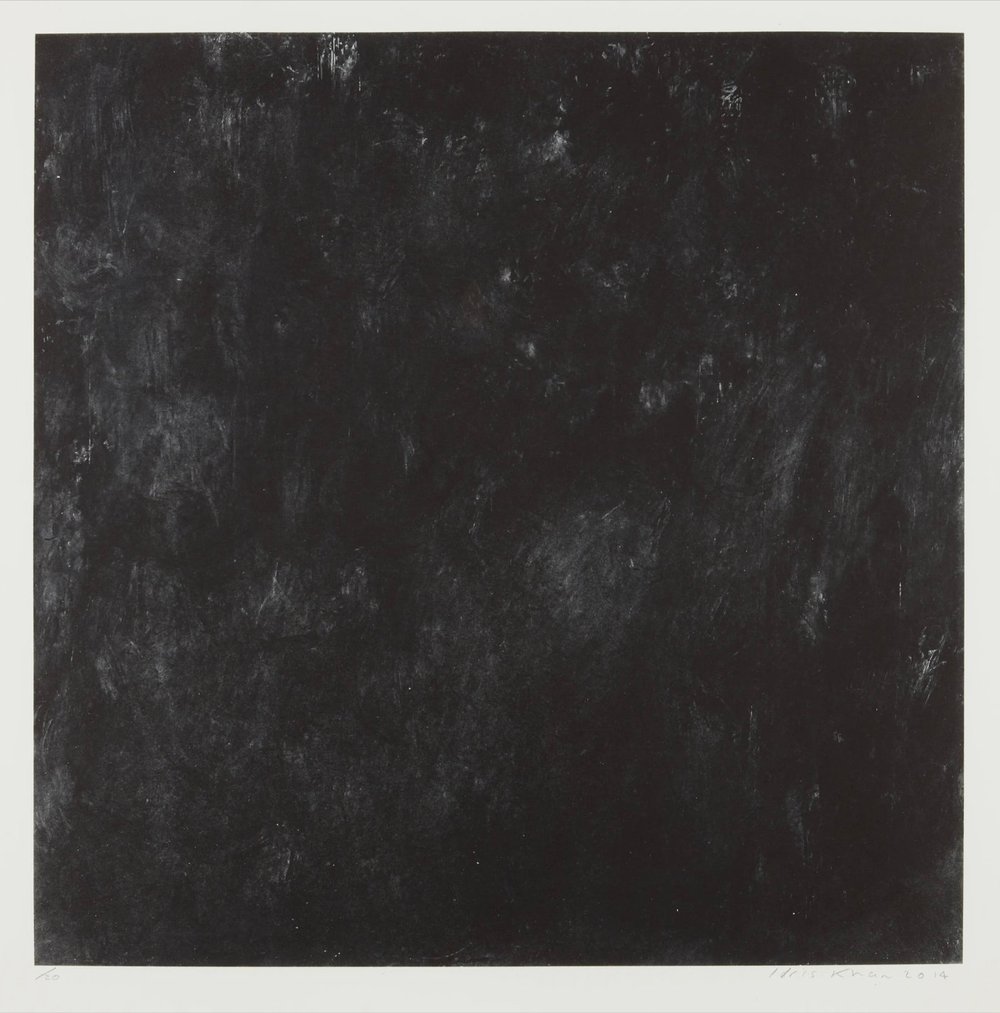
Hand lithograph on Somerset Satin paper.
Hand signed, dated and numbered by Khan.
Published by Eros Press London.
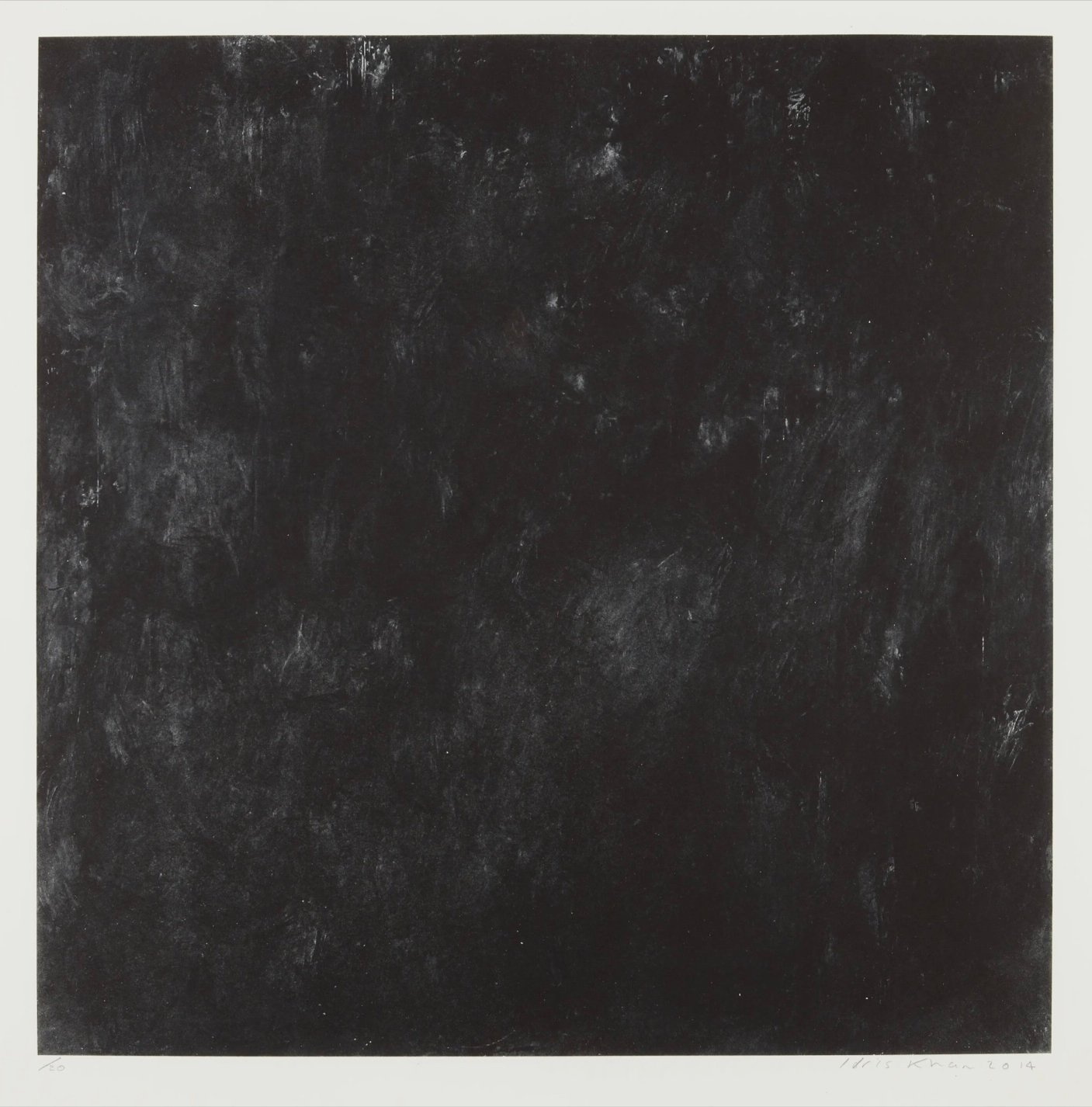
Idris Khan’s Death of Painting (2014) is a hand lithograph on Somerset Satin paper that explores density, repetition, and the limits of visual perception. The surface appears almost entirely black, yet closer observation reveals layered textures, ghostly traces, and subtle tonal variations that emerge from accumulated marks. Rather than depicting an image, Khan builds a field of compressed gestures, evoking the idea of painting reduced to its essential residue. Published by Eros Press London in a small edition, the work reflects his conceptual approach, where absence, memory, and erasure become central visual themes.
Artwork Copyright © Idris KhanIdris Khan (United Kingdom, 1978) creates layered photographs, prints, and paintings that merge literature, music, and history into dense visual fields. Known for digitally superimposing texts, musical scores, and archival images, his work explores memory, time, and authorship, producing rhythmic, almost abstract compositions with conceptual depth.
Artwork Copyright © Idris KhanDeath of Painting, 2014
Form
Medium
Size
- Inches
- Centimeters
Edition
Price
- USD
- EUR
- GBP
- CHF
- Authenticity Guaranteed
- Insured Shipping
- Online Since 2005
●Inventory 16850
●Signed
●Comes with gallery invoice and certificate
●Sell Us a Similar Artwork. Learn more.
Hand lithograph on Somerset Satin paper.
Hand signed, dated and numbered by Khan.
Published by Eros Press London.
Idris Khan’s Death of Painting (2014) is a hand lithograph on Somerset Satin paper that explores density, repetition, and the limits of visual perception. The surface appears almost entirely black, yet closer observation reveals layered textures, ghostly traces, and subtle tonal variations that emerge from accumulated marks. Rather than depicting an image, Khan builds a field of compressed gestures, evoking the idea of painting reduced to its essential residue. Published by Eros Press London in a small edition, the work reflects his conceptual approach, where absence, memory, and erasure become central visual themes.
Artwork Copyright © Idris KhanIdris Khan (United Kingdom, 1978) creates layered photographs, prints, and paintings that merge literature, music, and history into dense visual fields. Known for digitally superimposing texts, musical scores, and archival images, his work explores memory, time, and authorship, producing rhythmic, almost abstract compositions with conceptual depth.
Artwork Copyright © Idris Khan- Recently Added
- Price (Low-High)
- Price (High-Low)
- Year (Low-High)
- Year (High-Low)
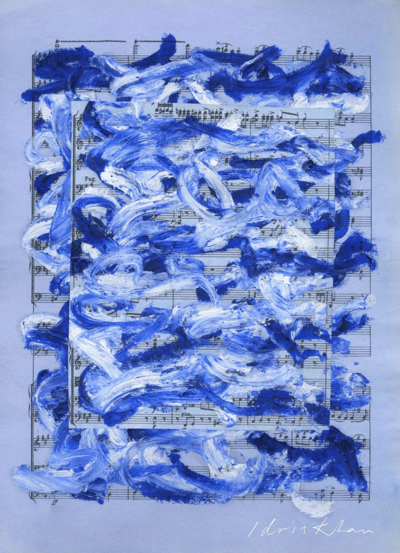
Idris Khan
Long Live Love, 2020
Limited Edition Print
Collage
GBP 2,500

Idris Khan
I Thought We Had More Time, 2022
Limited Edition Print
Archival Print
GBP 1,850

Idris Khan
Death of Painting, 2014
Limited Edition Print
Lithograph
GBP 3,000
Related Artists

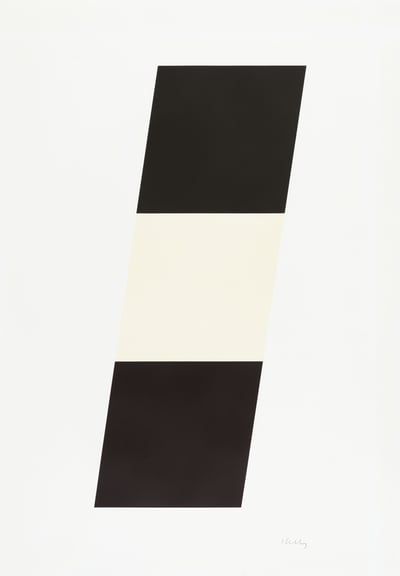

Artwork by Francois Morellet
What is geometric abstract art?
Geometric abstraction is a form of abstract art that uses geometric shapes arranged in a non-illusionistic space (though not always) and combined into non-representational (non-objective) compositions. Based on years of artistic research, some artists have proposed that geometric abstraction offers a solution to modern challenges by rejecting traditional illusionistic practices in favor of clarity and simplicity.
Idris Khan
Death of Painting, 2014
52 x 52 cm


