
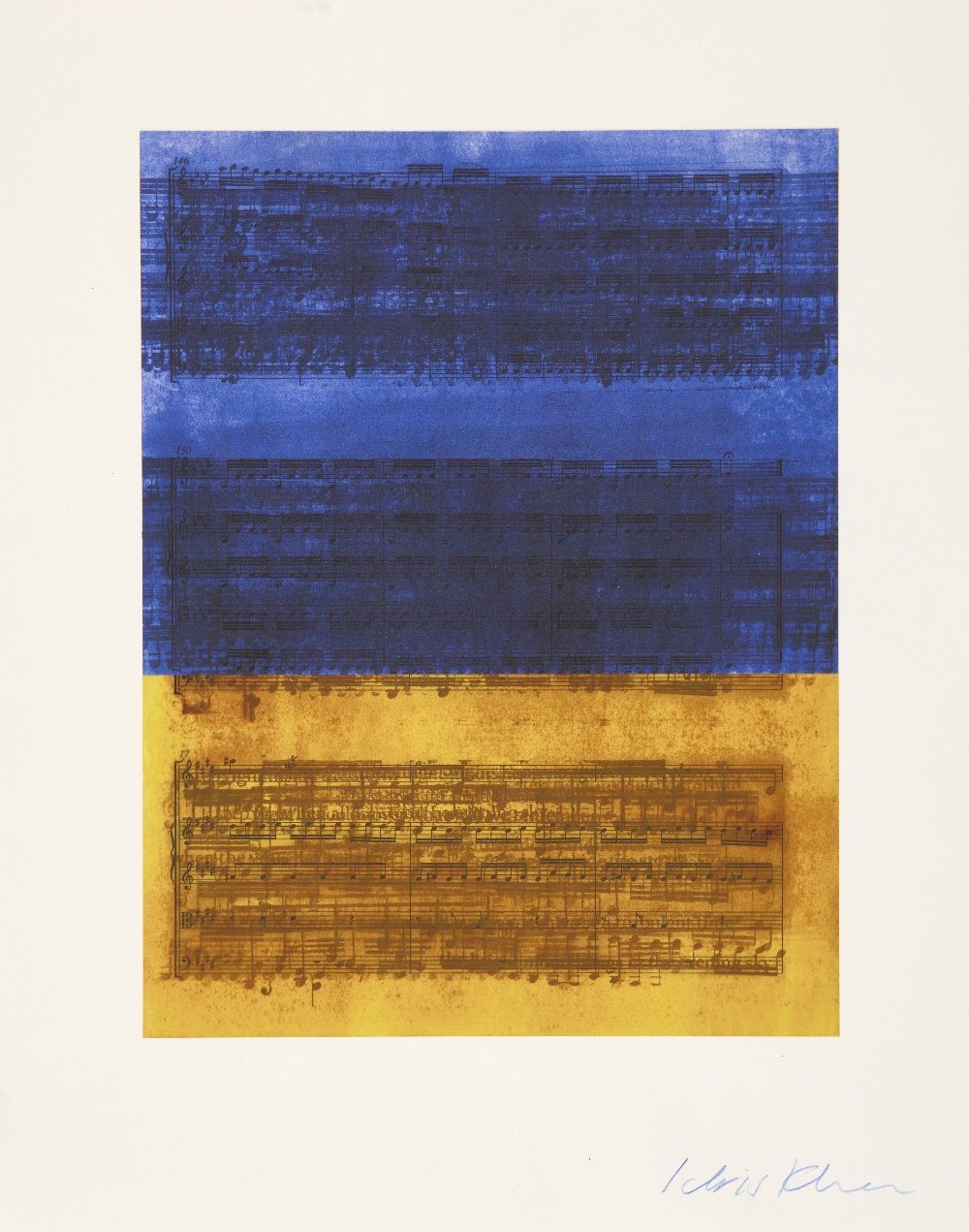
Collaged archival pigment print in colours.
Unknown edition size, from a timed-limited edition produced with Migrate Art in 2022.
Hand signed in crayon by Idris Khan.
Based on a collage created with music paper and watercolour in the colours of the Ukrainian flag.
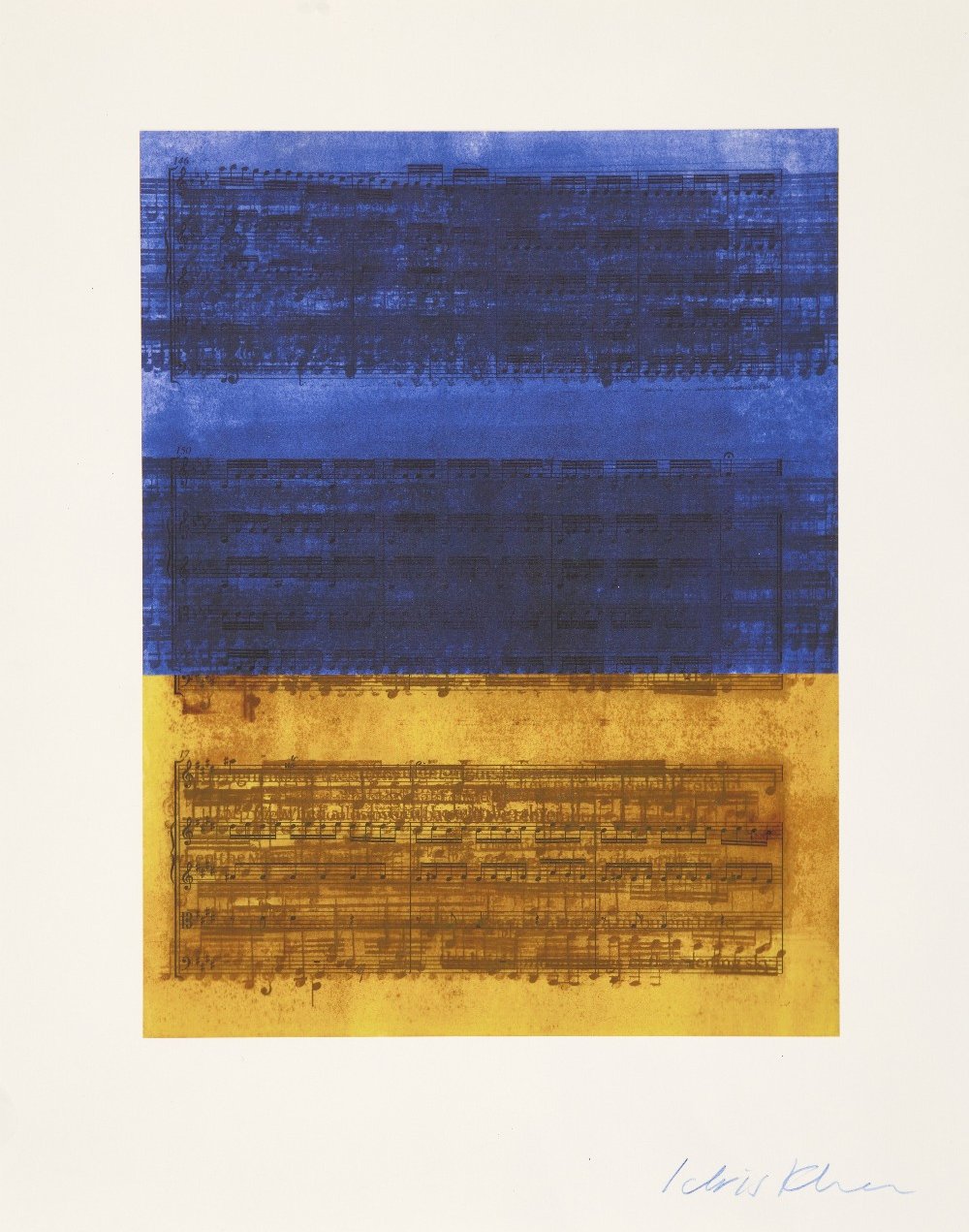
Idris Khan’s I Thought We Had More Time (2022) is a collaged archival pigment print that layers musical notation into dense, atmospheric bands of color. The composition is structured in horizontal fields of deep blue and warm yellow, echoing the Ukrainian flag, while overlapping fragments of sheet music create a sense of compression and visual rhythm. The accumulation of lines and notes becomes almost abstract, suggesting memory, loss, and the passage of time rather than legible sound. Created in support of Migrate Art, the work reflects Khan’s ongoing exploration of repetition, erasure, and cultural resonance through layered imagery.
Artwork Copyright © Idris KhanIdris Khan (United Kingdom, 1978) creates layered photographs, prints, and paintings that merge literature, music, and history into dense visual fields. Known for digitally superimposing texts, musical scores, and archival images, his work explores memory, time, and authorship, producing rhythmic, almost abstract compositions with conceptual depth.
Artwork Copyright © Idris KhanI Thought We Had More Time, 2022
Form
Medium
Size
- Inches
- Centimeters
Edition
Price
- USD
- EUR
- GBP
- CHF
- Authenticity Guaranteed
- Insured Shipping
- Online Since 2005
●Inventory 16852
●Signed
●Comes with gallery invoice and certificate
●Sell Us a Similar Artwork. Learn more.
Collaged archival pigment print in colours.
Unknown edition size, from a timed-limited edition produced with Migrate Art in 2022.
Hand signed in crayon by Idris Khan.
Based on a collage created with music paper and watercolour in the colours of the Ukrainian flag.
Idris Khan’s I Thought We Had More Time (2022) is a collaged archival pigment print that layers musical notation into dense, atmospheric bands of color. The composition is structured in horizontal fields of deep blue and warm yellow, echoing the Ukrainian flag, while overlapping fragments of sheet music create a sense of compression and visual rhythm. The accumulation of lines and notes becomes almost abstract, suggesting memory, loss, and the passage of time rather than legible sound. Created in support of Migrate Art, the work reflects Khan’s ongoing exploration of repetition, erasure, and cultural resonance through layered imagery.
Artwork Copyright © Idris KhanIdris Khan (United Kingdom, 1978) creates layered photographs, prints, and paintings that merge literature, music, and history into dense visual fields. Known for digitally superimposing texts, musical scores, and archival images, his work explores memory, time, and authorship, producing rhythmic, almost abstract compositions with conceptual depth.
Artwork Copyright © Idris Khan- Recently Added
- Price (Low-High)
- Price (High-Low)
- Year (Low-High)
- Year (High-Low)
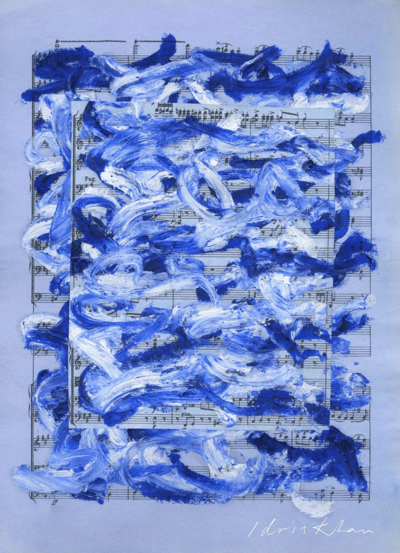
Idris Khan
Long Live Love, 2020
Limited Edition Print
Collage
GBP 2,500

Idris Khan
I Thought We Had More Time, 2022
Limited Edition Print
Archival Print
GBP 1,850

Idris Khan
Death of Painting, 2014
Limited Edition Print
Lithograph
GBP 3,000
Related Artists


Artwork by Helen Frankenthaler
What is abstract expressionism?
Abstract Expressionism is an art movement that emerged in the United States during the 1940s and 1950s. Characterized by large, abstract canvases, the movement emphasized spontaneous, expressive brushwork and the use of color and form to convey emotion rather than represent reality. Artists like Jackson Pollock, Mark Rothko, and Willem de Kooning are key figures in this movement. Abstract Expressionism marked a shift in the art world, making New York City a center of the international art scene.
Idris Khan
I Thought We Had More Time, 2022
42 x 33 cm


