

Hand painted collage : Acrylic on pvc, framed by the artist
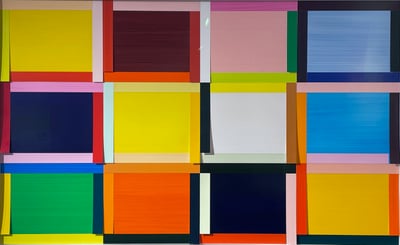
Face No 12 by Imi Knoebel is a striking composition that blends elements of painting and collage, showcasing the artist's dedication to minimalism and color field abstraction. Created between 2002 and 2014, this piece consists of hand-painted acrylic on PVC, arranged in a geometric layout that balances color blocks in shades of teal, blue, white, and subtle hints of pink. The structured grid of colors suggests an architectural quality, while the varied textures and tones evoke a sense of depth and movement within the flat surface. Knoebel’s precise placement of colors and shapes within the square format creates a visually harmonious yet dynamic piece. Measuring 36 cm by 36 cm, this work reflects Knoebel’s continuous exploration of form and color, inviting viewers to engage with its rhythmic simplicity.
Artwork Copyright © Imi KnoebelImi Knoebel (Germany, 1940) is a prominent abstract artist associated with minimalism and constructivism. Known for his bold use of color and geometric forms, his works span painting, sculpture, and installation. Influenced by the Bauhaus and his studies with Joseph Beuys, Knoebel's art explores light, space, and materiality.
Artwork Copyright © Imi KnoebelFace No 12, 2002/2014
Form
Medium
Size
- Inches
- Centimeters
Edition
Price
- Authenticity Guaranteed
- Insured Shipping
- Online Since 2005
●Inventory 5492
●Signed
●Comes with gallery invoice and certificate
●Sell Us a Similar Artwork. Learn more.
Hand painted collage : Acrylic on pvc, framed by the artist
Face No 12 by Imi Knoebel is a striking composition that blends elements of painting and collage, showcasing the artist's dedication to minimalism and color field abstraction. Created between 2002 and 2014, this piece consists of hand-painted acrylic on PVC, arranged in a geometric layout that balances color blocks in shades of teal, blue, white, and subtle hints of pink. The structured grid of colors suggests an architectural quality, while the varied textures and tones evoke a sense of depth and movement within the flat surface. Knoebel’s precise placement of colors and shapes within the square format creates a visually harmonious yet dynamic piece. Measuring 36 cm by 36 cm, this work reflects Knoebel’s continuous exploration of form and color, inviting viewers to engage with its rhythmic simplicity.
Artwork Copyright © Imi KnoebelImi Knoebel (Germany, 1940) is a prominent abstract artist associated with minimalism and constructivism. Known for his bold use of color and geometric forms, his works span painting, sculpture, and installation. Influenced by the Bauhaus and his studies with Joseph Beuys, Knoebel's art explores light, space, and materiality.
Artwork Copyright © Imi KnoebelAvailability
Size
Form
Medium
SORT BY

Imi Knoebel
Rosa Trapez, 1998-2001
Painting
Mixed Media
Inquire For Price

Imi Knoebel
Canapé Enfant, 1996
Limited Edition Print
Mixed Media
Artwork On Hold

Imi Knoebel
ohne Titel (4), 1995
Limited Edition Print
Screen-print
EUR 1,800

Imi Knoebel
ohne Titel (3), 1995
Limited Edition Print
Screen-print
EUR 1,800

Imi Knoebel
ohne Titel (2), 1995
Limited Edition Print
Screen-print
EUR 1,800

Imi Knoebel
Face No 12, 2002/2014
Drawing / Watercolor
Mixed Media
EUR 10,000 - 15,000
Imi Knoebel
Basel Fenster 5 ED, 2020
Limited Edition Print
Mixed Media
Currently Not Available
Related Artists


Artwork by Eduardo Chillida
What is abstract art?
Abstract art uses form, shape, line, and color to create a visual experience without attempting to represent external reality. The composition exists independently of the world's visual references, focusing on expressing ideas and emotions through non-representational means.

Imi Knoebel
Face No 12, 2002/2014
36 x 36 cm


