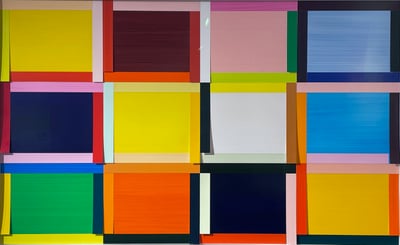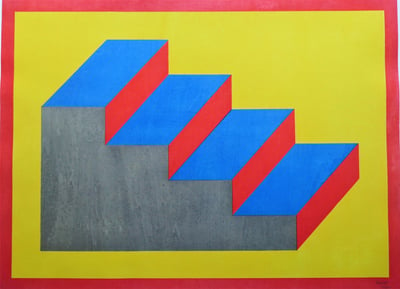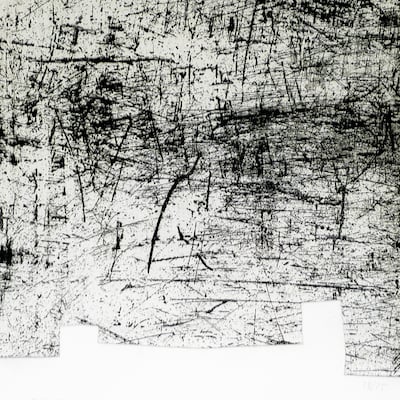
Knife Cuts by Imi Knoebel is a 1993 limited edition silkscreen print that showcases the artist's exploration of geometric abstraction. This composition features sharp, dynamic shapes that appear to slice through the space of the paper, creating an energetic interplay of color and form. The bold blocks of burgundy, turquoise, and other vivid hues are set against a white background, enhancing the sense of movement and rhythm. Knoebel’s use of clean lines and striking color combinations speaks to his minimalist and constructivist influences, creating a work that is both visually stimulating and structurally balanced.
Imi Knoebel (Germany, 1940) is a prominent abstract artist associated with minimalism and constructivism. Known for his bold use of color and geometric forms, his works span painting, sculpture, and installation. Influenced by the Bauhaus and his studies with Joseph Beuys, Knoebel's art explores light, space, and materiality.
Silkscreen Silkscreen is a printmaking method that uses a screen made of silk or other mesh fabric. The screen is treated with a substance that blocks ink in certain areas, allowing ink to pass through only in the desired sections. Each color in the print requires a separate screen.
Knife Cuts by Imi Knoebel is a 1993 limited edition silkscreen print that showcases the artist's exploration of geometric abstraction. This composition features sharp, dynamic shapes that appear to slice through the space of the paper, creating an energetic interplay of color and form. The bold blocks of burgundy, turquoise, and other vivid hues are set against a white background, enhancing the sense of movement and rhythm. Knoebel’s use of clean lines and striking color combinations speaks to his minimalist and constructivist influences, creating a work that is both visually stimulating and structurally balanced.
Imi Knoebel (Germany, 1940) is a prominent abstract artist associated with minimalism and constructivism. Known for his bold use of color and geometric forms, his works span painting, sculpture, and installation. Influenced by the Bauhaus and his studies with Joseph Beuys, Knoebel's art explores light, space, and materiality.
If you want to stay alive, you have to do something radical.
- Imi Knoebel
Imi Knoebel (b. 1940 Germany) is a German contemporary artist known for his contributions to minimalism and abstract art. Knoebel's work is characterized by its exploration of color, form, and space, often through the use of simple geometric shapes and a restricted color palette. A student of Joseph Beuys at the Kunstakademie Düsseldorf, Knoebel was initially influenced by Constructivism and the Bauhaus, leading him to develop a visual language that emphasizes purity of form and the interaction of shapes within a given space. His work often includes large-scale installations, paintings, and sculptures that challenge the boundaries between painting and sculpture. Knoebel is particularly known for his vibrant use of color in later works, where he expanded his palette to include bright, dynamic hues. His contributions to contemporary art have been widely recognized, with his work exhibited in major museums and galleries around the world, cementing his status as a significant figure in post-war European art.
Abstract art uses form, shape, line, and color to create a visual experience without attempting to represent external reality. The composition exists independently of the world's visual references, focusing on expressing ideas and emotions through non-representational means.