Signed, dated and titled
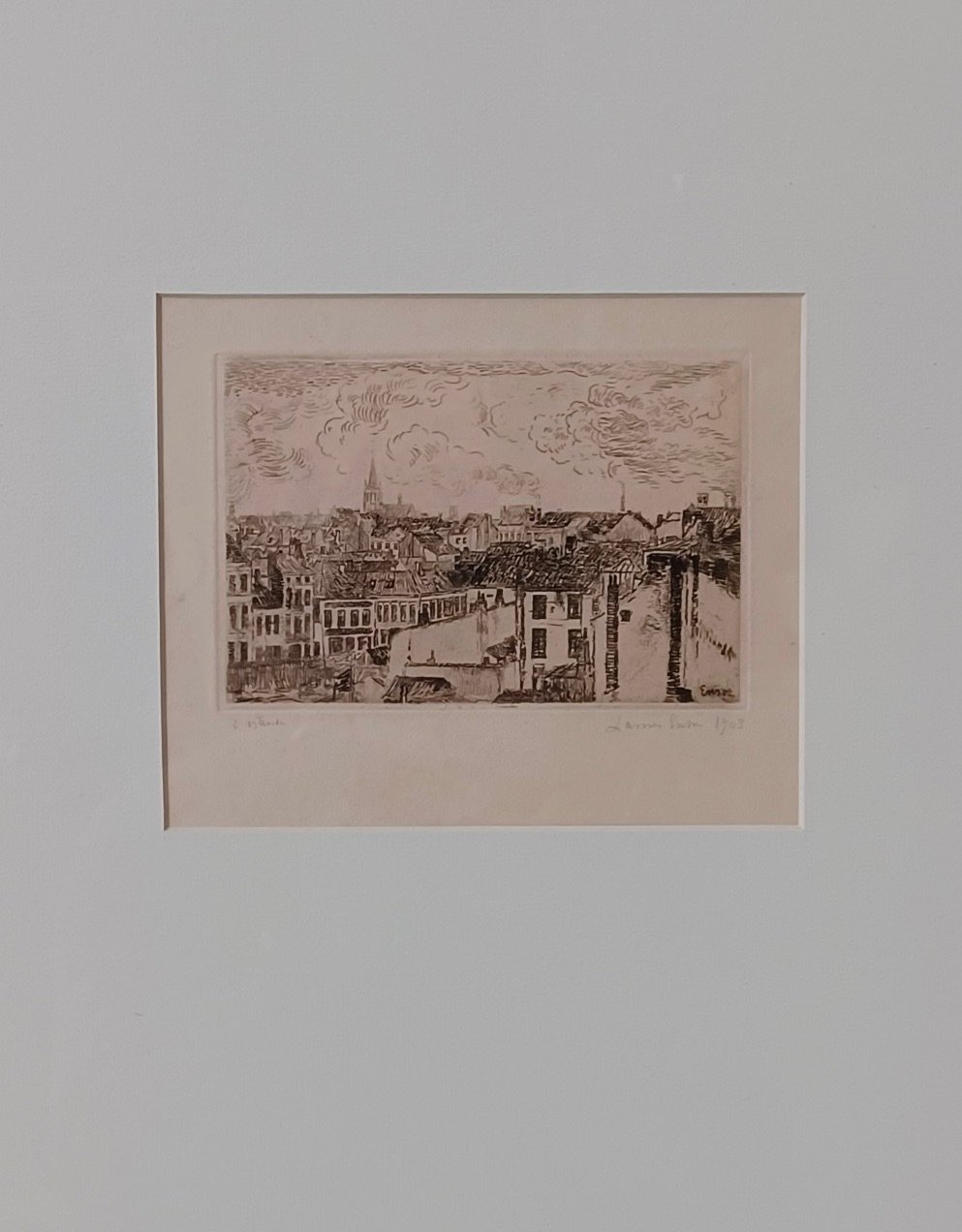
- Image 9.8 x 14.6 mm; 3 3/4 x 5 3/4 inches
- Sheet 53 x 40 mm; 20 3/4 x 15 3/4 inches
- Bibliography: Delteil, Croquez, Tavernier 120, Elesh 125
James Ensor’s 'Les Toits à Ostende' is a 1903 etching depicting a view of the rooftops in the Belgian coastal town of Ostend, where Ensor lived for much of his life. This intimate cityscape offers a glimpse into the town's architecture, with clustered buildings, chimneys, and steeples, set against a cloudy, dynamic sky. The fine detail in the etched lines captures the textures of the rooftops and the atmospheric quality of the overcast sky. The perspective feels close, almost as if viewed from a window, evoking a personal and familiar connection to the town. This piece reflects Ensor’s ability to blend realism with a touch of his characteristic expressiveness, portraying the everyday scene with a sensitivity to light, space, and mood.
James Ensor (Belgium, 1860–1949) was a groundbreaking Symbolist painter known for his satirical and macabre works. His use of masks, skeletons, and vibrant colors reflected themes of death, hypocrisy, and the grotesque, influencing early modern art and Expressionism.
EtchingEtching is a technique where a design is created on a metal surface by using a strong acid or mordant to eat away the unprotected parts of the metal, leaving the desired pattern in relief (intaglio). In modern art and manufacturing, different chemicals may be used depending on the material being etched.
Signed, dated and titled
- Image 9.8 x 14.6 mm; 3 3/4 x 5 3/4 inches
- Sheet 53 x 40 mm; 20 3/4 x 15 3/4 inches
- Bibliography: Delteil, Croquez, Tavernier 120, Elesh 125
James Ensor’s 'Les Toits à Ostende' is a 1903 etching depicting a view of the rooftops in the Belgian coastal town of Ostend, where Ensor lived for much of his life. This intimate cityscape offers a glimpse into the town's architecture, with clustered buildings, chimneys, and steeples, set against a cloudy, dynamic sky. The fine detail in the etched lines captures the textures of the rooftops and the atmospheric quality of the overcast sky. The perspective feels close, almost as if viewed from a window, evoking a personal and familiar connection to the town. This piece reflects Ensor’s ability to blend realism with a touch of his characteristic expressiveness, portraying the everyday scene with a sensitivity to light, space, and mood.
James Ensor (Belgium, 1860–1949) was a groundbreaking Symbolist painter known for his satirical and macabre works. His use of masks, skeletons, and vibrant colors reflected themes of death, hypocrisy, and the grotesque, influencing early modern art and Expressionism.
James Ensor (b. 1860 Belgium, d. 1949 Belgium) was a pioneering Belgian artist whose work bridged the Symbolist and Expressionist movements. Best known for his macabre and fantastical scenes, Ensor often depicted masked figures, skeletons, and bizarre creatures, reflecting his fascination with death, satire, and the absurdity of human existence. He primarily worked in oil painting but also explored etching and drawing.
Ensor’s unique style combined vibrant, almost garish colors with a loose, dynamic brushwork that challenged traditional aesthetics. His works, such as The Entry of Christ into Brussels in 1889, had a significant influence on later avant-garde movements, including Surrealism and German Expressionism. Rooted in the cultural milieu of his hometown, Ostend, and informed by his skepticism of societal norms, Ensor remains a key figure in the transition from 19th-century realism to the expressive experimentation of the 20th century.
Avant-garde refers to innovative and experimental ideas in the arts that challenge established norms and conventions. Originating from the French term for advance guard, it describes both the movement and the artists who push the boundaries of creativity, often exploring new techniques, forms, and concepts. The avant-garde has been a driving force in various art movements throughout history, such as Dadaism, Surrealism, and Abstract Expressionism, continually reshaping the landscape of art and culture.