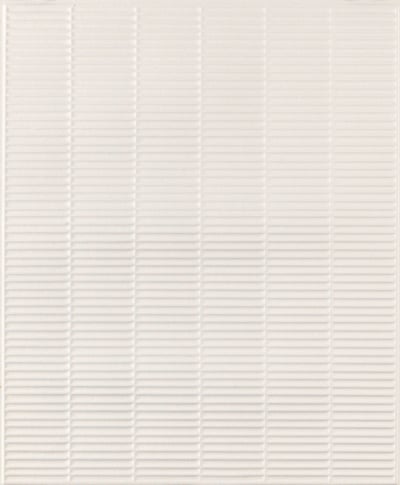
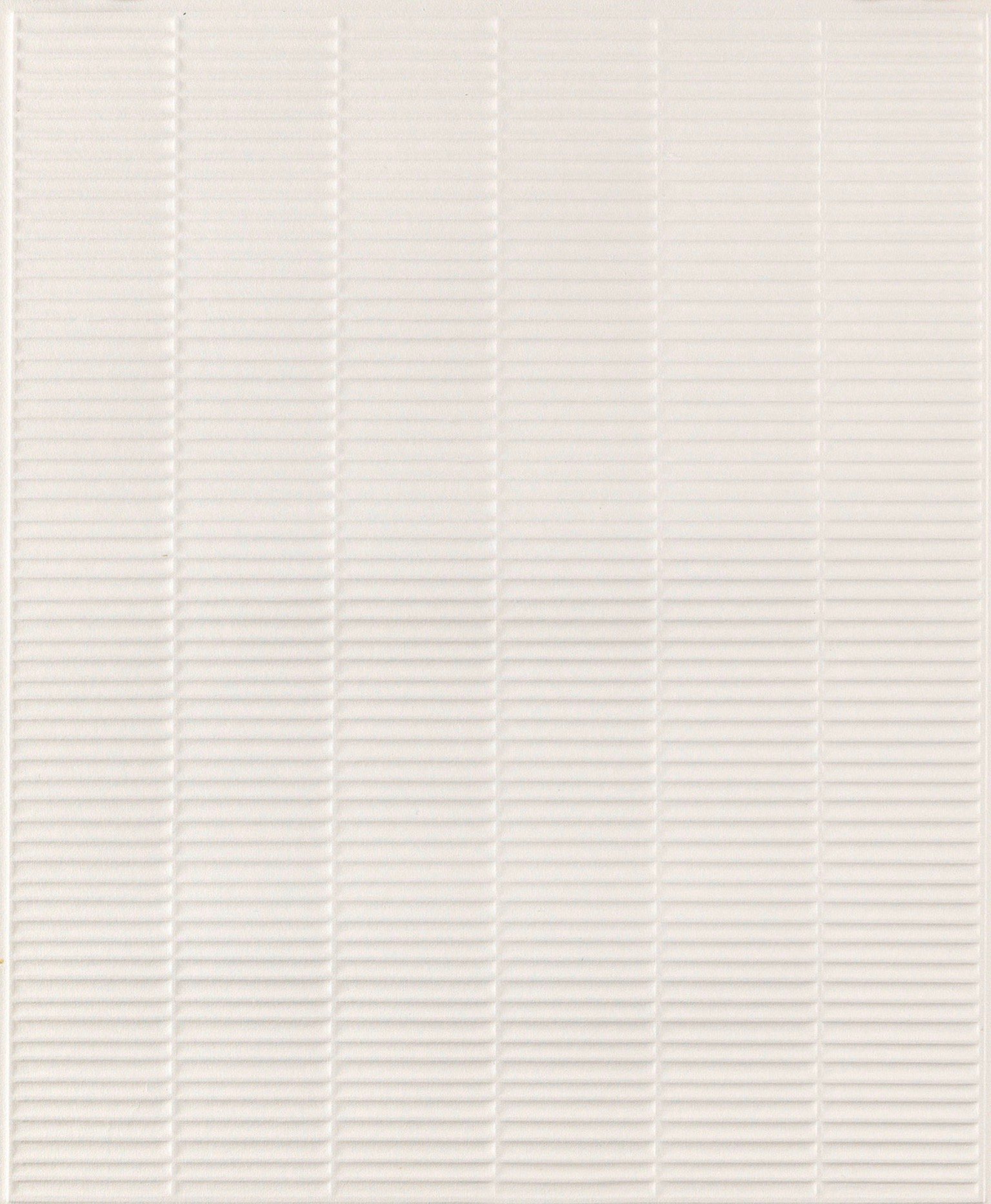
// Untitled M-IV by Jan Schoonhoven, created in 1972, is a limited edition embossing print that embodies the minimalist and structural essence of the Dutch artist's style. Known for his work in the Nul (Zero) movement, Schoonhoven’s piece reflects a fascination with repetition and precision. The embossed lines create a subtle three-dimensional texture, allowing light to play on the surface and emphasize the uniformity of the grid-like pattern. This restrained design invites viewers to consider the nuances of light and shadow, minimalism, and texture within a monochromatic palette. The artwork, limited to an edition of 120, reflects Schoonhoven's intent to explore form and repetition, providing a calm, meditative experience.
Jan Schoonhoven (Netherlands, 1914–1994) was a pioneering abstract artist and a leading figure of the Dutch Nul movement. Renowned for his monochromatic white reliefs, he explored texture and repetition using simple materials like cardboard and paper. His works embody a minimalist aesthetic, emphasizing light and shadow, and are celebrated in international collections.
EmbossingEmbossing is a technique used to create raised designs or images on a surface, typically paper. Artists achieve this effect by altering the shape of the paper, often by pressing it from the reverse side using a template and a tool like a sanded dowel. The result is a design with multiple levels of depth, giving a three-dimensional appearance.
// Untitled M-IV by Jan Schoonhoven, created in 1972, is a limited edition embossing print that embodies the minimalist and structural essence of the Dutch artist's style. Known for his work in the Nul (Zero) movement, Schoonhoven’s piece reflects a fascination with repetition and precision. The embossed lines create a subtle three-dimensional texture, allowing light to play on the surface and emphasize the uniformity of the grid-like pattern. This restrained design invites viewers to consider the nuances of light and shadow, minimalism, and texture within a monochromatic palette. The artwork, limited to an edition of 120, reflects Schoonhoven's intent to explore form and repetition, providing a calm, meditative experience.
Jan Schoonhoven (Netherlands, 1914–1994) was a pioneering abstract artist and a leading figure of the Dutch Nul movement. Renowned for his monochromatic white reliefs, he explored texture and repetition using simple materials like cardboard and paper. His works embody a minimalist aesthetic, emphasizing light and shadow, and are celebrated in international collections.
I want to make it completely immaterial. There must be no more thing from tangible reality.
- Jan Schoonhoven
Jan Schoonhoven was a Dutch artist who was part of the Nulgroep [Dutch Nul Group] in Holland. Another visual artist from the Abstract school, Schoonhoven was born in June 1914. He was trained at The Hague’s Royal Academy of Art, studying there from 1930 – 1934. Although he was mainly a weekend artist during the time he worked for the PPT, or Post Office, Schoonhoven is considered of the most well-respected Dutch artists of the twentieth century. He resided in Delft, Holland for the larger part of his life, though his impact on art movements such as Nederlandse Informele Groep, as well as many individual abstract expressionists, was great. This group was linked to the European Informel Group and the Zero Group. The art works of these groups were styled along the lines of Abstract Expressionism. At the commencement of his career, Schoonhoven painted watercolours, but his enquiries into the nature of art and his rebellion against the values of the Cobra School of Fine Art led him to attempt the creation of works from which all emotional values were expunged. During this period, his oeuvres were created from simple, everyday materials such as cardboard, papier-maché and plywood. Jan Schoonhoven’s art works have been exhibited in many galleries in Holland and Europe. He died in 1994.
Art Informel is a French term referring to the gestural and improvisational techniques common in abstract painting during the 1940s and 50s. It encompasses various styles that dominated these decades, characterized by informal, spontaneous methods. Artists used this term to describe approaches that moved away from traditional structures and embraced more expressive, unstructured techniques.