Screenprint on Arches 300 g Hot Press Watercolor paper
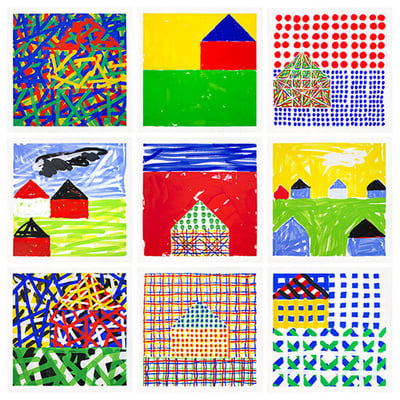
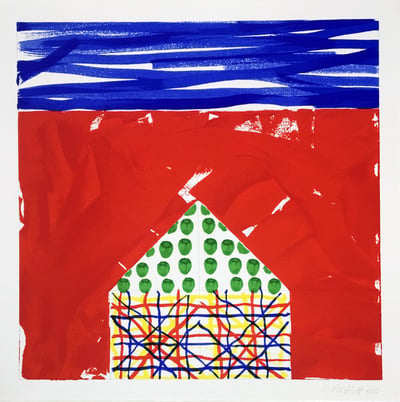
House II #5 by Jennifer Bartlett is a striking screen-print featuring bold color blocks and geometric patterns. Printed on Arches 300 g Hot Press Watercolor paper, the piece showcases a simplified house motif with a patterned roof made of green dots and a base formed by an intricate grid of intersecting lines in primary colors. The house sits against a solid red background, with a blue band at the top representing the sky. The print's layered textures and vibrant palette create a dynamic interplay between abstraction and recognizable forms, highlighting Bartlett's exploration of structure, repetition, and color within her conceptual framework.
Jennifer Bartlett (United States, 1941–2022) was a pioneering artist who merged conceptual rigor with the emotive gestures of Neo-Expressionism. Known for her signature enamel-coated steel plates arranged in grids, her iconic work 'Rhapsody' (1975–76) redefined large-scale painting, blending abstraction and representation with mathematical precision.
Screen-print Screen printing is a technique where ink is transferred through a mesh onto a substrate, with areas blocked by a stencil to prevent ink from passing through. This method, also known as serigraphy or silkscreen printing, is commonly used to produce prints on posters, T-shirts, vinyl, stickers, wood, and other materials. The process is a type of stencil printing, allowing for vibrant, detailed designs on various surfaces.
Screenprint on Arches 300 g Hot Press Watercolor paper
House II #5 by Jennifer Bartlett is a striking screen-print featuring bold color blocks and geometric patterns. Printed on Arches 300 g Hot Press Watercolor paper, the piece showcases a simplified house motif with a patterned roof made of green dots and a base formed by an intricate grid of intersecting lines in primary colors. The house sits against a solid red background, with a blue band at the top representing the sky. The print's layered textures and vibrant palette create a dynamic interplay between abstraction and recognizable forms, highlighting Bartlett's exploration of structure, repetition, and color within her conceptual framework.
Jennifer Bartlett (United States, 1941–2022) was a pioneering artist who merged conceptual rigor with the emotive gestures of Neo-Expressionism. Known for her signature enamel-coated steel plates arranged in grids, her iconic work 'Rhapsody' (1975–76) redefined large-scale painting, blending abstraction and representation with mathematical precision.
Jennifer Bartlett was an American artist who began her career in the mid-1960's after receiving a master of fine arts degree from Yale University’s School of Art and Architecture. At that time minimalism was the popular art form being taught, but Bartlett made a name for herself as an abstract and representational artist. Jennifer Bartlett is recognized for creating grids using 12-inch steel square plates that have been baked with white enamel with silkscreen, then she would paint ordinary everyday shapes, objects and scenes on these plates to form one cohesive piece of art. One of Bartlett's most famous works is titled “Rhapsody” which made its first appearance in 1976. The piece consists of 987 plates in 142 vertical rows of seven that presents an expandable painting that can be wrapped around walls and corners. This piece features a house, tree, mountain, and ocean along with various shapes such as a circle, square, triangle, and lines. This piece incorporates a variety of art styles including conceptual art, neo-expressionism, and photo realism.
Abstract Expressionism is an art movement that emerged in the United States during the 1940s and 1950s. Characterized by large, abstract canvases, the movement emphasized spontaneous, expressive brushwork and the use of color and form to convey emotion rather than represent reality. Artists like Jackson Pollock, Mark Rothko, and Willem de Kooning are key figures in this movement. Abstract Expressionism marked a shift in the art world, making New York City a center of the international art scene.