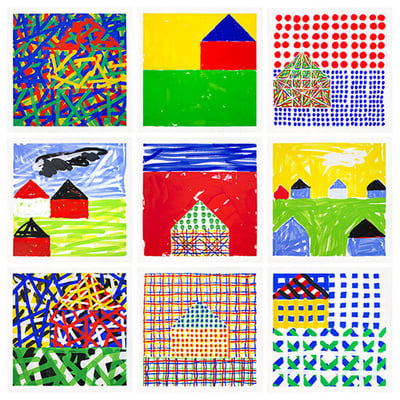
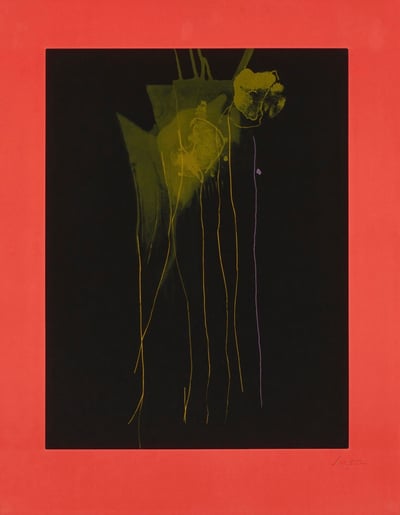
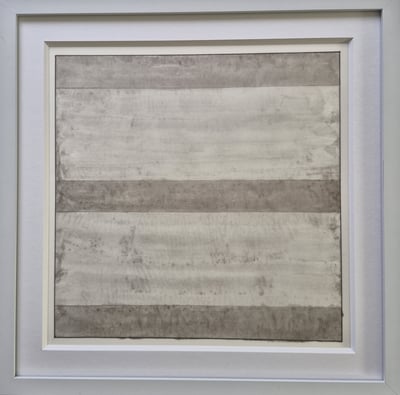
Set of 9 serigraphs - From the edition of 45 + PP
- Sheet size : 20" x 20" each - Image size : 18" x 18" each
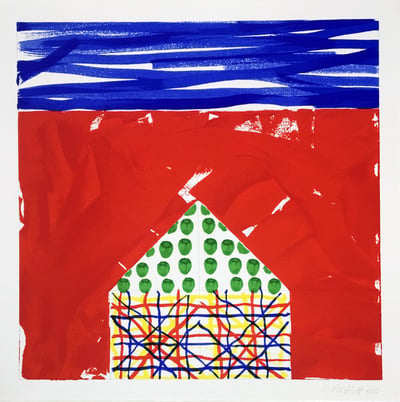
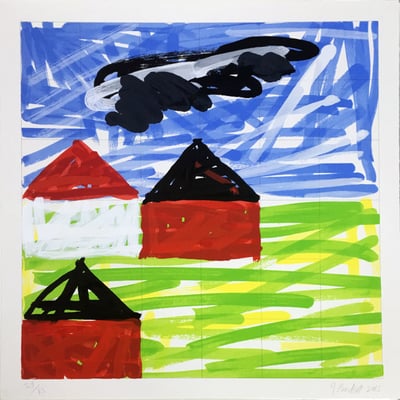
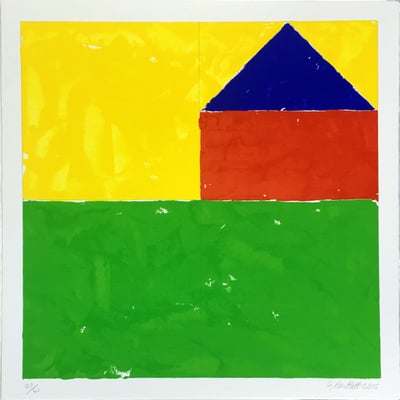
House II (Suite of 9) by Jennifer Bartlett is a serigraph series featuring nine vibrant prints that explore the recurring motif of a house. The limited edition set showcases Bartlett’s systematic and abstract approach, where each piece is rendered using bold primary colors, geometric patterns, and varied textures. The houses, depicted in a simplified form, are surrounded by grids, dots, and strokes, creating visual diversity and rhythm across the suite. Bartlett's methodical manipulation of these elements reflects her interest in repetition and variation, echoing the conceptual art movement she often engages with. This series demonstrates her ability to balance simplicity and complexity in contemporary art.
Jennifer Bartlett (United States, 1941–2022) was a pioneering artist who merged conceptual rigor with the emotive gestures of Neo-Expressionism. Known for her signature enamel-coated steel plates arranged in grids, her iconic work 'Rhapsody' (1975–76) redefined large-scale painting, blending abstraction and representation with mathematical precision.
Serigraph Serigraph is a printmaking process that uses silk screen techniques to create an image. The image is digitally separated into individual colors, each of which is assigned to a separate silk screen. These screens are then used to apply each color by hand, layer by layer, to replicate the original artwork, often based on an oil painting.
Set of 9 serigraphs - From the edition of 45 + PP
- Sheet size : 20" x 20" each - Image size : 18" x 18" each
House II (Suite of 9) by Jennifer Bartlett is a serigraph series featuring nine vibrant prints that explore the recurring motif of a house. The limited edition set showcases Bartlett’s systematic and abstract approach, where each piece is rendered using bold primary colors, geometric patterns, and varied textures. The houses, depicted in a simplified form, are surrounded by grids, dots, and strokes, creating visual diversity and rhythm across the suite. Bartlett's methodical manipulation of these elements reflects her interest in repetition and variation, echoing the conceptual art movement she often engages with. This series demonstrates her ability to balance simplicity and complexity in contemporary art.
Jennifer Bartlett (United States, 1941–2022) was a pioneering artist who merged conceptual rigor with the emotive gestures of Neo-Expressionism. Known for her signature enamel-coated steel plates arranged in grids, her iconic work 'Rhapsody' (1975–76) redefined large-scale painting, blending abstraction and representation with mathematical precision.
Jennifer Bartlett was an American artist who began her career in the mid-1960's after receiving a master of fine arts degree from Yale University’s School of Art and Architecture. At that time minimalism was the popular art form being taught, but Bartlett made a name for herself as an abstract and representational artist. Jennifer Bartlett is recognized for creating grids using 12-inch steel square plates that have been baked with white enamel with silkscreen, then she would paint ordinary everyday shapes, objects and scenes on these plates to form one cohesive piece of art. One of Bartlett's most famous works is titled “Rhapsody” which made its first appearance in 1976. The piece consists of 987 plates in 142 vertical rows of seven that presents an expandable painting that can be wrapped around walls and corners. This piece features a house, tree, mountain, and ocean along with various shapes such as a circle, square, triangle, and lines. This piece incorporates a variety of art styles including conceptual art, neo-expressionism, and photo realism.
Generative art refers to art that is wholly or partly created through an autonomous system. This system can be independent or non-human, capable of determining features that would otherwise be decided by the artist. The generative system can act as the creator or as a collaborator with the artist. Generative art often refers to works generated algorithmically by computers, where the system plays a significant role in the creation process.