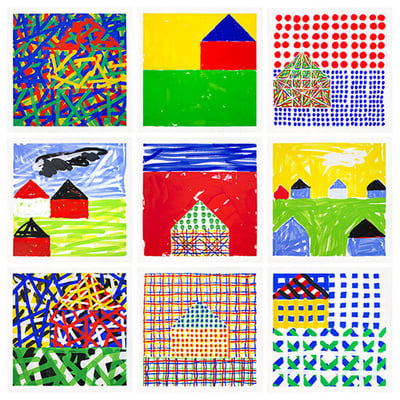
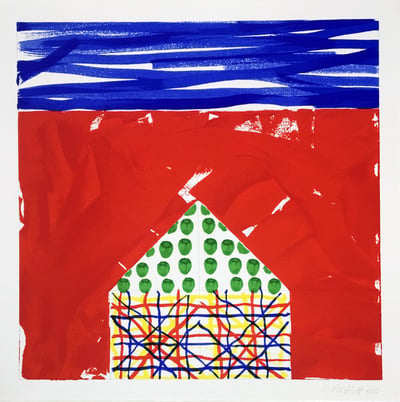
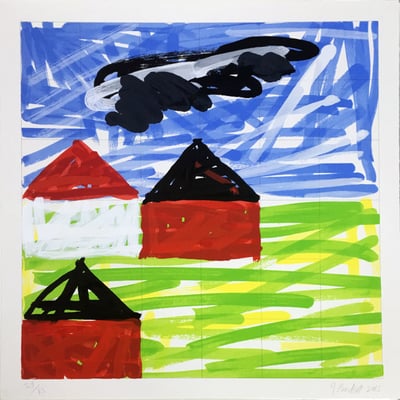
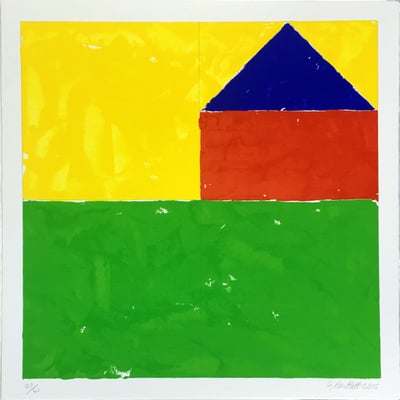
Screenprint on Arches 300 g Hot Press Watercolor paper
House II #6 by Jennifer Bartlett is a screen-print that explores simplicity through vivid color and geometric forms. Printed on Arches 300 g Hot Press Watercolor paper, the piece features a series of stylized houses against a bright yellow background with a white cloud, evoking a playful, almost childlike landscape. The green strokes at the bottom create a field, while blue, red, and black shapes form the house structures. Bartlett’s use of bold, flat colors and minimal details emphasizes the conceptual and abstract nature of her work, transforming the ordinary motif of a house into a study of pattern, color, and composition.
Jennifer Bartlett (United States, 1941–2022) was a pioneering artist who merged conceptual rigor with the emotive gestures of Neo-Expressionism. Known for her signature enamel-coated steel plates arranged in grids, her iconic work 'Rhapsody' (1975–76) redefined large-scale painting, blending abstraction and representation with mathematical precision.
Screen-print Screen printing is a technique where ink is transferred through a mesh onto a substrate, with areas blocked by a stencil to prevent ink from passing through. This method, also known as serigraphy or silkscreen printing, is commonly used to produce prints on posters, T-shirts, vinyl, stickers, wood, and other materials. The process is a type of stencil printing, allowing for vibrant, detailed designs on various surfaces.
Screenprint on Arches 300 g Hot Press Watercolor paper
House II #6 by Jennifer Bartlett is a screen-print that explores simplicity through vivid color and geometric forms. Printed on Arches 300 g Hot Press Watercolor paper, the piece features a series of stylized houses against a bright yellow background with a white cloud, evoking a playful, almost childlike landscape. The green strokes at the bottom create a field, while blue, red, and black shapes form the house structures. Bartlett’s use of bold, flat colors and minimal details emphasizes the conceptual and abstract nature of her work, transforming the ordinary motif of a house into a study of pattern, color, and composition.
Jennifer Bartlett (United States, 1941–2022) was a pioneering artist who merged conceptual rigor with the emotive gestures of Neo-Expressionism. Known for her signature enamel-coated steel plates arranged in grids, her iconic work 'Rhapsody' (1975–76) redefined large-scale painting, blending abstraction and representation with mathematical precision.
Jennifer Bartlett was an American artist who began her career in the mid-1960's after receiving a master of fine arts degree from Yale University’s School of Art and Architecture. At that time minimalism was the popular art form being taught, but Bartlett made a name for herself as an abstract and representational artist. Jennifer Bartlett is recognized for creating grids using 12-inch steel square plates that have been baked with white enamel with silkscreen, then she would paint ordinary everyday shapes, objects and scenes on these plates to form one cohesive piece of art. One of Bartlett's most famous works is titled “Rhapsody” which made its first appearance in 1976. The piece consists of 987 plates in 142 vertical rows of seven that presents an expandable painting that can be wrapped around walls and corners. This piece features a house, tree, mountain, and ocean along with various shapes such as a circle, square, triangle, and lines. This piece incorporates a variety of art styles including conceptual art, neo-expressionism, and photo realism.
Photorealism is a genre of art or artistic movement that involves drawing, painting, and other graphic media in which the artist carefully studies a photograph and attempts to reproduce it as realistically as possible in another medium. While the term can broadly describe any artwork created in this manner, it specifically refers to a group of painters and paintings in the U.S. art movement that emerged in the late 1960s and early 1970s.