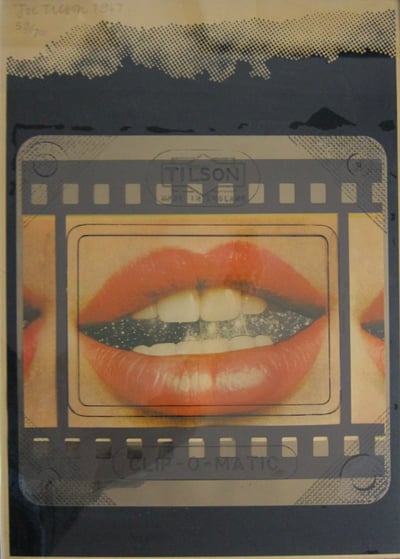
Screen print and offset on metallic film.
Size: 70.5 x 51 cm (frame size).
Published by the Marlborough Gallery, framed
Paper slightly yellowed (see photo), otherwise very good condition.
Joe Tilson’s Transparency (clip o matic) (1967) is a screen print and offset work on metallic film that reflects the visual language of British Pop Art. Published by Marlborough Gallery in a numbered edition of 70 and hand-signed by the artist, the print combines photographic imagery with graphic framing devices. A close-up of parted lips, rendered in warm tones, is set within a stylized filmstrip motif labeled “Clip-O-Matic,” evoking mass media, cinema, and mechanical reproduction. The metallic surface enhances the sense of sheen and artificiality, reinforcing themes of consumer culture and image circulation that defined the 1960s. The work’s layered transparency effects create a dialogue between glamour and industrial process.
Joe Tilson (United Kingdom, 1928–2023) was a British artist and a leading figure in the Pop Art movement of the 1960s. His work encompassed paintings, prints, and constructions, often incorporating vibrant colors and popular culture imagery. Tilson's art is held in public collections including the Tate Gallery, London; MoMA, New York; and the Stedelijk Museum, Amsterdam.
Mixed MediaMixed media refers to artwork that incorporates more than one medium within a single piece. Unlike multimedia art, which combines distinct forms of visual art and often includes elements like sound, video, or digital media, mixed media focuses on combining traditional art materials, such as paint, ink, and collage. Mixed media art allows artists to achieve a wide range of effects and textures by layering and blending different materials.
Screen print and offset on metallic film.
Size: 70.5 x 51 cm (frame size).
Published by the Marlborough Gallery, framed
Paper slightly yellowed (see photo), otherwise very good condition.
Joe Tilson’s Transparency (clip o matic) (1967) is a screen print and offset work on metallic film that reflects the visual language of British Pop Art. Published by Marlborough Gallery in a numbered edition of 70 and hand-signed by the artist, the print combines photographic imagery with graphic framing devices. A close-up of parted lips, rendered in warm tones, is set within a stylized filmstrip motif labeled “Clip-O-Matic,” evoking mass media, cinema, and mechanical reproduction. The metallic surface enhances the sense of sheen and artificiality, reinforcing themes of consumer culture and image circulation that defined the 1960s. The work’s layered transparency effects create a dialogue between glamour and industrial process.
Joe Tilson (United Kingdom, 1928–2023) was a British artist and a leading figure in the Pop Art movement of the 1960s. His work encompassed paintings, prints, and constructions, often incorporating vibrant colors and popular culture imagery. Tilson's art is held in public collections including the Tate Gallery, London; MoMA, New York; and the Stedelijk Museum, Amsterdam.
I think it's a mistake for painters or poets to get too involved in politics, any more than it makes sense for them to get swept up in being fashionable.
- Joe Tilson
One of the leading artists of the 1960’s British Pop Art movement, Joe Tilson has drawn from his own experience as a carpenter to create wooden reliefs and constructions, alongside prints and paintings. His earliest work was print-making; Tilson would craft unique prints on which he would paint directly, adding a handmade quality - he would often blur the lines between two and three-dimensional space, as evident in his Bela Lugosi Journal piece. Later in his career, Tilson began to widen his range of materials to include rope, straw and stone, all of which he used as a means to escape the constraints of time and culture by making use of pre-classical motifs for which he is now widely recognised. (Artist website)
Kitsch is a term used to describe cheap, commercial, sentimental, or vulgar art and objects commonly associated with popular culture. The word is borrowed from German, where it originally means trash. Since the 1920s, kitsch has been used to denote the opposite of high art, often implying that the work lacks sophistication or artistic merit.