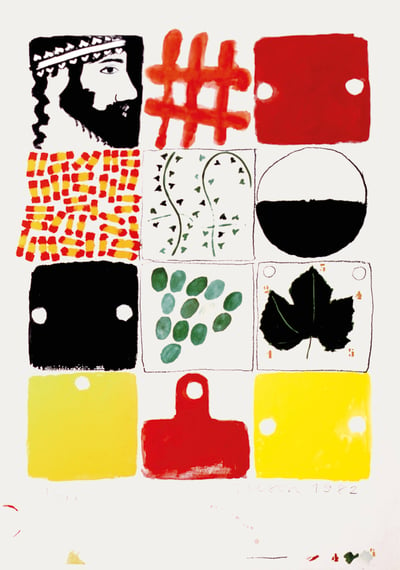
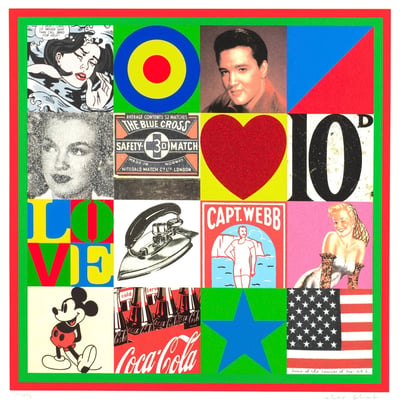
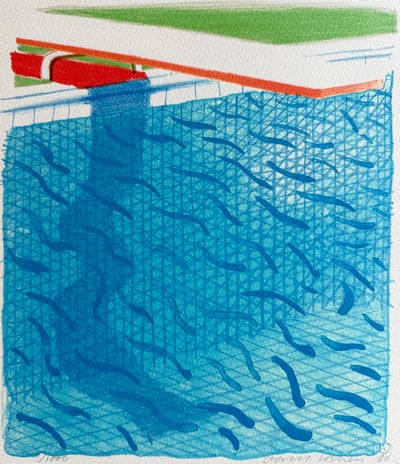
Joe Tilson’s Untitled (Symbols and Fragments) (1989) is a vibrant lithograph that assembles a grid of twelve colorful panels, each featuring distinct symbols, shapes, and textures. The artwork juxtaposes classical and natural imagery, such as a profile of a bearded figure evocative of ancient Greek art, with modern abstract forms, including grids, dots, and organic shapes like leaves and seeds. Tilson's use of bold, primary colors—red, yellow, black, and white—creates a dynamic and visually engaging composition. The grid structure and diverse motifs evoke themes of memory, culture, and the relationship between human-made and natural elements. This limited-edition print, measuring 100 x 70 cm, exemplifies Tilson’s ability to blend historical references with contemporary design aesthetics.
Joe Tilson (United Kingdom, 1928–2023) was a British artist and a leading figure in the Pop Art movement of the 1960s. His work encompassed paintings, prints, and constructions, often incorporating vibrant colors and popular culture imagery. Tilson's art is held in public collections including the Tate Gallery, London; MoMA, New York; and the Stedelijk Museum, Amsterdam.
Lithograph Lithography is a printing method based on the principle that water and oil do not mix. It can be used to print artwork or text onto paper or other suitable materials. Traditionally, an image was drawn with wax, fat, or oil onto a lithographic limestone surface or plate. Today, metal plates and other surfaces are also used in lithographic printing.
Joe Tilson’s Untitled (Symbols and Fragments) (1989) is a vibrant lithograph that assembles a grid of twelve colorful panels, each featuring distinct symbols, shapes, and textures. The artwork juxtaposes classical and natural imagery, such as a profile of a bearded figure evocative of ancient Greek art, with modern abstract forms, including grids, dots, and organic shapes like leaves and seeds. Tilson's use of bold, primary colors—red, yellow, black, and white—creates a dynamic and visually engaging composition. The grid structure and diverse motifs evoke themes of memory, culture, and the relationship between human-made and natural elements. This limited-edition print, measuring 100 x 70 cm, exemplifies Tilson’s ability to blend historical references with contemporary design aesthetics.
Joe Tilson (United Kingdom, 1928–2023) was a British artist and a leading figure in the Pop Art movement of the 1960s. His work encompassed paintings, prints, and constructions, often incorporating vibrant colors and popular culture imagery. Tilson's art is held in public collections including the Tate Gallery, London; MoMA, New York; and the Stedelijk Museum, Amsterdam.
I think it's a mistake for painters or poets to get too involved in politics, any more than it makes sense for them to get swept up in being fashionable.
- Joe Tilson
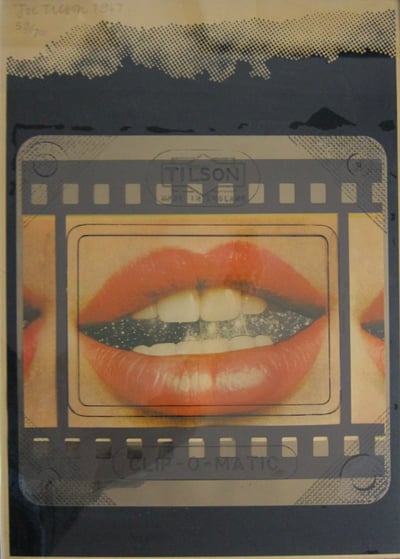
One of the leading artists of the 1960’s British Pop Art movement, Joe Tilson has drawn from his own experience as a carpenter to create wooden reliefs and constructions, alongside prints and paintings. His earliest work was print-making; Tilson would craft unique prints on which he would paint directly, adding a handmade quality - he would often blur the lines between two and three-dimensional space, as evident in his Bela Lugosi Journal piece. Later in his career, Tilson began to widen his range of materials to include rope, straw and stone, all of which he used as a means to escape the constraints of time and culture by making use of pre-classical motifs for which he is now widely recognised. (Artist website)
Activist Art is a form of art created to address social and political issues. It often involves public engagement and works closely with communities to raise awareness or inspire change. While it can include elements of performance art, it is not limited to this form. Examples include creating and distributing social protest posters or organizing community-based art projects that highlight specific causes.