Lithograph in colors with hand-coloring.
Image: 50.25 × 39 in (128 × 99 cm)
Sheet: 53.5 × 39.75 in (136 × 101 cm)
Signed, dated and numbered to lower edge .
Printed by Michael Mackenzie, New York and published by American Image Art, New York.
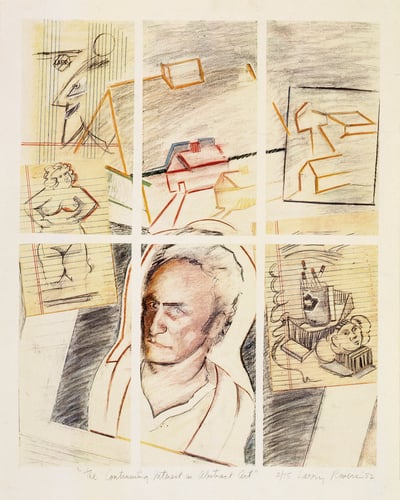
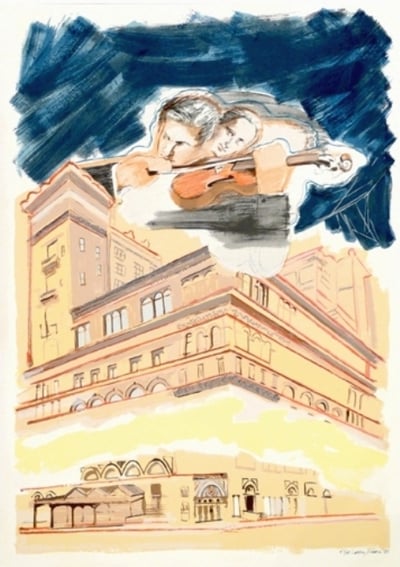
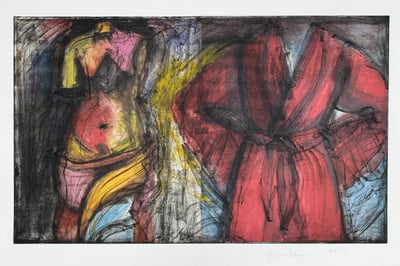
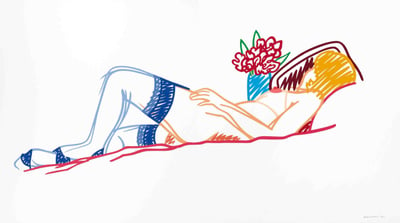
Golden Tales by Larry Rivers, created in 1990, is a large-scale lithograph enriched with hand-coloring, merging portraiture, symbolism, and playful commentary. A stylized figure labeled “Webster” sits in a wooden box-like structure, his face framed and surrounded by bright flowers. The fragmented rendering, expressive lines, and cartoonish touches highlight Rivers’ signature blend of realism and abstraction. The piece layers historical reference with satirical narrative, possibly alluding to American identity, memory, or mythology. Printed by Michael Mackenzie and published by American Image Art, this work exemplifies Rivers' ability to infuse fine art with personal, political, and cultural motifs.
Larry Rivers (United States, 1923–2002) was a multifaceted artist whose work bridged Abstract Expressionism and Pop Art. Initially a jazz saxophonist, he transitioned to visual arts, creating paintings and sculptures that often incorporated commercial imagery and cultural references. Rivers' innovative approach significantly influenced post-war American art.
Lithograph Lithography is a printing method based on the principle that water and oil do not mix. It can be used to print artwork or text onto paper or other suitable materials. Traditionally, an image was drawn with wax, fat, or oil onto a lithographic limestone surface or plate. Today, metal plates and other surfaces are also used in lithographic printing.
Lithograph in colors with hand-coloring.
Image: 50.25 × 39 in (128 × 99 cm)
Sheet: 53.5 × 39.75 in (136 × 101 cm)
Signed, dated and numbered to lower edge .
Printed by Michael Mackenzie, New York and published by American Image Art, New York.
Golden Tales by Larry Rivers, created in 1990, is a large-scale lithograph enriched with hand-coloring, merging portraiture, symbolism, and playful commentary. A stylized figure labeled “Webster” sits in a wooden box-like structure, his face framed and surrounded by bright flowers. The fragmented rendering, expressive lines, and cartoonish touches highlight Rivers’ signature blend of realism and abstraction. The piece layers historical reference with satirical narrative, possibly alluding to American identity, memory, or mythology. Printed by Michael Mackenzie and published by American Image Art, this work exemplifies Rivers' ability to infuse fine art with personal, political, and cultural motifs.
Larry Rivers (United States, 1923–2002) was a multifaceted artist whose work bridged Abstract Expressionism and Pop Art. Initially a jazz saxophonist, he transitioned to visual arts, creating paintings and sculptures that often incorporated commercial imagery and cultural references. Rivers' innovative approach significantly influenced post-war American art.
Any art communicates what you're in the mood to receive.
- Larry Rivers
Larry Rivers (b. 1923 USA, d. 2002 USA) was an influential American painter, sculptor, and filmmaker, often credited as a key figure in the development of Pop Art. Rivers' work is characterized by its bold use of color, dynamic compositions, and incorporation of everyday objects and popular culture references, blending abstraction with figuration in innovative ways. He began his career as a jazz musician before turning to painting in the late 1940s, studying under Hans Hofmann and becoming associated with the New York School. Rivers is best known for his works that juxtapose traditional artistic techniques with contemporary themes, such as his iconic Washington Crossing the Delaware (1953), which reinterprets the famous historical painting in a modern context. His art often challenged conventional boundaries, merging high art with popular imagery and exploring themes of history, identity, and politics. Rivers' work has been exhibited in major museums and galleries worldwide, and he remains a significant figure in the history of 20th-century American art. (Artist website)
Gestural art is a term that describes painting with freely sweeping brushstrokes. The primary goal of gestural art is to allow the artist to physically express emotional impulses. The varied, yet expressive paint marks are intended to convey the artist's inner thoughts and emotions, which viewers are believed to understand through the dynamic and spontaneous application of paint.