From the Carnegie Hall 100th Anniversary portfolio
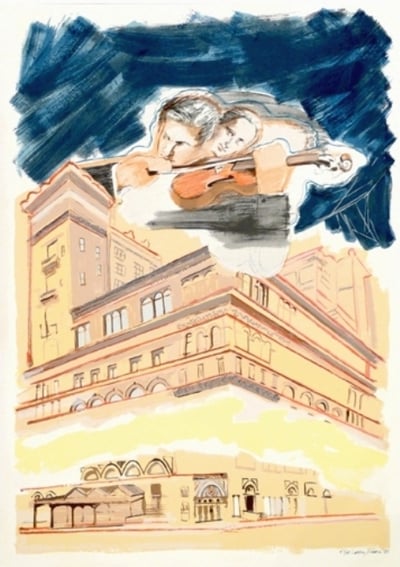
Larry Rivers' Sky Music Over Carnegie Hall (1990) is a vibrant screen-print created in celebration of Carnegie Hall's 100th anniversary. This artwork combines architectural elements with a dynamic, expressive portrayal of musicians, highlighting the iconic venue's significance as a cultural landmark. The lower portion depicts the historic façade of Carnegie Hall in warm hues, while above, two musicians are shown immersed in their performance, their forms blending into the night sky painted in bold, expressive strokes. The contrast between the architectural structure and the energetic portrayal of the musicians captures the spirit of Carnegie Hall as a place where art and music converge. This print reflects Rivers’ interest in merging realism with abstract expression, and it serves as a tribute to the artistic legacy of Carnegie Hall.
Larry Rivers (United States, 1923–2002) was a multifaceted artist whose work bridged Abstract Expressionism and Pop Art. Initially a jazz saxophonist, he transitioned to visual arts, creating paintings and sculptures that often incorporated commercial imagery and cultural references. Rivers' innovative approach significantly influenced post-war American art.
ScreenprintScreen printing is a technique where ink is transferred through a mesh onto a substrate, with areas blocked by a stencil to prevent ink from passing through. This method, also known as serigraphy or silkscreen printing, is commonly used to produce prints on posters, T-shirts, vinyl, stickers, wood, and other materials. The process is a type of stencil printing, allowing for vibrant, detailed designs on various surfaces.
From the Carnegie Hall 100th Anniversary portfolio
Larry Rivers' Sky Music Over Carnegie Hall (1990) is a vibrant screen-print created in celebration of Carnegie Hall's 100th anniversary. This artwork combines architectural elements with a dynamic, expressive portrayal of musicians, highlighting the iconic venue's significance as a cultural landmark. The lower portion depicts the historic façade of Carnegie Hall in warm hues, while above, two musicians are shown immersed in their performance, their forms blending into the night sky painted in bold, expressive strokes. The contrast between the architectural structure and the energetic portrayal of the musicians captures the spirit of Carnegie Hall as a place where art and music converge. This print reflects Rivers’ interest in merging realism with abstract expression, and it serves as a tribute to the artistic legacy of Carnegie Hall.
Larry Rivers (United States, 1923–2002) was a multifaceted artist whose work bridged Abstract Expressionism and Pop Art. Initially a jazz saxophonist, he transitioned to visual arts, creating paintings and sculptures that often incorporated commercial imagery and cultural references. Rivers' innovative approach significantly influenced post-war American art.
Any art communicates what you're in the mood to receive.
- Larry Rivers
Larry Rivers (b. 1923 USA, d. 2002 USA) was an influential American painter, sculptor, and filmmaker, often credited as a key figure in the development of Pop Art. Rivers' work is characterized by its bold use of color, dynamic compositions, and incorporation of everyday objects and popular culture references, blending abstraction with figuration in innovative ways. He began his career as a jazz musician before turning to painting in the late 1940s, studying under Hans Hofmann and becoming associated with the New York School. Rivers is best known for his works that juxtapose traditional artistic techniques with contemporary themes, such as his iconic Washington Crossing the Delaware (1953), which reinterprets the famous historical painting in a modern context. His art often challenged conventional boundaries, merging high art with popular imagery and exploring themes of history, identity, and politics. Rivers' work has been exhibited in major museums and galleries worldwide, and he remains a significant figure in the history of 20th-century American art. (Artist website)
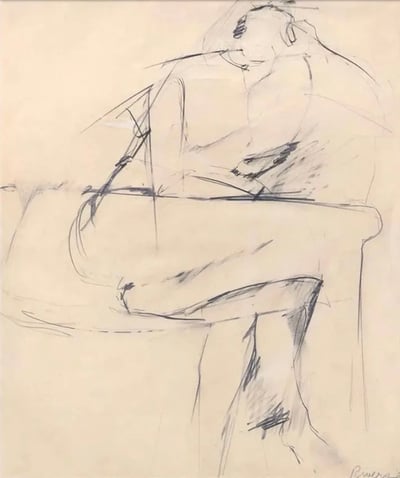
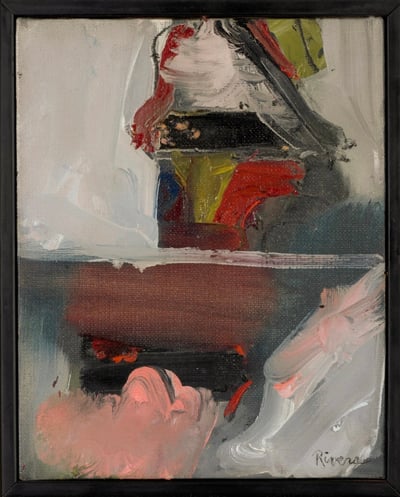
Gestural art is a term that describes painting with freely sweeping brushstrokes. The primary goal of gestural art is to allow the artist to physically express emotional impulses. The varied, yet expressive paint marks are intended to convey the artist's inner thoughts and emotions, which viewers are believed to understand through the dynamic and spontaneous application of paint.