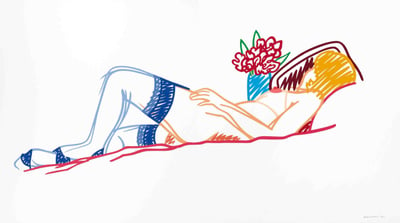
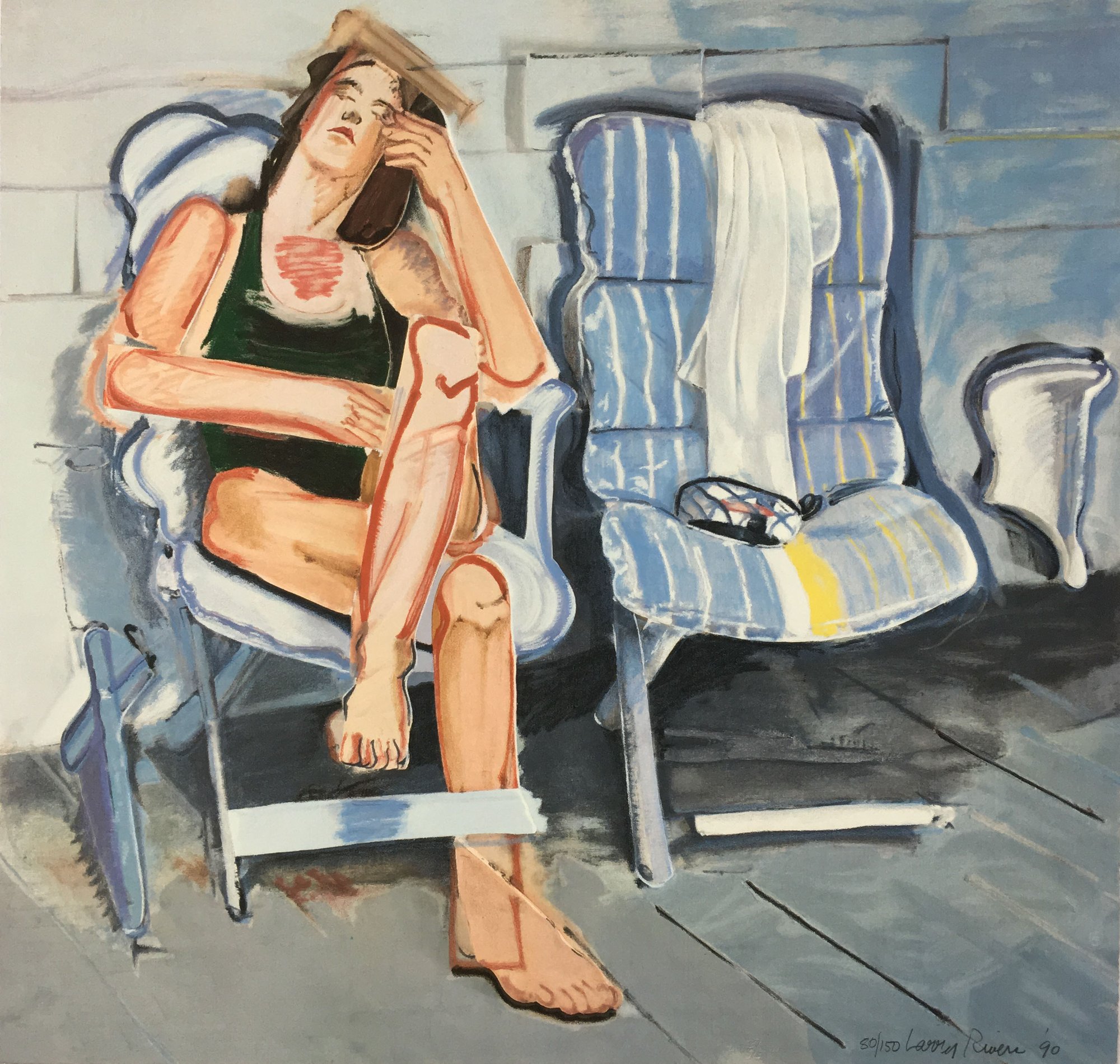
// House of Cards - Blue by Larry Rivers is a compelling screen print from 1990, capturing a contemplative moment with bold and expressive lines. The artwork presents a seated woman with her arm resting on her head, lost in thought. She occupies a set of blue-striped chairs, with a towel draped over one and a mask casually placed beside her, suggesting a moment of pause or introspection. Rivers’ distinctive style combines loosely sketched elements with blocks of color, creating a dynamic interplay between realism and abstraction. The blue tones lend the piece a serene, reflective mood, contrasting with the red outline details that add a sense of energy and movement. Produced as a limited edition of 150, House of Cards - Blue invites viewers to consider themes of solitude and contemplation.
Larry Rivers (United States, 1923–2002) was a multifaceted artist whose work bridged Abstract Expressionism and Pop Art. Initially a jazz saxophonist, he transitioned to visual arts, creating paintings and sculptures that often incorporated commercial imagery and cultural references. Rivers' innovative approach significantly influenced post-war American art.
Screen-print Screen printing is a technique where ink is transferred through a mesh onto a substrate, with areas blocked by a stencil to prevent ink from passing through. This method, also known as serigraphy or silkscreen printing, is commonly used to produce prints on posters, T-shirts, vinyl, stickers, wood, and other materials. The process is a type of stencil printing, allowing for vibrant, detailed designs on various surfaces.
// House of Cards - Blue by Larry Rivers is a compelling screen print from 1990, capturing a contemplative moment with bold and expressive lines. The artwork presents a seated woman with her arm resting on her head, lost in thought. She occupies a set of blue-striped chairs, with a towel draped over one and a mask casually placed beside her, suggesting a moment of pause or introspection. Rivers’ distinctive style combines loosely sketched elements with blocks of color, creating a dynamic interplay between realism and abstraction. The blue tones lend the piece a serene, reflective mood, contrasting with the red outline details that add a sense of energy and movement. Produced as a limited edition of 150, House of Cards - Blue invites viewers to consider themes of solitude and contemplation.
Larry Rivers (United States, 1923–2002) was a multifaceted artist whose work bridged Abstract Expressionism and Pop Art. Initially a jazz saxophonist, he transitioned to visual arts, creating paintings and sculptures that often incorporated commercial imagery and cultural references. Rivers' innovative approach significantly influenced post-war American art.
Any art communicates what you're in the mood to receive.
- Larry Rivers
Larry Rivers (b. 1923 USA, d. 2002 USA) was an influential American painter, sculptor, and filmmaker, often credited as a key figure in the development of Pop Art. Rivers' work is characterized by its bold use of color, dynamic compositions, and incorporation of everyday objects and popular culture references, blending abstraction with figuration in innovative ways. He began his career as a jazz musician before turning to painting in the late 1940s, studying under Hans Hofmann and becoming associated with the New York School. Rivers is best known for his works that juxtapose traditional artistic techniques with contemporary themes, such as his iconic Washington Crossing the Delaware (1953), which reinterprets the famous historical painting in a modern context. His art often challenged conventional boundaries, merging high art with popular imagery and exploring themes of history, identity, and politics. Rivers' work has been exhibited in major museums and galleries worldwide, and he remains a significant figure in the history of 20th-century American art. (Artist website)
Lettrism is an art form that uses letters, words, and symbols to create artwork. The movement was established in Paris in the 1940s and later gained popularity in the 1950s in America. Lettrisme is the French spelling of the movement's name, derived from the French word for letter.