


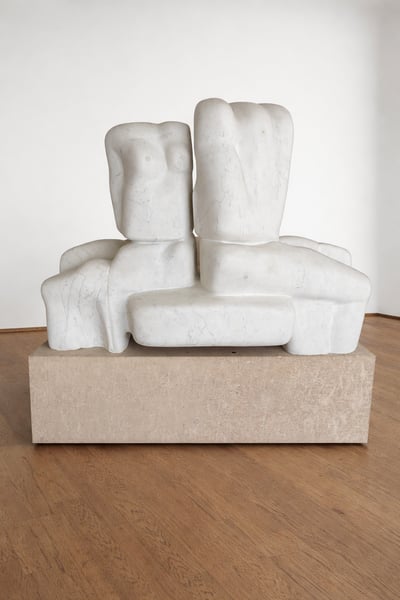
Hand-carved from a single piece of Carrara marble, this sculpture rests on its original stone base, which is included with the work.
'Seated Couple' by Livia Canestraro is a hand-carved Carrara marble sculpture composed of interlocking, abstracted human forms. The figures are reduced to smooth, rounded volumes with minimal anatomical detail, their bodies merging into a unified block. Subtle indications of torsos and limbs suggest intimacy and physical closeness, while the polished white marble surface reveals delicate veining that adds texture and depth. The composition emphasizes balance and solidity, resting firmly on a rectangular stone base. The work reflects modern sculptural tendencies toward abstraction, exploring themes of companionship, unity, and the human form through simplified, monumental shapes.
Artwork Copyright © Livia CanestraroLivia Canestraro (Rome, 1936) is a Belgian sculptor and painter known for her figurative public artworks. Working often with her husband, Stefaan Depuydt, she created sculptures that combine human warmth with civic presence. Her best-known works in Bruges reflect a late modern style rooted in public space, architecture, and accessible emotion.
Artwork Copyright © Livia CanestraroSeated Couple, ca 1985
Form
Medium
Size
- Inches
- Centimeters
Edition
Price
- USD
- EUR
- GBP
- CHF
- Authenticity Guaranteed
- Insured Shipping
- Online Since 2005
●Inventory 16779
●Signed
●Comes with gallery invoice and certificate
●Sell Us a Similar Artwork. Learn more.
Hand-carved from a single piece of Carrara marble, this sculpture rests on its original stone base, which is included with the work.
'Seated Couple' by Livia Canestraro is a hand-carved Carrara marble sculpture composed of interlocking, abstracted human forms. The figures are reduced to smooth, rounded volumes with minimal anatomical detail, their bodies merging into a unified block. Subtle indications of torsos and limbs suggest intimacy and physical closeness, while the polished white marble surface reveals delicate veining that adds texture and depth. The composition emphasizes balance and solidity, resting firmly on a rectangular stone base. The work reflects modern sculptural tendencies toward abstraction, exploring themes of companionship, unity, and the human form through simplified, monumental shapes.
Artwork Copyright © Livia CanestraroLivia Canestraro (Rome, 1936) is a Belgian sculptor and painter known for her figurative public artworks. Working often with her husband, Stefaan Depuydt, she created sculptures that combine human warmth with civic presence. Her best-known works in Bruges reflect a late modern style rooted in public space, architecture, and accessible emotion.
Artwork Copyright © Livia Canestraro- Recently Added
- Price (Low-High)
- Price (High-Low)
- Year (Low-High)
- Year (High-Low)
Livia Canestraro
Seated Couple, ca 1985
Sculpture / Object
Marble
EUR 17,500

Livia Canestraro
Standing Woman
Sculpture / Object
Bronze
EUR 15,000
Related Artists


Artwork by Alex Katz
What is figurative art?
Sometimes known as Figurativism, figurative art refers to sculptures and paintings that are clearly or specifically derived from real objects, making them representational. The term figurative art is often used in contrast to abstract art. However, since the emergence of abstract art, figurative art has come to describe any form of modern art that has strong references to the real world or actual situations.



