From Façade portfolio.
- Literature: Baro 72; 75
- Two photographic collage screeprints on wove paper with screenprint on acetate overlay.
- Each signed in pencil, dated and numbered.
- Published/printed by Harry N. Abrams/Chiron Press, New York,
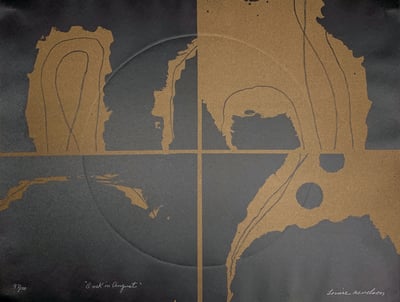
Louise Nevelson’s Clown's Houses and Four in the Morning, from her 1966 Façade series, are photographic collage screenprints enhanced with acetate overlays. These monochromatic works reflect Nevelson’s sculptural aesthetic, translating her assemblages into layered two-dimensional compositions. Using overlapping photographic images of wooden reliefs and structural forms, Nevelson creates an abstract architectural language—evoking both physical and psychological spaces. The play of shadow and form, combined with the translucent acetate layer, adds depth and a sense of motion. These prints were produced in an edition of 125, with a smaller colored-paper version also issued.
Louise Nevelson (USA, 1899–1988) was a pioneering sculptor known for her monumental, monochromatic assemblages crafted from wood and found objects. Her works, often painted in black, white, or gold, create intricate, architectural compositions. Nevelson’s innovative approach to abstraction and use of recycled materials established her as a key figure in 20th-century sculpture.
CollageCollage is a production art technique commonly used in visual arts where a new artwork is created by assembling various materials. These materials can include ribbons, newspaper and magazine clippings, pieces of handmade or colored paper, photographs, text fragments, and other objects, all combined to form a cohesive whole.
From Façade portfolio.
- Literature: Baro 72; 75
- Two photographic collage screeprints on wove paper with screenprint on acetate overlay.
- Each signed in pencil, dated and numbered.
- Published/printed by Harry N. Abrams/Chiron Press, New York,
Louise Nevelson’s Clown's Houses and Four in the Morning, from her 1966 Façade series, are photographic collage screenprints enhanced with acetate overlays. These monochromatic works reflect Nevelson’s sculptural aesthetic, translating her assemblages into layered two-dimensional compositions. Using overlapping photographic images of wooden reliefs and structural forms, Nevelson creates an abstract architectural language—evoking both physical and psychological spaces. The play of shadow and form, combined with the translucent acetate layer, adds depth and a sense of motion. These prints were produced in an edition of 125, with a smaller colored-paper version also issued.
Louise Nevelson (USA, 1899–1988) was a pioneering sculptor known for her monumental, monochromatic assemblages crafted from wood and found objects. Her works, often painted in black, white, or gold, create intricate, architectural compositions. Nevelson’s innovative approach to abstraction and use of recycled materials established her as a key figure in 20th-century sculpture.
You must create your own world. I am responsible for my world.
- Louise Nevelson
Louise Nevelson is especially well known for her monochromatic wooden wall pieces and sculptures which are located permanently in the outdoors. Before centering her work as a sculptor, she tried out work in the media of painting and printing. However, it became clear that sculpture was where the strength lay. Most of her pieces are made out of wood and they appear almost puzzle lie. There are usually lots of different defined pieces which come together to create a whole. They are either standing independently or fixed to a wall. She likes to make work in monochromatic black and white as it adds to the starkness of the sculpture. Known internationally she has exhibited widely and her work can be found in museums and galleries across the world. She is probably one of the most famous and important figures in twentieth century sculpture history.
Cubism is an art movement that aimed to depict multiple perspectives of objects or figures within a single picture. Artists Georges Braque and Pablo Picasso pioneered this style around 1907. The name Cubism emerged from their use of geometric shapes and outlines that often resembled cubes, breaking objects down into abstracted forms.