


Printed Wood.
Signed in marker at the bottom
Sculptura 763 (2024) by Marcello Morandini exemplifies the artist’s commitment to geometric precision and optical dynamism. Crafted from printed wood in a distinctive star-shaped form, the sculpture features a hypnotic interplay of black and white lines arranged in a radial, almost kaleidoscopic configuration. The precise symmetry and sharp contrast create an illusion of depth and movement, engaging the viewer’s perception in ever-shifting ways. Known for his role in the Concrete and Op Art movements, Morandini’s work merges architecture, design, and visual art. This signed edition of 20 (+IV artist proofs), in mint condition, measures 40 x 40 x 3 cm.
Artwork Copyright © Marcello MorandiniMarcello Morandini (Italy, 1940) is a celebrated architect, designer, and artist, renowned for his geometric and optical art. His bold black-and-white compositions explore spatial perception, blending art with functional design. Morandini’s innovative approach has positioned him as a key figure in the international Op Art and Constructivist movements.
Artwork Copyright © Marcello MorandiniSculptura 763, 2024
Form
Medium
Size
- Inches
- Centimeters
Edition
Price
- USD
- EUR
- GBP
- CHF
- Authenticity Guaranteed
- Insured Shipping
- Online Since 2005
●Inventory 15796
●Signed in marker at the bottom
●Comes with gallery invoice and certificate
●Any questions?
Printed Wood.
Signed in marker at the bottom
Sculptura 763 (2024) by Marcello Morandini exemplifies the artist’s commitment to geometric precision and optical dynamism. Crafted from printed wood in a distinctive star-shaped form, the sculpture features a hypnotic interplay of black and white lines arranged in a radial, almost kaleidoscopic configuration. The precise symmetry and sharp contrast create an illusion of depth and movement, engaging the viewer’s perception in ever-shifting ways. Known for his role in the Concrete and Op Art movements, Morandini’s work merges architecture, design, and visual art. This signed edition of 20 (+IV artist proofs), in mint condition, measures 40 x 40 x 3 cm.
Artwork Copyright © Marcello MorandiniMarcello Morandini (Italy, 1940) is a celebrated architect, designer, and artist, renowned for his geometric and optical art. His bold black-and-white compositions explore spatial perception, blending art with functional design. Morandini’s innovative approach has positioned him as a key figure in the international Op Art and Constructivist movements.
Artwork Copyright © Marcello Morandini- Recently Added
- Price (Low-High)
- Price (High-Low)
- Year (Low-High)
- Year (High-Low)

Marcello Morandini
Sculptura 762, 2024
Sculpture / Object
Wood
EUR 1,200

Marcello Morandini
Sculptura 763, 2024
Sculpture / Object
Wood
EUR 1,200

Marcello Morandini
Sculptura 720, 2020
Sculpture / Object
Acrylic sculpture
EUR 4,500
Related Artists


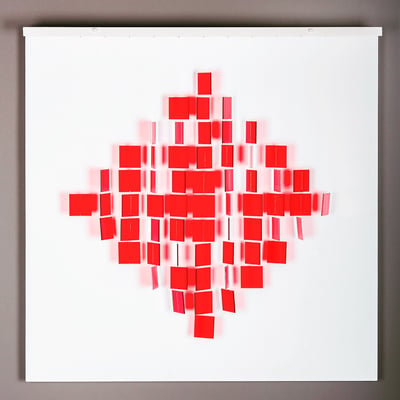

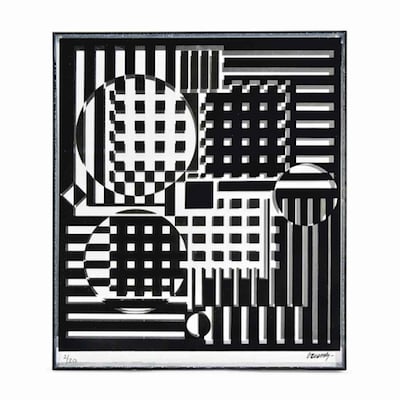
Artwork by Victor Vasarely
What is Op Art?
Op Art is a visual art style that uses optical illusions to create the impression of movement, vibrating patterns, flashing, or hidden images. The works are typically abstract, with many well-known pieces in black and white. The roots of Op Art can be traced back to earlier movements like Futurism, Constructivism, Dada, and Neo-Impressionism, particularly in their use of color effects and graphic design.


Marcello Morandini
Sculptura 763, 2024
40 x 40 x 3 cm


