


Printed Wood.
Signed in marker at the bottom.
Sculptura 762 (2024) by Marcello Morandini is a hexagonal printed wood sculpture that exemplifies his mastery of geometric abstraction and optical play. Radiating from a central hexagon, a series of sharply angled black, white, and pale blue forms generate a hypnotic sense of depth and motion. The work's precision and clarity create a dynamic visual rhythm, inviting the viewer’s eye to spiral inward. Morandini, a key figure in Op Art and Concrete Art, fuses spatial design with graphic exactitude. This signed edition of 20 (+IV artist proofs), measuring 40 x 35 x 3 cm, reflects his continued exploration of structure and perception.
Artwork Copyright © Marcello MorandiniMarcello Morandini (Italy, 1940) is a celebrated architect, designer, and artist, renowned for his geometric and optical art. His bold black-and-white compositions explore spatial perception, blending art with functional design. Morandini’s innovative approach has positioned him as a key figure in the international Op Art and Constructivist movements.
Artwork Copyright © Marcello MorandiniSculptura 762, 2024
Form
Medium
Size
- Inches
- Centimeters
Edition
Price
- USD
- EUR
- GBP
- CHF
- Authenticity Guaranteed
- Insured Shipping
- Online Since 2005
●Inventory 15797
●Signed in marker at the bottom
●Comes with gallery invoice and certificate
●Any questions?
Printed Wood.
Signed in marker at the bottom.
Sculptura 762 (2024) by Marcello Morandini is a hexagonal printed wood sculpture that exemplifies his mastery of geometric abstraction and optical play. Radiating from a central hexagon, a series of sharply angled black, white, and pale blue forms generate a hypnotic sense of depth and motion. The work's precision and clarity create a dynamic visual rhythm, inviting the viewer’s eye to spiral inward. Morandini, a key figure in Op Art and Concrete Art, fuses spatial design with graphic exactitude. This signed edition of 20 (+IV artist proofs), measuring 40 x 35 x 3 cm, reflects his continued exploration of structure and perception.
Artwork Copyright © Marcello MorandiniMarcello Morandini (Italy, 1940) is a celebrated architect, designer, and artist, renowned for his geometric and optical art. His bold black-and-white compositions explore spatial perception, blending art with functional design. Morandini’s innovative approach has positioned him as a key figure in the international Op Art and Constructivist movements.
Artwork Copyright © Marcello Morandini- Recently Added
- Price (Low-High)
- Price (High-Low)
- Year (Low-High)
- Year (High-Low)

Marcello Morandini
Sculptura 762, 2024
Sculpture / Object
Wood
EUR 1,200

Marcello Morandini
Sculptura 763, 2024
Sculpture / Object
Wood
EUR 1,200

Marcello Morandini
Sculptura 720, 2020
Sculpture / Object
Acrylic sculpture
EUR 4,500
Related Artists


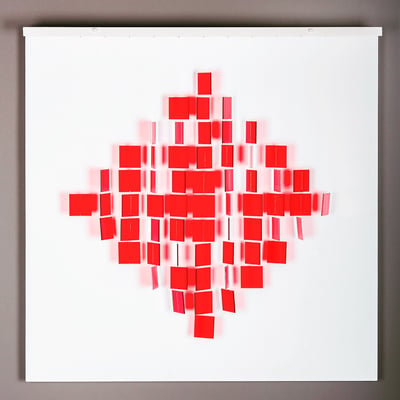


Artwork by Francois Morellet
What is geometric abstract art?
Geometric abstraction is a form of abstract art that uses geometric shapes arranged in a non-illusionistic space (though not always) and combined into non-representational (non-objective) compositions. Based on years of artistic research, some artists have proposed that geometric abstraction offers a solution to modern challenges by rejecting traditional illusionistic practices in favor of clarity and simplicity.

Marcello Morandini
Sculptura 762, 2024
40 x 35 x 3 cm


