
Etching, aquatint, soft paint and drypoint on glossy paper
- Signature and number of the specimen in pencil on lower right margin
- Embossed stamp on the lower right margin of the editor Franco Masoero, Turin.
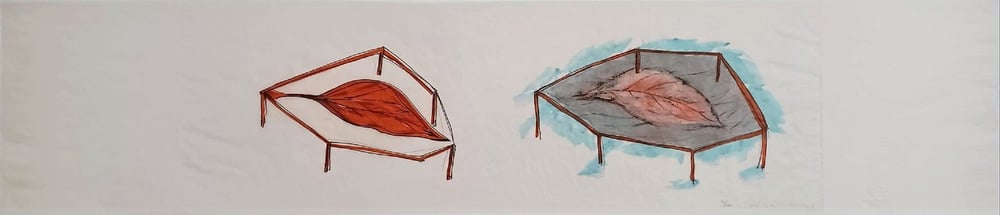
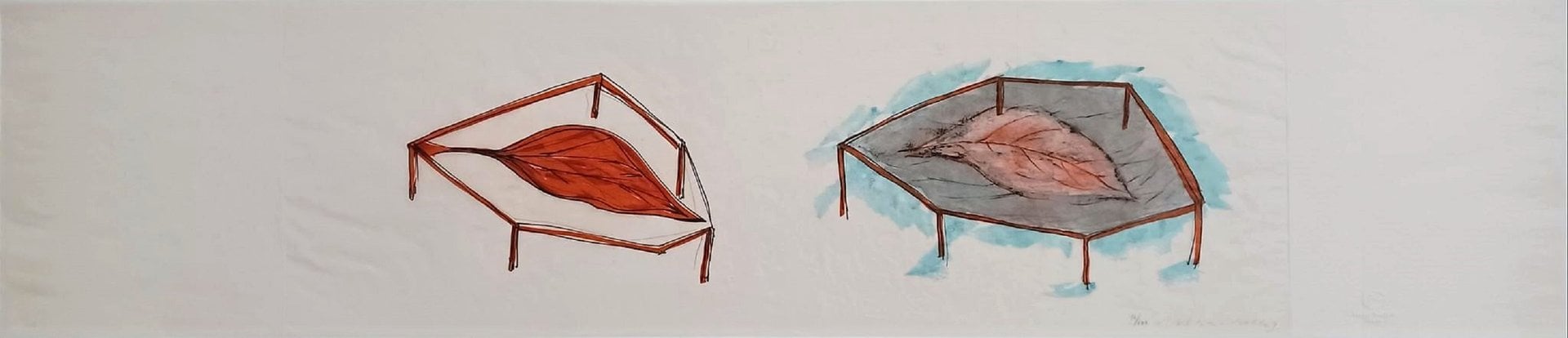
Mario Merz's Senza titolo (1991) is a mixed media print that combines etching, aquatint, soft paint, and drypoint techniques on glossy paper. Measuring 21 x 96.5 cm, the work features two pentagonal frames, each containing an abstract representation of a leaf. The delicate red and orange hues of the leaves contrast with the geometric structures of the frames, creating an interplay between organic and constructed forms. Merz’s work often explores themes of nature and geometry, and this untitled piece encapsulates that tension, blending the natural world with human-made structures in a subtle, contemplative composition.
Artwork Copyright © Mario MerzMario Merz (Italy, 1925–2003) was a central figure in the Arte Povera movement, known for his use of everyday materials like glass, neon, and organic elements. His iconic igloos and Fibonacci sequences explore themes of nature, time, and space. Merz's work redefined contemporary art by blending conceptual ideas with tactile forms.
Artwork Copyright © Mario MerzSenza titolo, 1991
Form
Medium
Size
- Inches
- Centimeters
Edition
Price
- USD
- EUR
- GBP
- CHF
- Authenticity Guaranteed
- Insured Shipping
- Online Since 2005
●Inventory 13476
●Signed
●Comes with gallery invoice and certificate
●Sell Us a Similar Artwork. Learn more.
Etching, aquatint, soft paint and drypoint on glossy paper
- Signature and number of the specimen in pencil on lower right margin
- Embossed stamp on the lower right margin of the editor Franco Masoero, Turin.
Mario Merz's Senza titolo (1991) is a mixed media print that combines etching, aquatint, soft paint, and drypoint techniques on glossy paper. Measuring 21 x 96.5 cm, the work features two pentagonal frames, each containing an abstract representation of a leaf. The delicate red and orange hues of the leaves contrast with the geometric structures of the frames, creating an interplay between organic and constructed forms. Merz’s work often explores themes of nature and geometry, and this untitled piece encapsulates that tension, blending the natural world with human-made structures in a subtle, contemplative composition.
Artwork Copyright © Mario MerzMario Merz (Italy, 1925–2003) was a central figure in the Arte Povera movement, known for his use of everyday materials like glass, neon, and organic elements. His iconic igloos and Fibonacci sequences explore themes of nature, time, and space. Merz's work redefined contemporary art by blending conceptual ideas with tactile forms.
Artwork Copyright © Mario Merz- Recently Added
- Price (Low-High)
- Price (High-Low)
- Year (Low-High)
- Year (High-Low)

Mario Merz
Senza titolo, 1991
Limited Edition Print
Mixed Media
EUR 1,600

Mario Merz
Ohne Titel
Limited Edition Print
Lithograph
Currently Not Available
Related Artists

Artwork by Eduardo Kac
What is New Media Art?
New Media Art is a genre that includes all artworks created using new technologies, such as computer graphics, digital art, virtual art, internet art, computer animation, video games, 3D printing, and robotics. This genre often explores themes related to mass media, telecommunications, and digital electronics. The methods for presenting New Media Art range from installations and performances to virtual and conceptual art
Mario Merz
Senza titolo, 1991
21 x 96.5 cm


