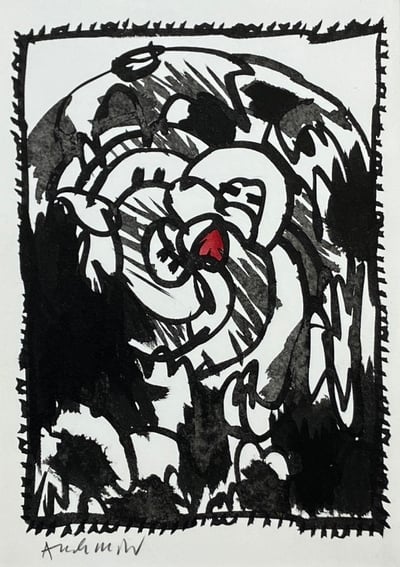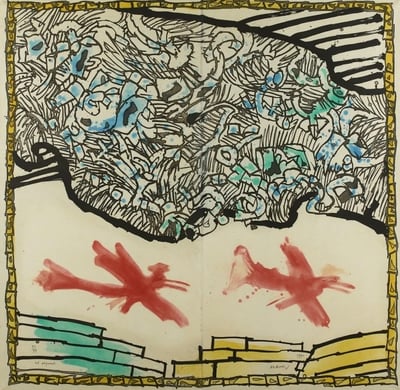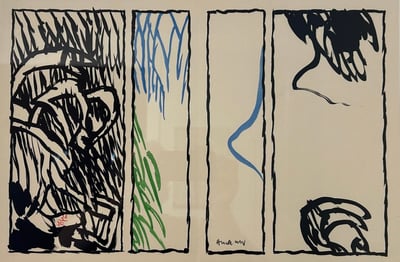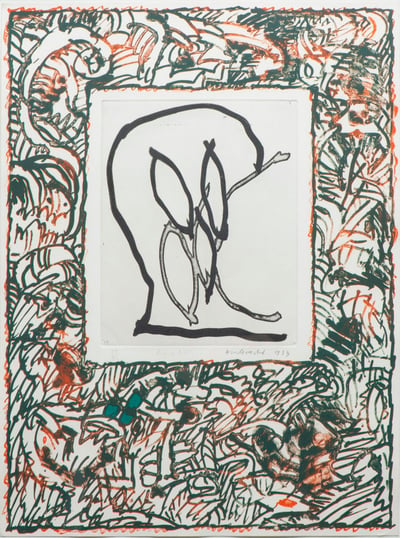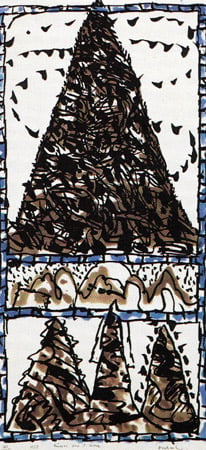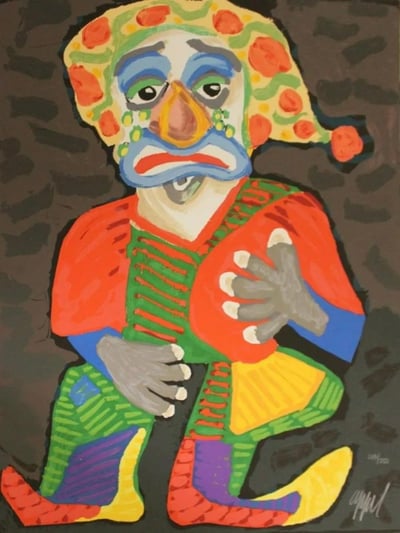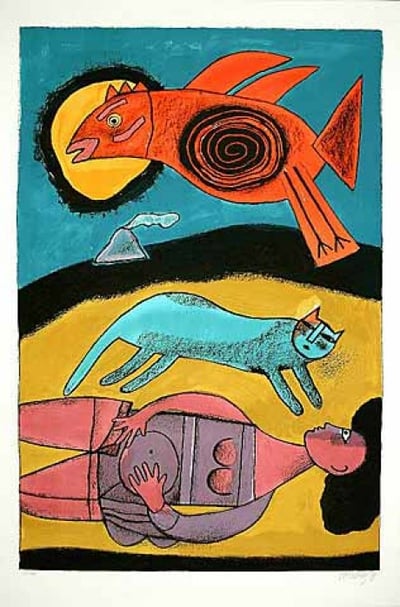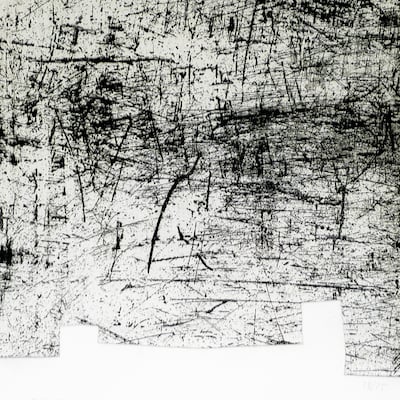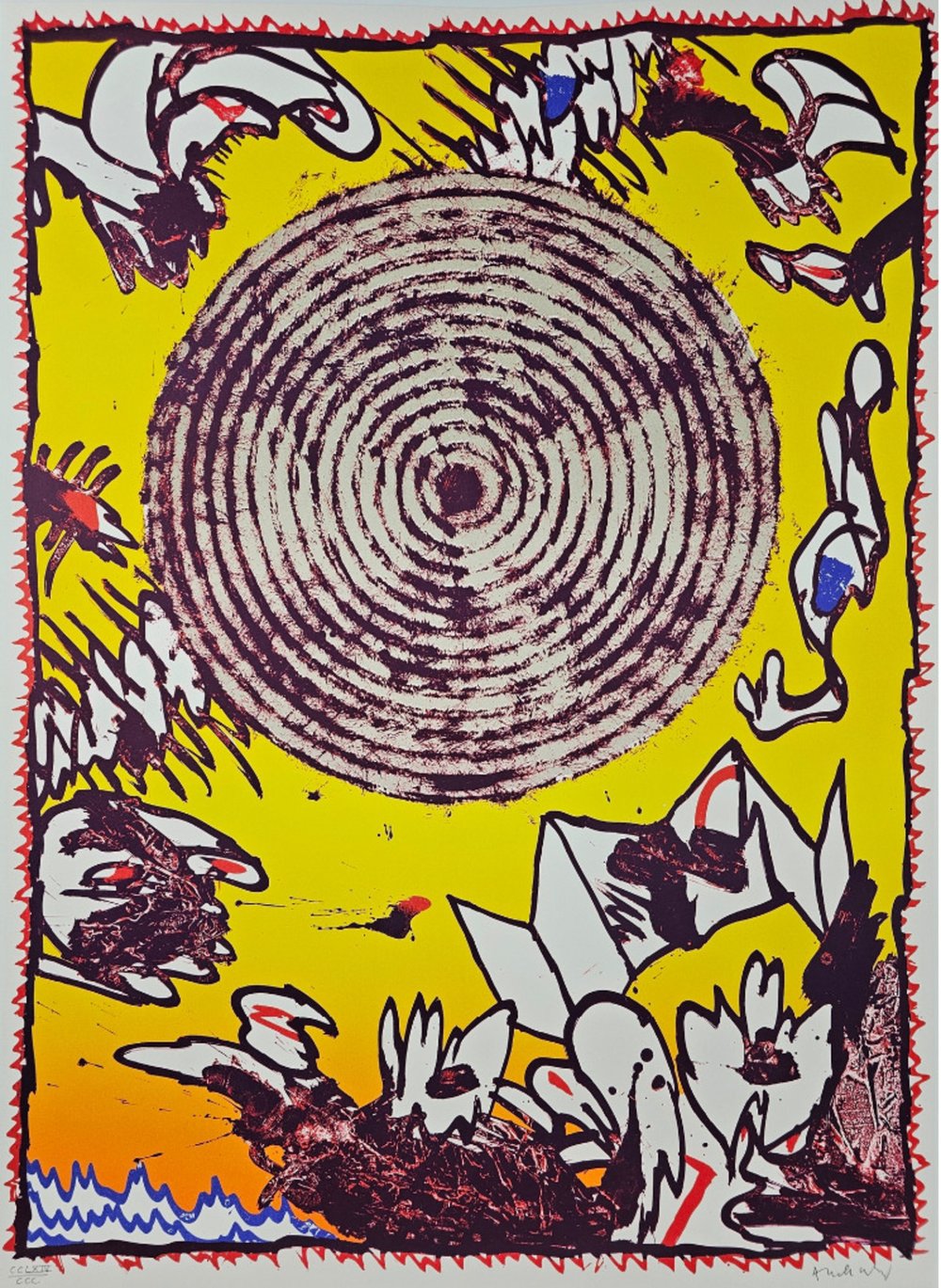
Alechinsky's spiraling red form dances across a luminous yellow ground, accompanied by fluid calligraphic marks that evoke East Asian brushwork. This work embodies the CoBrA movement's gestural abstraction—spontaneous, energetic, and deeply connected to cultural exchange with the East. The dynamic swirl suggests movement, growth, and the artist's hand, while the luminous colour field creates a sense of spiritual elevation, merging Western modernism with Eastern philosophical sensibility.
Pierre Alechinsky (Belgium, 1927) is a prominent painter and printmaker associated with the CoBrA movement, known for his vibrant, expressive works blending abstraction and figurative elements. Inspired by calligraphy and traditional printmaking techniques, Alechinsky's dynamic compositions often explore humor, spontaneity, and the subconscious. His work is celebrated worldwide in major museum collections.
Lithograph Lithography is a printing method based on the principle that water and oil do not mix. It can be used to print artwork or text onto paper or other suitable materials. Traditionally, an image was drawn with wax, fat, or oil onto a lithographic limestone surface or plate. Today, metal plates and other surfaces are also used in lithographic printing.
Alechinsky's spiraling red form dances across a luminous yellow ground, accompanied by fluid calligraphic marks that evoke East Asian brushwork. This work embodies the CoBrA movement's gestural abstraction—spontaneous, energetic, and deeply connected to cultural exchange with the East. The dynamic swirl suggests movement, growth, and the artist's hand, while the luminous colour field creates a sense of spiritual elevation, merging Western modernism with Eastern philosophical sensibility.
Pierre Alechinsky (Belgium, 1927) is a prominent painter and printmaker associated with the CoBrA movement, known for his vibrant, expressive works blending abstraction and figurative elements. Inspired by calligraphy and traditional printmaking techniques, Alechinsky's dynamic compositions often explore humor, spontaneity, and the subconscious. His work is celebrated worldwide in major museum collections.
Everything that you paint may be used as evidence against you.
- Pierre Alechinsky
Pierre Alechinsky is associated with Abstract Expressionist, Lyrical Abstraction and the abstract style of art known as Tachisme. Using a range of media in his art, he is an engraver, graphic artist, painter and film maker. He learned engraving and gained other skills in Brussels and Paris. First he studied printmaking, illustration and photography at the National School of Decorative Arts in La Cambre. He became specialized in Etchings, Aquatint and watercolor on rice paper. He then continued his art education at Atelier 17 in Paris, where he was a student of the printmaker Stanley William Hayter. In 1949 the art group Cobra was formed. Its purpose was to break away accepted standards of western art and to make art more about the human condition. Pierre Alechinsky became a member after getting to know the other Cobra artists, and he showed his work in several Cobra exhibitions. In Paris Alechinsky worked as a correspondent for Bokubi, a Japanese journal on the use of ink in art. He went to Japan in 1955, where his work Night was exhibited, and while there he also made a film on Japanese calligraphy. By the end of the 1950s, some of Pierre Alechinsky’s works had been shown at the Venice Biennial and exhibited in London and Bern. In the 1960s his reputation grew internationally when his art went on show in New York, Pittsburgh and Amsterdam. In 1983 Alechinsky was appointed Professor of Painting at the National School of Fine Arts in Paris and was awarded an honorary doctorate from the Free University of Brussels in 1994.
Abstract art uses form, shape, line, and color to create a visual experience without attempting to represent external reality. The composition exists independently of the world's visual references, focusing on expressing ideas and emotions through non-representational means.