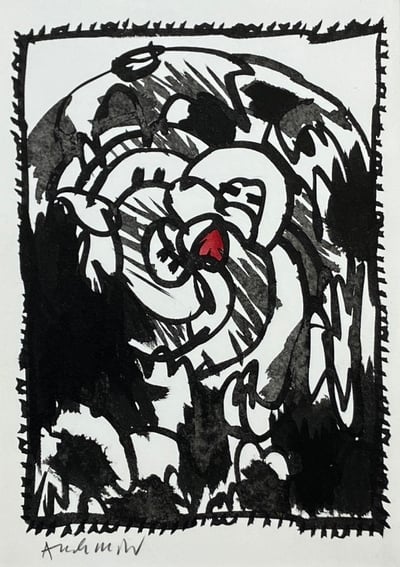
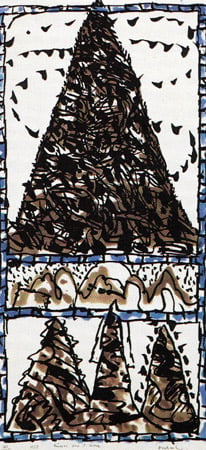
Ink drawing, signed in the lower left corner. - Dimensions: 21 × 15 cm - From the deluxe edition of Tête Bêche, S.l., Marchant Ducel, 1987.
The accompanying book is included and also signed by the artist.
'Tête Bêche' by Pierre Alechinsky is an expressive ink drawing created in 1987. The work showcases Alechinsky's signature dynamic style, characterized by bold, gestural lines and intricate compositions. This piece combines abstract and figurative elements, with swirling black and white forms accented by a striking touch of red at the center, evoking tension and vitality. The frenetic energy of the strokes contrasts with the controlled composition, encapsulating a sense of movement and emotion. The work’s title, 'Tête Bêche,' refers to opposites or inversions, a theme reflected in the interplay between chaos and structure. This signed drawing is part of a deluxe edition by Marchant Ducel, including a book also signed by the artist.
Pierre Alechinsky (Belgium, 1927) is a prominent painter and printmaker associated with the CoBrA movement, known for his vibrant, expressive works blending abstraction and figurative elements. Inspired by calligraphy and traditional printmaking techniques, Alechinsky's dynamic compositions often explore humor, spontaneity, and the subconscious. His work is celebrated worldwide in major museum collections.
InkInk is a colored liquid or paste used for writing, drawing, painting, and printing. The term also refers to the process of applying ink to mark, cover, stain, draw, or trace over pencil lines. Ink can be applied using various tools, such as pens, brushes, and quills.
Ink drawing, signed in the lower left corner. - Dimensions: 21 × 15 cm - From the deluxe edition of Tête Bêche, S.l., Marchant Ducel, 1987.
The accompanying book is included and also signed by the artist.
'Tête Bêche' by Pierre Alechinsky is an expressive ink drawing created in 1987. The work showcases Alechinsky's signature dynamic style, characterized by bold, gestural lines and intricate compositions. This piece combines abstract and figurative elements, with swirling black and white forms accented by a striking touch of red at the center, evoking tension and vitality. The frenetic energy of the strokes contrasts with the controlled composition, encapsulating a sense of movement and emotion. The work’s title, 'Tête Bêche,' refers to opposites or inversions, a theme reflected in the interplay between chaos and structure. This signed drawing is part of a deluxe edition by Marchant Ducel, including a book also signed by the artist.
Pierre Alechinsky (Belgium, 1927) is a prominent painter and printmaker associated with the CoBrA movement, known for his vibrant, expressive works blending abstraction and figurative elements. Inspired by calligraphy and traditional printmaking techniques, Alechinsky's dynamic compositions often explore humor, spontaneity, and the subconscious. His work is celebrated worldwide in major museum collections.
Everything that you paint may be used as evidence against you.
- Pierre Alechinsky
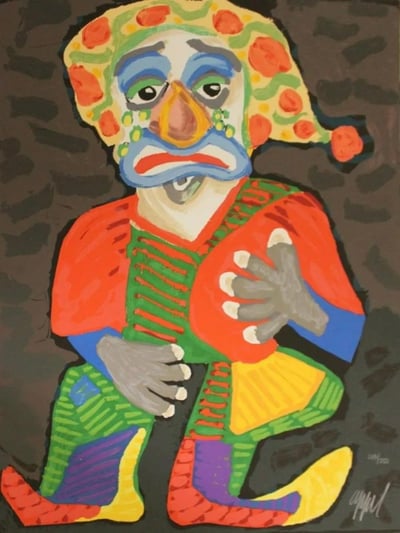
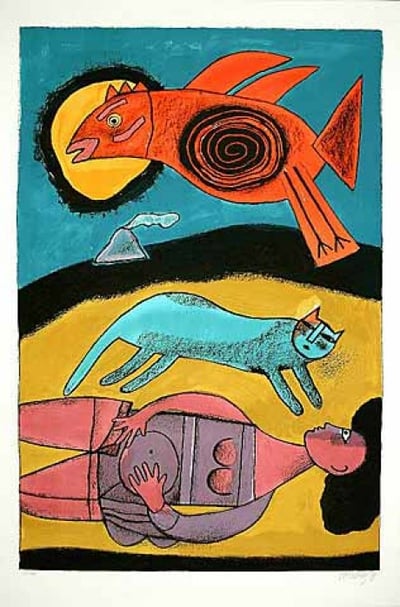
Pierre Alechinsky is associated with Abstract Expressionist, Lyrical Abstraction and the abstract style of art known as Tachisme. Using a range of media in his art, he is an engraver, graphic artist, painter and film maker. He learned engraving and gained other skills in Brussels and Paris. First he studied printmaking, illustration and photography at the National School of Decorative Arts in La Cambre. He became specialized in Etchings, Aquatint and watercolor on rice paper. He then continued his art education at Atelier 17 in Paris, where he was a student of the printmaker Stanley William Hayter. In 1949 the art group Cobra was formed. Its purpose was to break away accepted standards of western art and to make art more about the human condition. Pierre Alechinsky became a member after getting to know the other Cobra artists, and he showed his work in several Cobra exhibitions. In Paris Alechinsky worked as a correspondent for Bokubi, a Japanese journal on the use of ink in art. He went to Japan in 1955, where his work Night was exhibited, and while there he also made a film on Japanese calligraphy. By the end of the 1950s, some of Pierre Alechinsky’s works had been shown at the Venice Biennial and exhibited in London and Bern. In the 1960s his reputation grew internationally when his art went on show in New York, Pittsburgh and Amsterdam. In 1983 Alechinsky was appointed Professor of Painting at the National School of Fine Arts in Paris and was awarded an honorary doctorate from the Free University of Brussels in 1994.
Lyrical abstraction is a descriptive term characterizing a type of abstract painting closely related to Abstract Expressionism, in use from the 1940s to the present. The term can also describe two distinct but related trends in post-World War II modernist painting. This art movement originated in Paris, France, after the war, emphasizing personal expression, spontaneity, and the emotional use of color and form.