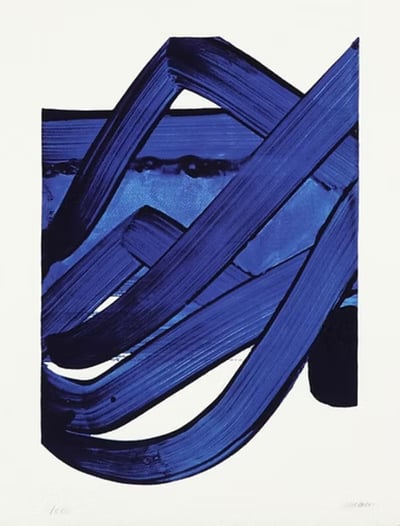
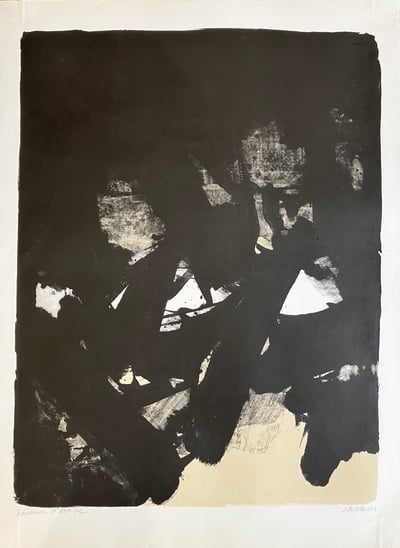
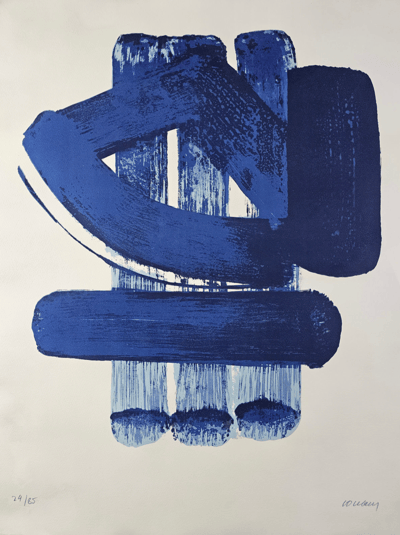
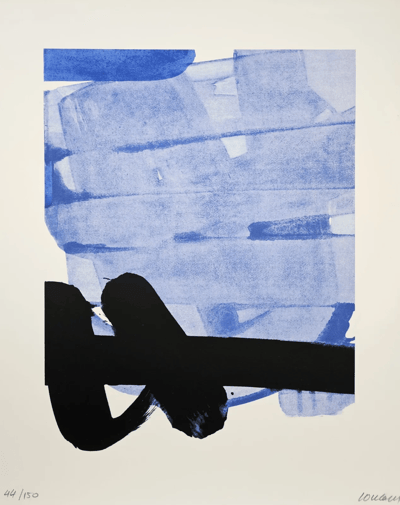
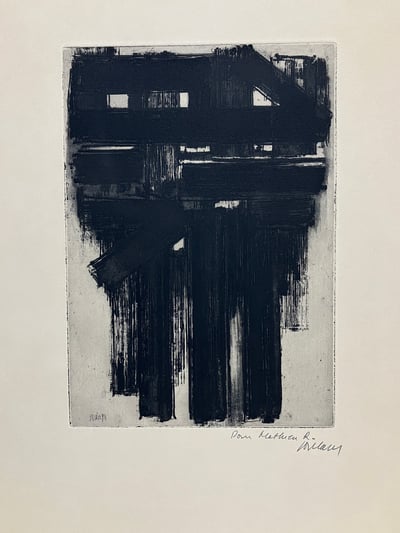
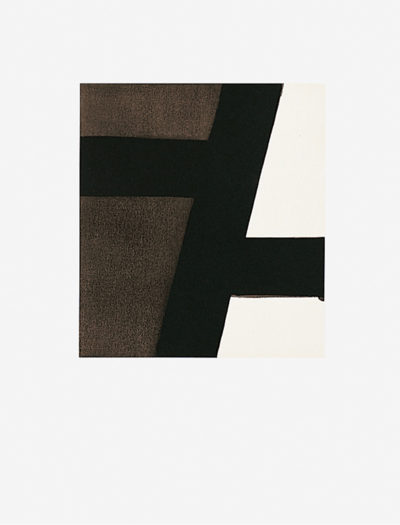
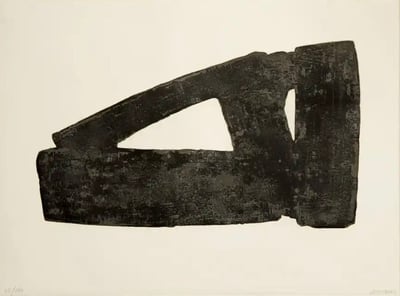
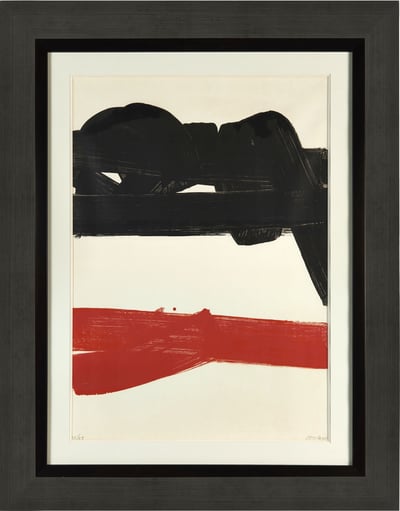
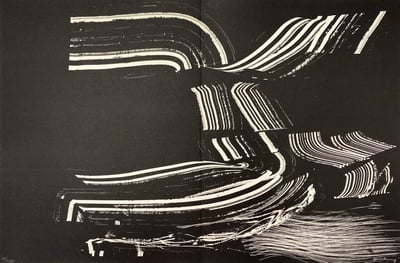
Colour lithograph on Arches wove paper, with deckled edges. From the Official Arts Portfolio of the XXIV Olympiad, Seoul, Korea. Hand-signed and numbered by Pierre Soulages.
This commanding lithograph from 1988 reveals Pierre Soulages at the height of his graphic mastery, channelling deep ultramarine into sweeping diagonal gestures of extraordinary force. Thick bands of blue-black pigment overlap and collide across the white ground, each stroke asserting its presence while building passages of remarkable spatial depth. The tension between the opacity of layered ink and the luminosity of unmarked paper lies at the heart of Soulages' enduring investigation into outrenoir — light conjured through the very density of darkness itself. Signed and numbered by the artist.
Pierre Soulages (France, 1919–2022) was a master of abstract art, celebrated for his iconic 'noir-lumière' technique. Using intense black surfaces to play with light reflection, his works evoke depth and texture. Known as the 'Painter of Black,' Soulages’ art redefined abstraction, with pieces housed in major museums, including the Louvre and Centre Pompidou.
Lithograph Lithography is a printing method based on the principle that water and oil do not mix. It can be used to print artwork or text onto paper or other suitable materials. Traditionally, an image was drawn with wax, fat, or oil onto a lithographic limestone surface or plate. Today, metal plates and other surfaces are also used in lithographic printing.
Colour lithograph on Arches wove paper, with deckled edges. From the Official Arts Portfolio of the XXIV Olympiad, Seoul, Korea. Hand-signed and numbered by Pierre Soulages.
This commanding lithograph from 1988 reveals Pierre Soulages at the height of his graphic mastery, channelling deep ultramarine into sweeping diagonal gestures of extraordinary force. Thick bands of blue-black pigment overlap and collide across the white ground, each stroke asserting its presence while building passages of remarkable spatial depth. The tension between the opacity of layered ink and the luminosity of unmarked paper lies at the heart of Soulages' enduring investigation into outrenoir — light conjured through the very density of darkness itself. Signed and numbered by the artist.
Pierre Soulages (France, 1919–2022) was a master of abstract art, celebrated for his iconic 'noir-lumière' technique. Using intense black surfaces to play with light reflection, his works evoke depth and texture. Known as the 'Painter of Black,' Soulages’ art redefined abstraction, with pieces housed in major museums, including the Louvre and Centre Pompidou.
It's what I do that teaches me what I'm looking for.
- Pierre Soulages
Beginning with splash and dribbled painting techniques, which mirrored the 1950's Abstract Expressionist American School, Pierre Soulages has built a remarkable body of work, centred around his attraction for the transfiguration of light and colour. For Soulages, these two elements constitute a theoretical plane of investigation, which he has been exploring for over seven decades now. He has developed over the years, a unique affinity for the black tone colouring, which he both interprets as an expression of the presence of light, as well as, the absence of light. This is the essential substance of his works. On the one hand, he uses black tones as a way to give back light in his paintings, and on the other hand, he allows them to define colour and luminosity, thus becoming an expression of radiance. Soulages was born in 1919 in the South of France, and is considered to be one of the greatest contemporary painters. He had long lasting friendships with Pablo Picasso, Willem de Kooning and Mark Rothko among many other luminaries. Growing up near famous prehistoric locations, he said he must have been influenced by the primordial and symbolic executions, he saw in these ancient sites as a child. Soulages has famously coined his own technical approach 'Beyond Black', due to the interminable profundity which the absence of light unveils in his paintings. He refuses to explore conventional space and movement on his canvases, but prefers instead to pull back into something more elemental and unadulterated. He says his fascination with black paint reflects his belief that, unlike windows, which connect us to the outer world, painting should connect u to the world within.
Art Informel is a French term referring to the gestural and improvisational techniques common in abstract painting during the 1940s and 50s. It encompasses various styles that dominated these decades, characterized by informal, spontaneous methods. Artists used this term to describe approaches that moved away from traditional structures and embraced more expressive, unstructured techniques.