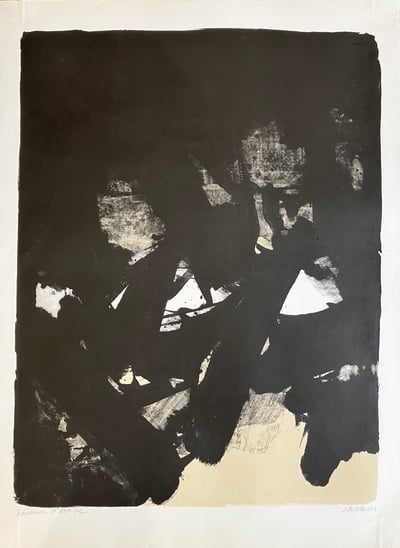
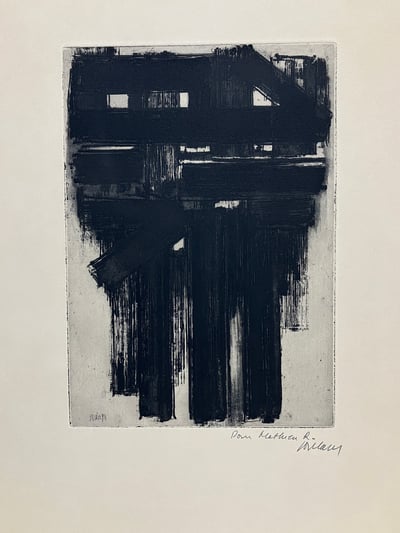
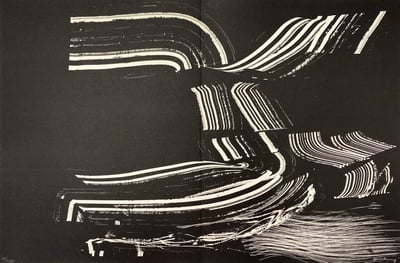
Etching on Rives wove paper, signed in pencil.
Image dimensions: 25 x 17.5 cm / Sheet dimensions: 46 x 32.5 cm.
Rare full-margin copy outside the numbered edition, used as the cover plate for the Pierre Soulages exhibition catalogue at the Galerie de France in 1956.
From an edition of 200 unnumbered impressions (as issued).
Printed by Lacourière, Paris; published by Galerie de France.
Bibliography: Pierre Encrevé, Soulages, l’œuvre imprimé, Bibliothèque nationale de France (BNF), Paris, 2003, no. 3B.
Eau-forte III (1956) by Pierre Soulages is an etching that exemplifies the artist’s deep exploration of black as a material and expressive force. Created with bold, sweeping strokes of deep black ink, the composition balances weight and structure with gestural freedom. Printed on Rives wove paper, this impression is one of 200 unnumbered prints used for the Galerie de France exhibition catalogue. The abstract form evokes architectural presence and rhythmic density, typical of Soulages’ early printmaking. His approach, which he called "noir-lumière" (black-light), reflects the tension between opacity and luminosity in this tactile and visually intense work.
Pierre Soulages (France, 1919–2022) was a master of abstract art, celebrated for his iconic 'noir-lumière' technique. Using intense black surfaces to play with light reflection, his works evoke depth and texture. Known as the 'Painter of Black,' Soulages’ art redefined abstraction, with pieces housed in major museums, including the Louvre and Centre Pompidou.
EtchingEtching is a technique where a design is created on a metal surface by using a strong acid or mordant to eat away the unprotected parts of the metal, leaving the desired pattern in relief (intaglio). In modern art and manufacturing, different chemicals may be used depending on the material being etched.
Etching on Rives wove paper, signed in pencil.
Image dimensions: 25 x 17.5 cm / Sheet dimensions: 46 x 32.5 cm.
Rare full-margin copy outside the numbered edition, used as the cover plate for the Pierre Soulages exhibition catalogue at the Galerie de France in 1956.
From an edition of 200 unnumbered impressions (as issued).
Printed by Lacourière, Paris; published by Galerie de France.
Bibliography: Pierre Encrevé, Soulages, l’œuvre imprimé, Bibliothèque nationale de France (BNF), Paris, 2003, no. 3B.
Eau-forte III (1956) by Pierre Soulages is an etching that exemplifies the artist’s deep exploration of black as a material and expressive force. Created with bold, sweeping strokes of deep black ink, the composition balances weight and structure with gestural freedom. Printed on Rives wove paper, this impression is one of 200 unnumbered prints used for the Galerie de France exhibition catalogue. The abstract form evokes architectural presence and rhythmic density, typical of Soulages’ early printmaking. His approach, which he called "noir-lumière" (black-light), reflects the tension between opacity and luminosity in this tactile and visually intense work.
Pierre Soulages (France, 1919–2022) was a master of abstract art, celebrated for his iconic 'noir-lumière' technique. Using intense black surfaces to play with light reflection, his works evoke depth and texture. Known as the 'Painter of Black,' Soulages’ art redefined abstraction, with pieces housed in major museums, including the Louvre and Centre Pompidou.
It's what I do that teaches me what I'm looking for.
- Pierre Soulages
Beginning with splash and dribbled painting techniques, which mirrored the 1950's Abstract Expressionist American School, Pierre Soulages has built a remarkable body of work, centred around his attraction for the transfiguration of light and colour. For Soulages, these two elements constitute a theoretical plane of investigation, which he has been exploring for over seven decades now. He has developed over the years, a unique affinity for the black tone colouring, which he both interprets as an expression of the presence of light, as well as, the absence of light. This is the essential substance of his works. On the one hand, he uses black tones as a way to give back light in his paintings, and on the other hand, he allows them to define colour and luminosity, thus becoming an expression of radiance. Soulages was born in 1919 in the South of France, and is considered to be one of the greatest contemporary painters. He had long lasting friendships with Pablo Picasso, Willem de Kooning and Mark Rothko among many other luminaries. Growing up near famous prehistoric locations, he said he must have been influenced by the primordial and symbolic executions, he saw in these ancient sites as a child. Soulages has famously coined his own technical approach 'Beyond Black', due to the interminable profundity which the absence of light unveils in his paintings. He refuses to explore conventional space and movement on his canvases, but prefers instead to pull back into something more elemental and unadulterated. He says his fascination with black paint reflects his belief that, unlike windows, which connect us to the outer world, painting should connect u to the world within.
Naïve art describes a style of artwork that is simple and unsophisticated, often created by artists without formal training in an academy or art school. The style is characterized by a lack of advanced techniques, giving it a childlike appearance. Naïve art often features bright colors, simple shapes, and a straightforward approach to subject matter, reflecting the artist's untrained perspective.